 AI-First Culture
Business Central Copilot Credits: Which Job Pays for Your Agents?

For years, software was a license. You bought it, someone put it in overhead, and by the time the budget was approved it was a rounding error. Business Central Copilot credits work differently. Microsoft's setup page for the Payables Agent says the agent "requires Copilot Credits to process incoming vendor invoices." A credit is a unit of use. More invoices, more credits.
A cost that moves with volume has a different character from a license, and construction finance already knows what to do with costs like that. It asks which job they belong to.
The math, from Microsoft's own example
Microsoft's consumption page, updated July 8, 2026, lists the Payables Agent at 50 credits per invoice plus 5 credits per invoice line. Its worked example is 100 invoices a month with 3 lines each, which comes to 6,500 credits. The same page lists the Expense Agent, still in preview, at 50 credits per receipt, and the Sales Order Agent at 2 to 5 credits per action.
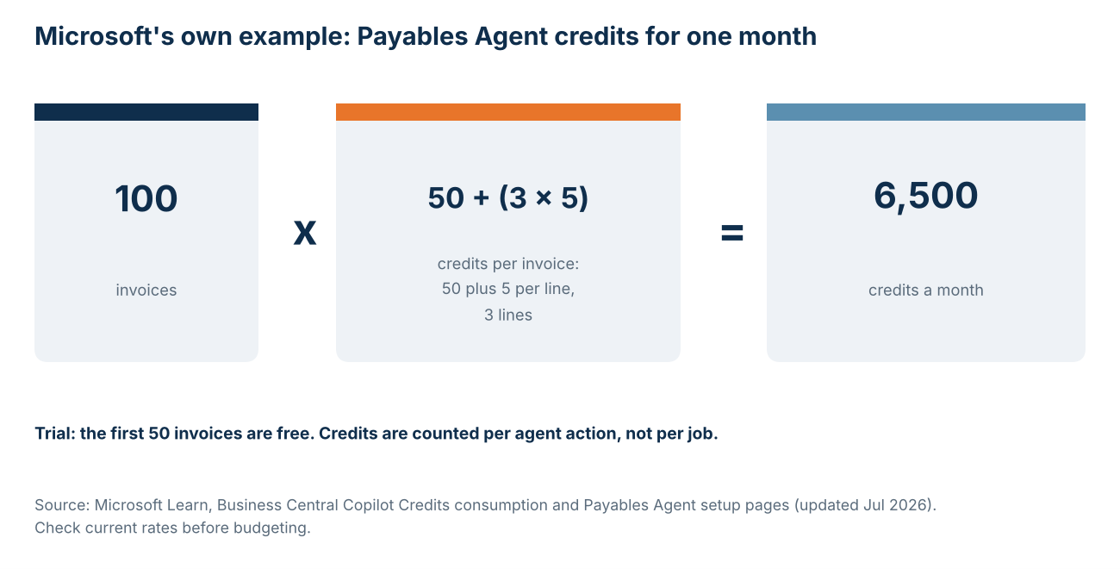
Microsoft's example, as arithmetic. Check current rates on Microsoft's pages before budgeting.
We have left dollar figures out on purpose. Rates change, and your agreement with Microsoft or your reseller is what counts. What you can do today is count: how many vendors invoices a month, and how many lines on a typical one?
There is also a trial. According to the setup page, the first 50 invoices are processed without consuming billable credits. After that the trial ends automatically and the agent starts using billable credits, with no further configuration needed.
Business Central Copilot credits: what happens when they run out
This is the part that deserves a line in your month-end checklist. Per the setup page, when your organization's credit quota is depleted, the agent stops processing new invoices from the monitored mailbox. The consumption page says the AI capability is unavailable until more capacity is added. Invoices still arrive. They wait.
When credits return, the agent picks up the unread invoice emails that piled up. Microsoft's own wording is that this can use a significant portion of your renewed credits quickly. So, a stall at the end of the month can also drain the start of the next one.
Two meters, and only one changed on December 1
Reading Microsoft's pages, we found two separate places where credits show up, and they are easy to confuse.
The first is Microsoft 365 Copilot. According to Partner Center, usage-based billing becomes the default for new Microsoft 365 Copilot Business licenses bought through CSP partners on December 1, 2026. Earlier communications said November 2, which is now only the sandbox date. The default spending limit is 4,000 credits per user per month, and Microsoft says the feature is not initially available in several countries, including Australia. That is relevant if you run in Australia or New Zealand.
The second is Business Central agents. Their capacity is managed in the Business Central admin center and the Power Platform admin center. Credit packs are purchased through the Microsoft 365 admin center, or by resellers through Partner Center. The December 1 change is about the first meter. It does not bring Business Central agents into usage-based billing.
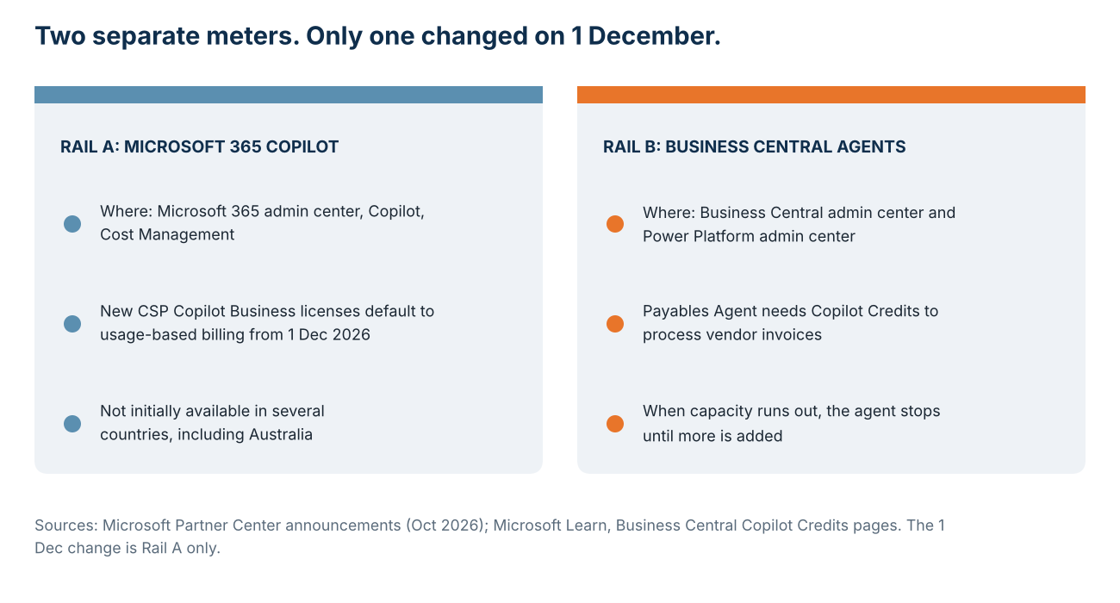
Two meters. The December 1 default applies to Microsoft 365 Copilot Business, not to Business Central agents.
We have not found a Microsoft page that explains how the two relate in a tenant that uses both. That is a question for your partner, and a good one to ask before the first invoice.
Which job pays?
Here is our opinion, which is not Microsoft's. Contractors already allocate variable costs to jobs: equipment time, fuel, small tools. Credits are a variable cost with a clear driver, which is the number of documents and lines. Whether you allocate them to jobs or leave them in overhead is a policy choice, and either is reasonable. What is not reasonable is never having decided.
To make it concrete, here is an invented example, not customer data. Three jobs sent in 40, 35 and 25 invoices with three lines each. At 65 credits per invoice, that is 2,600, 2,275 and 1,625 credits, for 6,500 in all. The credits themselves are counted per agent action, not per job, so splitting them by job is something you design.
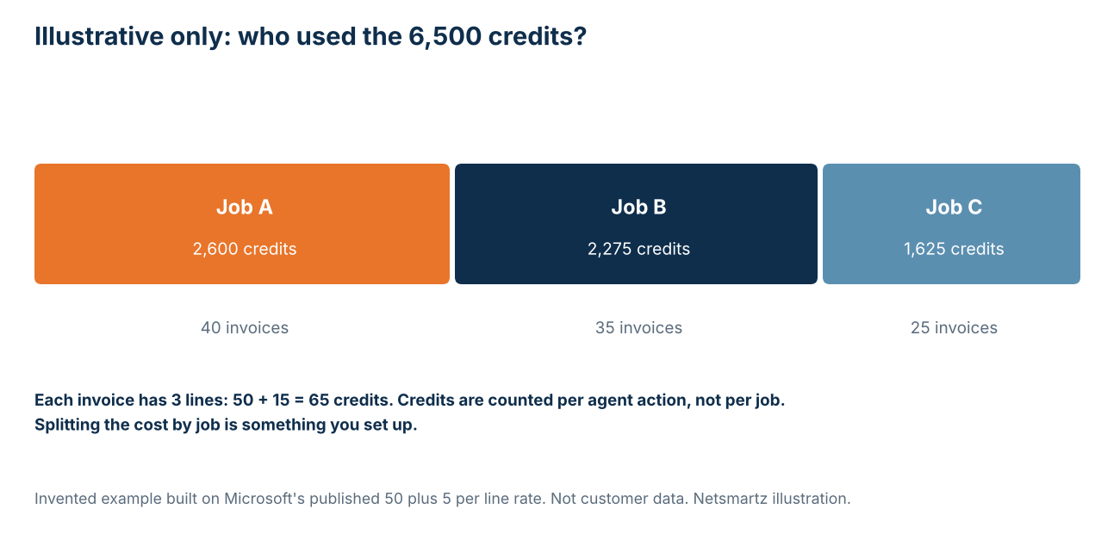
An illustrative split. Invented example built on Microsoft's published rates, not customer data.
Planning for this is also not a solved problem elsewhere. A Gartner abstract from September 28 says CFOs plan roughly 15 to 16 percent higher AI budgets for 2027, and that 67 percent hold contingency buffers of only 1 to 10 percent despite costs that move with consumption. The abstract does not state a sample size, so treat it as a signal, not a benchmark.
Four decisions for the finance office
Who owns the credit budget, and what is it called in the ledger? A metered agent needs a named owner, a monthly figure and an account. If it lands in a general IT line, nobody will connect it to the work it did.
Is invoice processing overhead or job cost in your policy? Decide it before the pilot, and write it down.
What happens at month-end if the credits run out? Name the person who checks consumption before cut-off, and the manual fallback if the mailbox stalls.
Who is watching the trial clock? The shift from free to billable is automatic after 50 invoices. Put that date in the budget calendar before the pilot starts.
Where Netsmartz for Construction fits
Microsoft meters the credits. ProjectPro, which is built natively on Business Central, is where the job records and subcontract and billing data live, so the invoices the agent prepares land in the same system as your job cost. ProjectPro does not allocate Copilot Credits to jobs. That is a finance policy, and the practice side of our work is helping you design it: who owns the budget, how consumption gets checked before cut-off and what the fallback is. And on the agent side we use the same rule as everywhere else: a written scope and a named human approver for each agent task, so a cheap agent is never an unsupervised one.
Who owns the meter in your Business Central set-up?
Talk to our Business Central team about credit ownership, month-end checks and approval controls before you scale an agent.
Frequently Asked Questions
Yes. Microsoft's setup page says the agent requires Copilot Credits to process incoming vendor invoices, and consumption shows in a Cost section on its configuration page.
Microsoft's consumption page lists 50 credits per invoice plus 5 per invoice line. Its example of 100 invoices with 3 lines each is 6,500 credits a month. Check Microsoft's current figures before budgeting.
Microsoft documents a trial that processes the first 50 invoices without consuming billable credits. After that the agent starts consuming credits automatically.
Per Microsoft's pages, the agent stops processing new invoices from the monitored mailbox until more capacity is added, then picks up the unread invoices that accumulated.
For new licenses purchased through CSP, on December 1, 2026, according to Partner Center. It was previously communicated as November 2, 2026. This applies to Microsoft 365 Copilot Business, not to Business Central agents.
Keep reading



Ready to build smarter? Let's talk.
Our experts are ready to help you turn ideas into production-ready AI, cloud and digital solutions.
Get In Touch →Let's Discuss Your Growth Strategy
Let's discuss how we can help you accelerate growth, improve efficiency, and drive real business outcomes.