 AI-First Culture
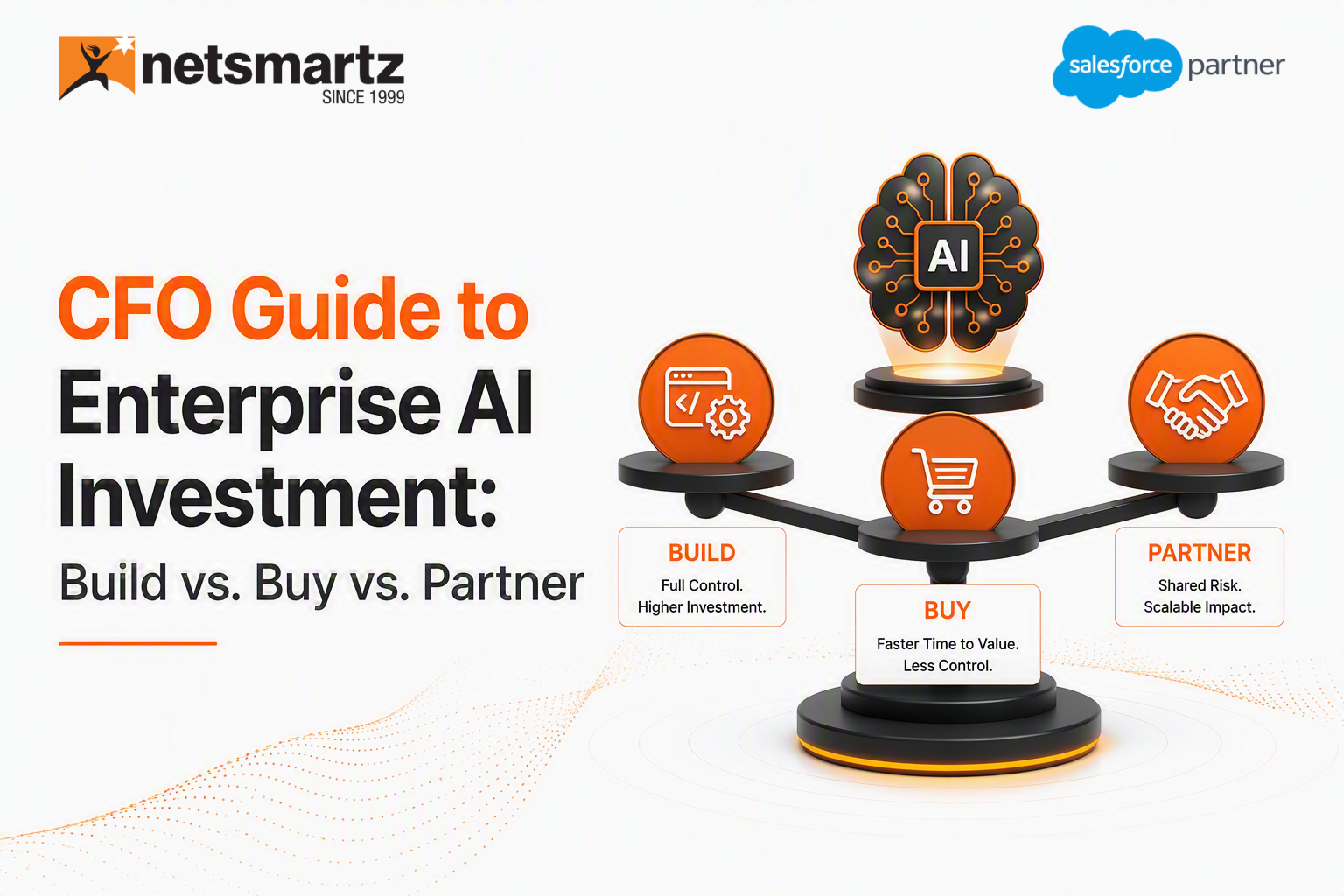
CFO Guide to Enterprise AI Investment: Build vs. Buy vs. Partner
"The question is no longer whether to invest in AI. It's how to invest without locking the business into the wrong architecture for the next five years."
Introduction
AI has quietly moved out of the innovation budget and into a core strategy. Which means it landed on the CFO's desk, invited or not.
A few years ago, this was a CIO conversation. AI spend was a rounding error; someone ran a pilot, finance signed off without much thought. That's over. Today, the same decisions touch multi-year licensing commitments, headcount planning, data residency obligations, and in some cases the operating model itself.
So, approval isn't the hard part. Choosing the approach is. There are three on the table. Build the capability internally. Buy a platform that already has it. Or bring in a partner to implement and run the thing. Cost curves differ. Risk profiles differ. Timelines differ enormously.
What follows is a way to evaluate all three using criteria finance teams already work with daily.
Why This Isn't a Normal Technology Decision
Standard software procurement rests on a few assumptions: the market is reasonably stable, depreciation is predictable, the product looks roughly similar three years out.
AI breaks all of them. Capabilities that justified a build decision eighteen months ago now ship as standard features in commercial platforms. Vendors are repricing aggressively, sometimes twice a year. Model performance shifts underneath you without warning.
The cost structure surprises people too. Licensing is usually the smallest line on the invoice. What actually consumes budget is data preparation, integration, change management, governance, and the ongoing work of keeping models supervised.
PwC's 29th Global CEO Survey, released in January 2026 and drawing on responses from 4,454 chief executives across 95 countries, put a number on how badly this goes when it isn't managed well. 56% of CEOs reported neither increased revenue nor reduced costs from AI over the past year, while only 12% saw both. The survey's own framing is telling it points to a widening divide between companies piloting AI and those that have actually scaled it with proper foundations in place, things like responsible AI frameworks and enterprise-wide integration. Notice that neither of those is a model-quality problem. They're finance and governance problems.
Before anyone argues build versus buy, get honest answers to four things:
- What return are we expecting, and how exactly will we measure it?
- How fast does value appear, and can the business realistically wait?
- What breaks from a regulatory or risk standpoint?
- How much internal expertise does this need, and do we have it?
Vague answers here produce vague investment decisions.
The Three Approaches
Build
Developing AI internally. Proprietary applications, industry-specific platforms, predictive models trained on your own data and tuned to your processes.
The appeal is controlled. You own the roadmap, you get differentiation competitors can't buy, and customization goes all the way down to individual workflows.
The trouble is everything else. Build carries the heaviest upfront investment, depends on hiring AI talent in a market where that talent is scarce and expensive, and takes longer to reach production than anything else on this list. It also carries a specific risk worth naming commercial products to overtake your build mid-development, leaving you with sunk cost and a capability that's now available off the shelf.
Buy
Licensing platforms that already exist. Salesforce Agentforce, Microsoft Copilot, and the widening field of service and sales AI applications.
Speed is the whole argument. Deployment runs in weeks instead of quarters. Upfront capital stays low. Somebody else carries the R&D burden of keeping pace with a fast-moving field.
You pay for that in flexibility. Customization hits a ceiling fairly quickly; you inherit a vendor's roadmap and pricing decisions, and usage-based licensing has a habit of producing uncomfortable surprises at renewal.
Partner
Bringing in implementation of specialists or consultants, either for a defined program or as an ongoing managed service.
You get expertise without permanently hiring it; execution moves faster than building alone, and implementation risk drops considerably because the partner has done this before and knows where projects usually stall. This is also where platform credentials matter: working with certified Salesforce partners rather than generalist consultancies tends to shorten deployment cycles, mainly because the implementation patterns are already established rather than invented on your budget.
Two costs. The obvious one is ongoing fees. The less obvious one is selection difficulty, since virtually every consultancy in the region now claims AI credentials, and sorting genuine capability from repositioned marketing takes real diligence.
Five Criteria Worth Applying
1. Total Cost of Ownership
Ignore the licensing line or at least don't let it anchor the conversation. Three-year TCO has to include infrastructure, configuration or development effort, support, maintenance, training, and internal time spent on change management.
Force two questions into every vendor's conversation. What does this cost over three years rather than one? And which expenses show up in year two that weren't in year one proposal?
Build front-loads costs a lot. Buy spreads it out but escalates with scale. Partner sits between them, weighted toward ongoing spend.
2. Time to Value
Build runs long. Twelve to twenty-four months is typical before anything reaches production on a meaningful scale. Buy is fastest, occasionally a matter of weeks when the use case is well defined. Partner-led work usually lands in between, though a capable partner can compress a buy deployment substantially.
Here's why this matters more than usual right now. Organizations working against Vision 2030 timelines or aggressive transformation targets often find time to value outweighs raw cost. A cheaper solution arriving in two years can be worth less than an expensive one arriving in three months.
3. Talent
This is where build decisions fall apart most often.
Demand for AI specialists across the region has far outpaced supply, and salaries have moved accordingly. Before committing, assess three things honestly: what capability exists internally today, what hiring genuinely costs once you include time to productivity, and whether upskilling current teams is realistic against your timeline.
A build strategy that depends on hiring people you can't actually hire is just a buy strategy with a delay attached.
4. Compliance and Risk
Data residency, sector regulation, and security standards can eliminate options before you've evaluated a single feature. Saudi Arabia's PDPL and UAE data protection rules govern where data lives and how automated decisions get governed and audited.
Resolve three things before signing anything:
- Where is our data stored?
- How are AI-driven decisions logged and reviewed?
- What controls exist when the system gets something wrong?
A vendor who can't answer those clearly has told you what you need to know.
5. Scalability
Whatever you pick should survive past the first use case. Look at how easily new use cases get added, how the solution integrates with what you already run, and whether the approach accommodates capabilities that don't exist yet.
Locking into something narrow to solve one problem fast is a common mistake, and an expensive one to reverse.
Which Approach Fits
Build suits organizations where AI is a genuine differentiator; mature internal capability already exists, and leadership accepts a long horizon. Typically, large enterprises, or technology-first companies where the AI is part of the product itself.
Buy suits for nearly everyone else. When speed matters most, use cases are proven, and you're automating established processes; it's almost always the right starting point. Sales and service initiatives in particular rarely justify anything more complicated.
Partner suits organizations with limited internal expertise, or those who need adoption to happen faster than hiring permits, or where strategic guidance matters as much as execution. Works for companies early in the journey and equally for those scaling past a pilot team that's now stretched thin.
Regional Factors
National agendas have compressed everyone's timeline. Vision 2030 programs, smart government initiatives, and economic diversification agendas mean organizations face external pressure to demonstrate progress rather than plans.
The gap between intent and execution is the real story, though. On raw adoption, the region is genuinely ahead of the world. Microsoft's AI Diffusion Report for early 2026 found the UAE leading global AI adoption at 64% of its working-age population using AI tools, well ahead of the US and most of Europe. That's a genuine advantage in workforce readiness. But population-level tool usage and enterprise-scale, governed by deployment are two different things, and the PwC data above suggests most organizations everywhere, including here, are still further along on the first than the second.
That pattern should shape the build-buy-partner call. Plenty of organizations in this market can get AI into people's hands. Fewer can scale a governed, auditable program on top of that enthusiasm without help.
Data sovereignty deserves early attention specifically because discovering a hosting restriction late in procurement is expensive and embarrassing. Industry regulation and local hosting expectations rule out otherwise strong platforms more often than people expect.
The Framework, Simplified
Build if AI is core to competitive advantage, mature teams are already in place, and deep customization is genuinely critical rather than just preferable.
Buy if ROI needs to be demonstrable quickly, you're optimizing standard processes, and internal AI resources are thin.
Partner if implementation support is needed, risk reduction ranks high, and business outcomes matter more than owning every layer of the stack.
Most Organizations Do All Three
The realistic pattern across MENA enterprises: buy proven platforms for standard processes, engage a partner to implement and govern them properly, then reserve custom development for the narrow slice of use cases where proprietary capability creates actual separation from competitors.
That combination tends to balance speed against control better than any single approach manages alone.
Conclusion
No universal answer exists here. The right call depends on business objectives, budget, available talent, compliance obligations, and how urgently the organization needs to see value.
For most regional organizations, success comes from balancing speed, scalability, and governance rather than chasing technology for its own sake. The CFOs getting this right are the ones treating AI as a business-value question from day one, not a technology question finance reviews after the fact.
Planning your enterprise AI strategy?
We help organizations assess, implement, and scale AI initiatives with the right mix of platforms, expertise, and governance to maximize business value.
Contact Us NowFrequently Asked Questions
Buying means licensing a platform and deploying it yourself. Partnering means engaging specialists to implement, integrate, and often run it for you. Most organizations end up doing both things.
When the AI capability itself is a competitive differentiator, you have mature internal teams, and you can absorb a 12-to-24-month timeline before production value.
Data preparation, integration with existing systems, change management, and ongoing governance. Licensing is usually the smallest component of three-year TCO.
Bought platforms applied to standard processes can show operational returns within 6 to 12 months. Custom builds take considerably longer and carry more risk of not delivering at all.
Significantly. PDPL in Saudi Arabia and UAE data protection regulations can eliminate platforms that cannot host data locally, so confirm this early rather than late in procurement.
Yes, though switching costs are real. Starting with buy or partner and selectively building later is far easier than unwinding a custom build that didn't work out.
Usually, not model quality. The gap tracks back to weak foundations, unclear business value, and thin governance, all of which respond to financial discipline applied upfront rather than more sophisticated technology.
Ready to build smarter? Let's talk.
Our experts are ready to help you turn ideas into production-ready AI, cloud and digital solutions.
Get in touch →Let's Discuss Your Growth Strategy
Let's discuss how we can help you accelerate growth, improve efficiency, and drive real business outcomes.