 AI-First Culture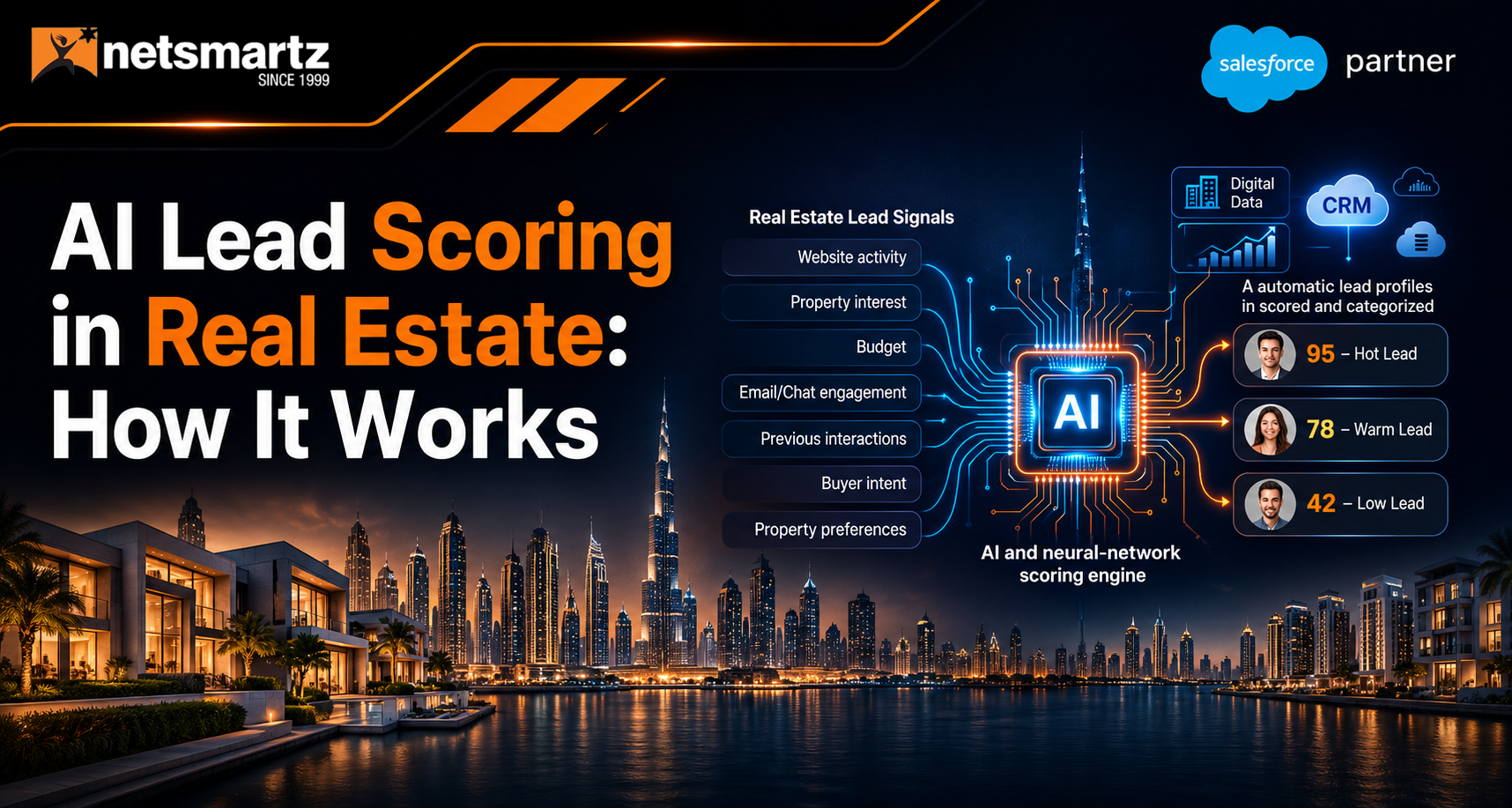
Every real estate business eventually runs into the same problem: more leads than hours in the day to work them. AI lead scoring real estate teams are increasingly adopting is the technology built specifically to solve that problem, not by generating fewer leads, but by ranking the ones already in the pipeline so agents know which contact deserves attention first. This piece walks through what the technology actually does, why it matters, how the scoring itself works under the hood, and what integrating it into an existing business actually looks like.
The Growing Role of AI in Real Estate Business
Real estate has quietly become a data heavy industry, even for businesses that do not think of themselves as tech driven. Every portal inquiry, every property search, every email open, and every mortgage calculator visit generates a data point, and a modern brokerage or developer is sitting on far more of this information than most teams realize. AI has moved into this space because the volume of data finally outpaced what a human team could reasonably process by hand. Property portals, CRM platforms, and marketing tools have all become significantly more instrumented over the past few years, capturing behavioral signals that used to go completely unrecorded. The businesses treating this data as a byproduct rather than an asset are the ones now falling behind competitors who built a system around it early.
How AI Lead Scoring Actually Works
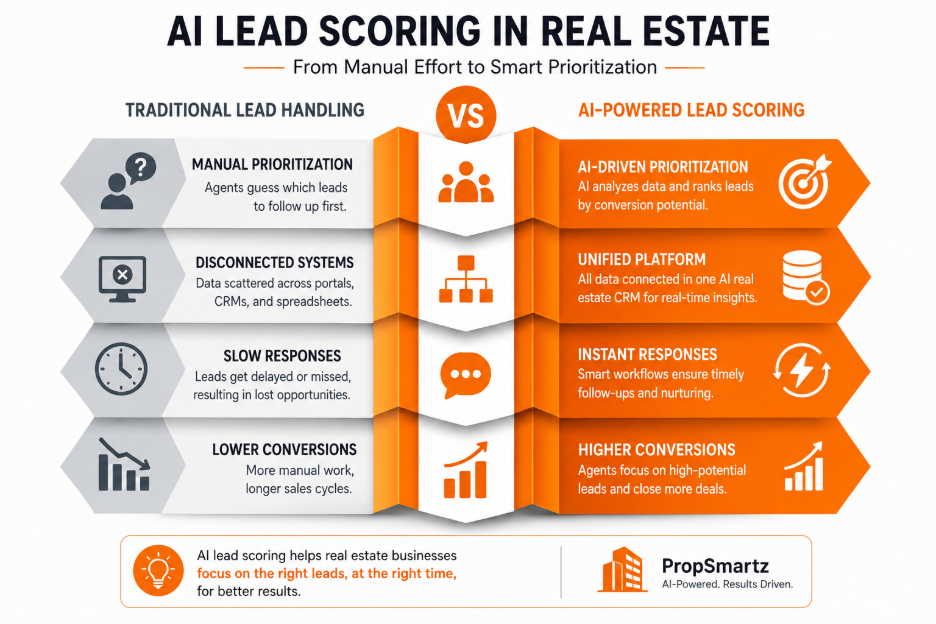
At a technical level, AI lead scoring uses machine learning models trained on historical conversion data to predict how likely a current lead is to close. Simpler implementations rely on logistic regression, which calculates a probability based on a defined set of weighted factors. More advanced systems use models like random forest or gradient boosted trees, which can capture complex, non-linear relationships between dozens of signals at once rather than treating each factor in isolation. What makes this different from an old fashioned scoring spreadsheet is that the model recalibrates itself continuously. When a lead that scored highly actually converts, the system adjusts its weighting to favor similar patterns going forward, and when a high scoring lead goes cold, it learns from that too.
The signals feeding these models vary by platform, but they typically fall into a few consistent categories.
| Signal Category | What It Captures |
|---|---|
| Behavioral engagement | Property page views, search frequency, email opens and clicks, and how quickly a lead responds to outreach |
| Financial readiness | Mortgage pre-approval activity, budget indicators, and financing related inquiries |
| Property interest specificity | Repeat views of the same listing, saved searches, and requests for viewings or brochures |
| Historical pattern matching | How closely a lead's behavior resembles previously converted leads with similar profiles |
None of this replaces human judgment entirely. It replaces the need for an agent to manually guess which of fifty new contacts is worth a callback first. McKinsey similarly notes that AI-powered sales organizations are increasingly using predictive analytics and automation to prioritize opportunities and improve conversion performance at scale.
Key Benefits of AI Lead Scoring
The operational effects of adopting this technology tend to show up in a consistent set of places.
- Faster prioritization: agents see a ranked list instead of a raw, unsorted queue, cutting the time spent deciding who to contact next.
- Higher conversion rates: industry data across multiple 2026 studies points to conversion improvements commonly in the 20 to 40 percent range when scoring is implemented well.
- Reduced bias in prioritization: a model scores based on behavior and data patterns, not an agent's gut feeling about who seems promising.
- Better resource allocation: teams can route high value leads to senior agents while lower scoring leads go into automated nurture sequences.
- Continuous improvement: unlike a fixed scoring rubric, the model keeps learning from new outcomes rather than staying static.
"In real estate, success is not about generating more leads. It is about knowing which lead is ready to act and responding at the right moment."
Why AI Lead Scoring Matters for Real Estate Businesses
Beyond the operational benefits above, there is a more structural reason this matters now rather than later. Businesses that start scoring leads today are also accumulating the historical conversion data that makes future scoring more accurate, which creates a compounding advantage over competitors who delay adoption. Forbes highlights that businesses are increasingly moving from AI experimentation to outcome-based execution, using data-driven systems to improve decision-making and operational efficiency. A business running AI lead scoring for two years has a training dataset a late adopter simply does not have yet, and that gap does not close quickly once a competitor gets ahead of it. There is also a straightforward capacity argument: a team using AI lead scoring can typically manage a larger volume of active leads with the same headcount, since agent time gets concentrated on the contacts most likely to actually close rather than spread evenly across everyone.
How to Integrate AI Lead Scoring Into a Business
Adoption tends to go more smoothly when it follows a defined sequence rather than switching everything on at once.
- Clean up CRM data first, since a scoring model trained on inconsistent or incomplete records will produce unreliable scores no matter how sophisticated the underlying algorithm is.
- Define what counts as a successful outcome for the business, whether that is a closed sale, a signed lease, or a completed viewing, since this determines what the model actually learns to predict.
- Connect the scoring engine to an AI real estate CRM rather than running it as a disconnected side tool, so scores update automatically as new behavior comes in instead of requiring manual data exports.
- Run the model in parallel with existing manual prioritization for an initial calibration period, comparing its rankings against actual outcomes before fully trusting it.
- Route scored leads into clear workflows, sending top ranked leads to available agents immediately and lower ranked leads into automated follow up sequences.
PropSmartz and AI Driven Lead Scoring
PropSmartz, an AI first real estate platform built on Salesforce, includes an AI Lead Scoring Agent as one of its embedded capabilities, offering a useful real world example of how this technology gets applied in practice. Rather than functioning as a separate tool bolted onto a CRM, the scoring runs natively inside the same platform handling the rest of the deal lifecycle, so a lead's score updates as new behavioral data arrives without a manual sync step. This kind of native integration reflects a broader shift in the market: lead scoring is moving away from standalone add-ons and toward a built-in layer of platforms designed around AI from the ground up rather than retrofitted onto older systems.
Conclusion
AI lead scoring real estate businesses are adopting is not a speculative technology anymore, it is a practical response to a problem every growing brokerage or developer eventually runs into: too many leads and not enough hours to manually judge each one. Understanding how the scoring actually works, from the signals it reads to the models doing the calculating, makes it easier to evaluate whether a given platform is doing something genuinely useful or just repackaging a simple rules based checklist as artificial intelligence. Businesses that integrate it thoughtfully, starting with clean data and a clear definition of success, tend to see the benefit show up quickly in both conversion rates and agent time saved.
Turn More Real Estate Leads into Closings with AI
Discover how AI-powered lead scoring helps your team prioritize high-intent prospects, improve conversions, and maximize agent productivity.
Book a Free DemoFrequently Asked Questions
It is the use of machine learning models to analyze lead behavior and predict which prospects are most likely to convert, ranking them so agents know who to prioritize.
AI models generally outperform manual scoring because they process far more signals consistently and without personal bias, though accuracy still depends heavily on the quality of underlying CRM data.
No, scoring models are typically calibrated around what counts as a successful outcome for that specific business, whether that is a closed sale, a signed lease, or another defined conversion event.
Yes, most modern implementations connect directly to an AI real estate CRM so scores update automatically as new lead activity comes in, rather than requiring manual data transfers.
No, it prioritizes which leads deserve attention first, but agents still apply judgment on tone, context, and relationship factors a model cannot fully capture.

Ready to build smarter? Let's talk.
Our experts are ready to help you turn ideas into production-ready AI, cloud and digital solutions.
Get in touch →Let's Discuss Your Growth Strategy
Let's discuss how we can help you accelerate growth, improve efficiency, and drive real business outcomes.