 AI-First Culture
What Is Salesforce Agentforce? A Business Leader's Guide to AI Agents
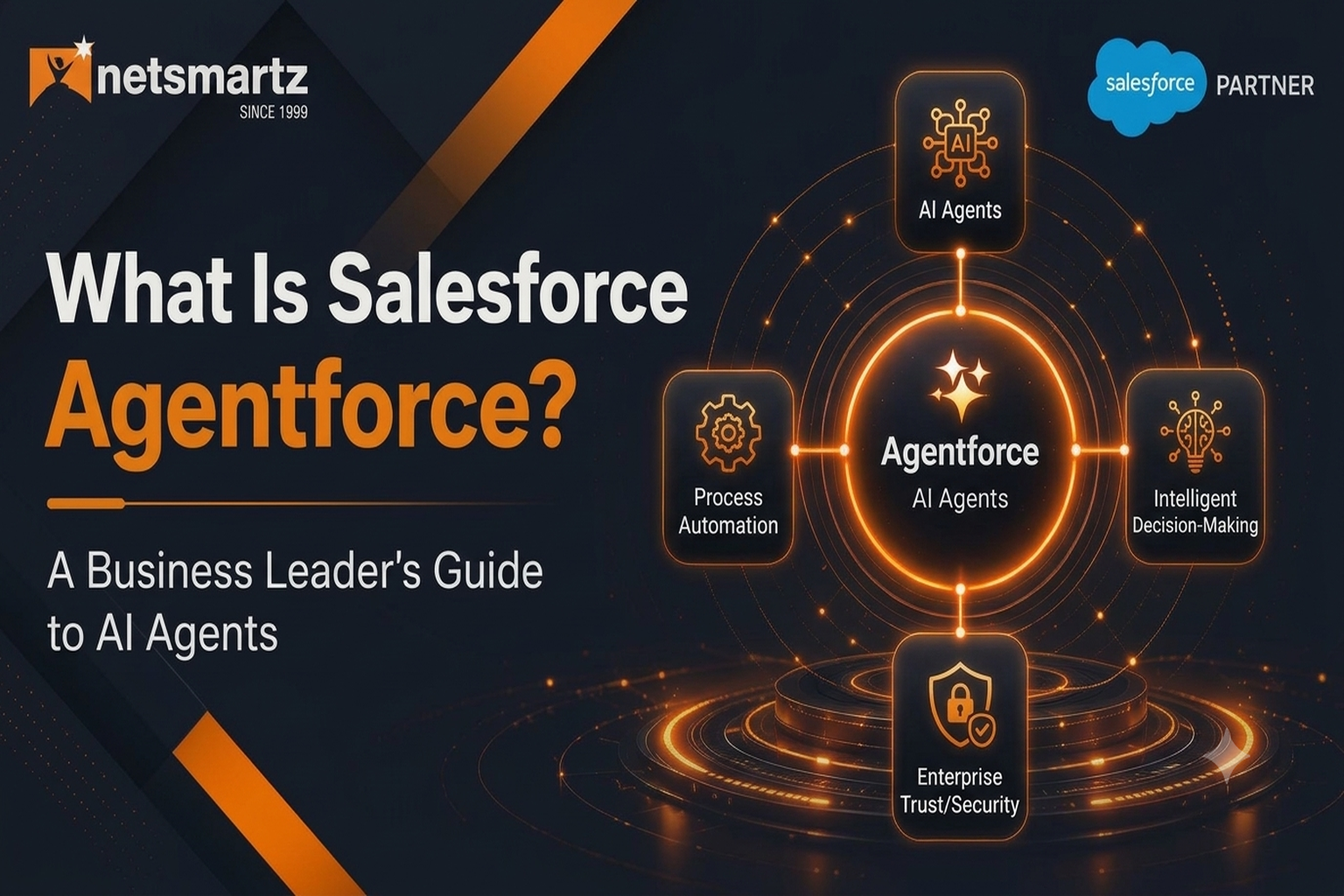
Sit through enough boardroom conversations about AI and one word keeps coming up lately: Agentforce. It's Salesforce's answer to something a lot of leaders have started asking themselves without quite saying it out loud, which is basically: what happens once the AI stops just suggesting things and starts doing them instead? Below is a straight walkthrough, what Agentforce actually is, how it functions day to day, what results it's already produced, and whether this is the right moment for your business to look at it seriously.
What Exactly Is Agentforce
Agentforce is Salesforce's autonomous AI agent platform, launched at Dreamforce back in September 2024 and opened up to everyone the month after. Strip away the marketing language and it comes down to this: organizations can build, deploy, and manage AI agents that take real action inside Salesforce and whatever's connected to it, without someone having to kick off every step by hand.
Here's the bit that confuses most people at first. There's a real difference between automation and autonomy, and it's easy to blur the two. A standard Salesforce Flow only fires when something specific happens, a record gets created, a field changes, a deadline hits, and then it just follows rules that were written ahead of time. Nothing cleverer than that. Agentforce doesn't work that way. Give it something open-ended, a customer email, a messy support case, whatever, and it actually reasons through what's going on, figures out what needs to happen next, and does it. Marc Benioff calls this the "third wave of AI," past search tools, past copilots that just make suggestions, into agents doing the work themselves inside whatever boundaries a business set for them.
How an Agentforce Agent Actually Works
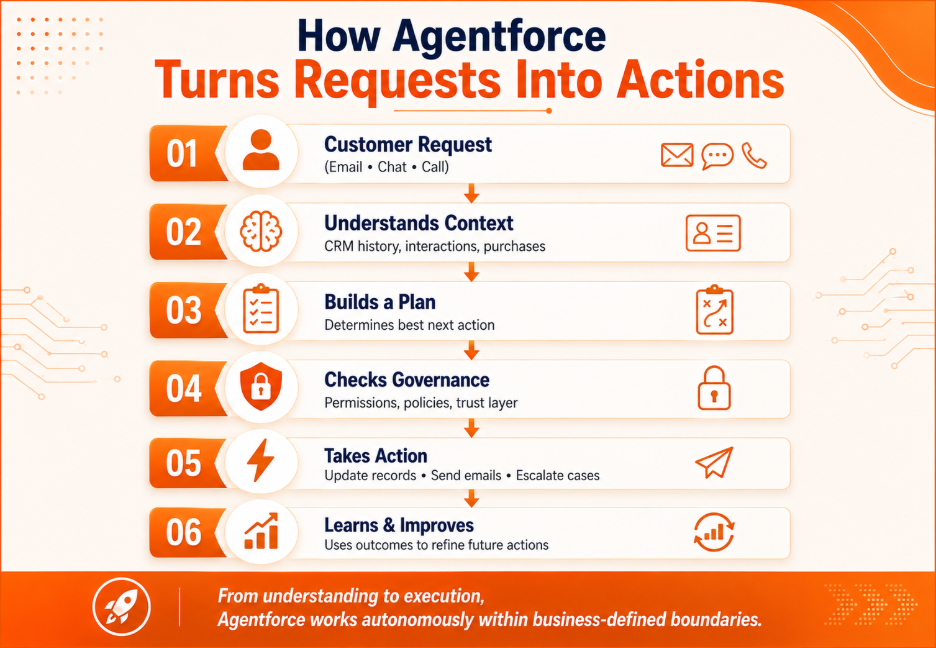
It's easier to picture this as a sequence rather than a feature list. Say a customer reaches out, doesn't matter if it's email, chat, or a phone call, the agent is already watching all three at once. Before it says a word back, it pulls up the customer's full CRM record, whatever they've dealt with before, and their purchase history, leaning on Salesforce's Atlas Reasoning Engine to actually understand who it's talking to rather than guessing. From there it maps out a plan, checks that plan against whatever rules the business has set, and moves. Sometimes that means updating a record. Sometimes it fires off an email. Other times it just hands the whole thing to a human, but with the context already written up so nobody has to start from scratch. And every one of these exchanges quietly feeds back into how the agent behaves next time, so a system that's been live six months tends to handle things noticeably better than one that just went live.
Core Capabilities Worth Knowing
None of these runs on a single feature. It's a handful of pieces working together, and they don't do much in isolation.
| Capability | What It Does |
|---|---|
| End-to-end automation | Runs structured tasks like case resolution around the clock without anyone stepping in; the foundation everything else builds on |
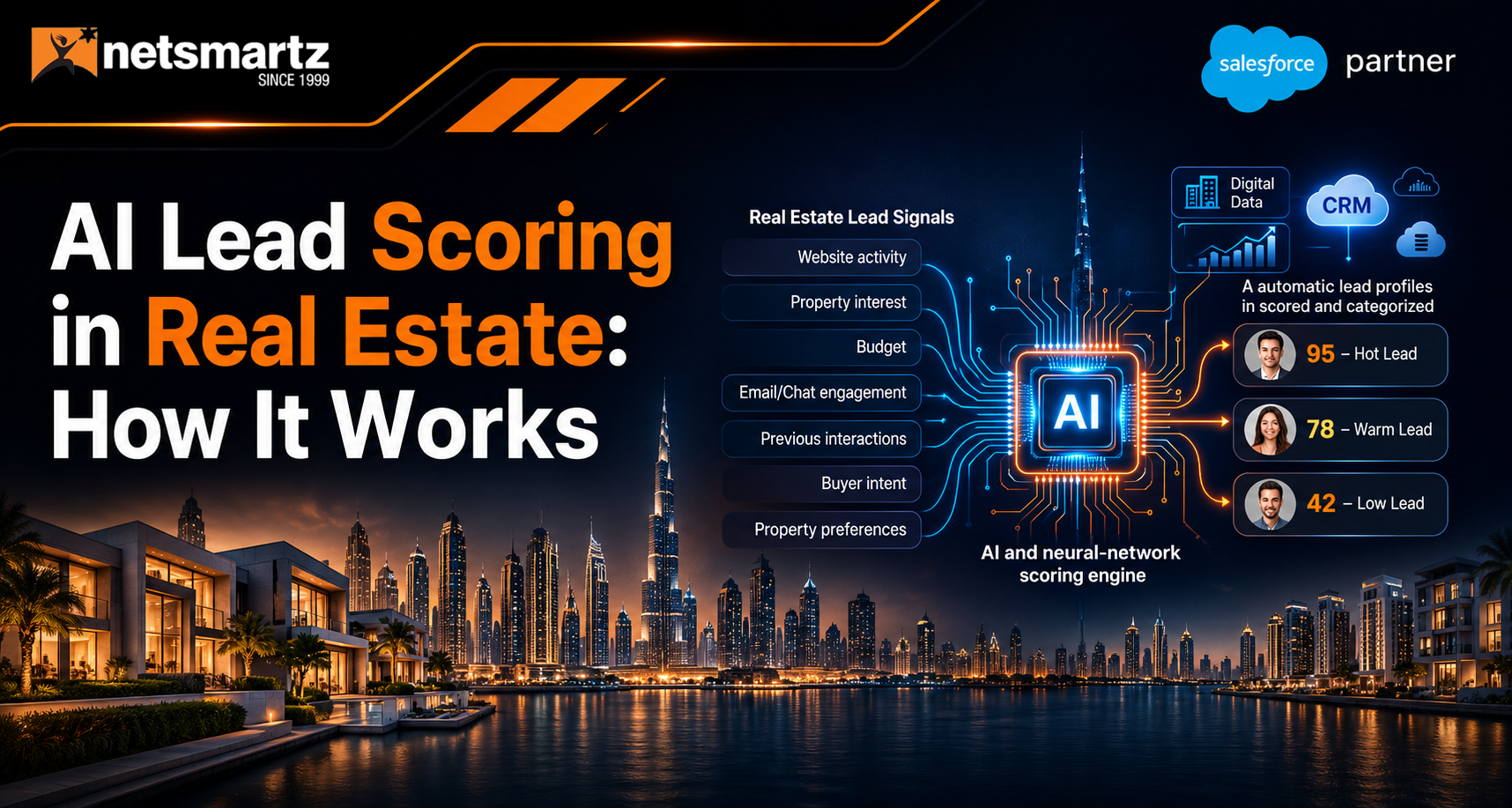
| Intelligent lead prioritization | Uses real-time signals and predictive scoring to push sales attention toward whichever lead is actually worth chasing, not just whichever arrived first |
| Personalized interactions | Draws on a live customer profile instead of a script, which is why responses feel less canned than older chatbot tools |
| Native platform integration | Works across Sales Cloud, Service Cloud, Marketing Cloud, and Field Service, and reaches outward through MuleSoft to ERPs and other third-party systems |
| Built-in security | Runs through the Einstein Trust Layer, with data masking, zero-retention processing, and full audit logging |
Why the Adoption Numbers Matter
Enterprise-Wide Momentum
The wider market data lines up with what's happening on the ground. Deloitte's 2026 State of AI in the Enterprise survey, which polled 3,235 leaders across 24 countries, found that by 2027, 74 percent of companies expect to be using AI agents at least moderately, with 23 percent of those expecting to use it extensively. Governance hasn't kept up, though. Only 21 percent of organizations say they actually have a mature governance model in place for autonomous agents, even with a majority naming data privacy and security as a top concern. Separately, Gartner expects 40 percent of enterprise applications to have task-specific AI agents built in by the end of 2026, up from under 5 percent in 2025, a pace of change that rivals the early cloud computing shift.
Agentforce-Specific Results
Agentforce's own numbers track closely with that bigger picture, and the most recent figures are the clearest signal yet of how far this has scaled. According to Salesforce's Q2 FY27 results, reported August 26, 2026, Agentforce ARR has exceeded $1.5 billion, up more than 240 percent year-over-year, making it one of the fastest-growing product lines in Salesforce's history. In that same quarter, 2,000 new paying production customers were added alone, with the number of accounts running agents in actual production growing 70 percent sequentially. On the usage side, 3.2 billion Agentic Work Units, Salesforce's unit for agent-completed tasks, were delivered in Q2 FY27 alone, up 97 percent quarter-over-quarter, bringing the cumulative total to 7.0 billion across Agentforce and Slack combined.
Speed of rollout tells a similar story. According to a 2025 Valoir study, companies went from a plan on paper to a full production system in 4.8 months on average, versus 75.5 months for anyone trying to build something equivalent from scratch. And once these things are live, they tend to earn their keep fast. Wiley, the publisher, saw case resolution climb more than 40 percent and reported 213 percent ROI from its combined Service Cloud and Agentforce spend, alongside $230,000 in documented savings and 50 percent faster onboarding for seasonal agents. Saks Global had its first agent live in under ten days, across all its North American stores.
Traditional Automation vs. Agentforce
| Dimension | Traditional Automation | Agentforce |
|---|---|---|
| Trigger | Specific event or schedule | Open-ended input or request |
| Logic | Rules defined in advance | Reasoning based on live context |
| Handles ambiguity? | No | Yes |
| Requires human initiation? | Depends on trigger type | No, works autonomously |
| Best for | Structured, repeatable processes | Variable, judgment-intensive tasks |
This distinction is particularly important for businesses comparing conversational automation with autonomous AI. For a closer look at when each approach makes sense, see our guide to Agentforce vs bots.
Where Agentforce Is Making the Biggest Difference
- Financial services have agents handling first-notice-of-loss intake on insurance claims, turning what used to take days into something closer to an hour, while quietly checking every transaction against regulatory rules as it goes.
- Retail leans on this for the bulk of its service volume, returns, exchanges, order status checks, all of it handled at 2am just as easily as 2pm, with full order history already pulled up.
- Manufacturing uses SDR agents to qualify inbound leads and check service availability before a rep ever sees the inquiry, which shrinks early pipeline stages from weeks to days.
What This Means for Leaders in MENA
For organizations across the UAE, Saudi Arabia, and the wider GCC, this is landing at a moment when the region's AI infrastructure and national strategies are already ahead of most of the world, not catching up to it. Confidence that AI will pay off within twelve months runs higher here than in most markets, so the board conversation has mostly moved past whether to adopt agentic AI and into how quickly it can be scoped and rolled out. For businesses evaluating MENA AI adoption, the opportunity is increasingly about turning that regional momentum into practical, governed use cases.
There's one detail that matters more here than almost anywhere else, and it's easy to overlook: language. Deployments that build Arabic in as a native capability, rather than bolting on a translation layer over an English-first system, see noticeably stronger engagement from customers. Get that right from the start of a regional rollout. Fixing it after launch is a much harder conversation.
What Business Leaders Should Do Before Deploying
- Get the data clean first. An agent is only as good as what it can see, so data quality work needs to happen before deployment, not as damage control afterward.
- Check your existing flows. Agents call these as actions, so anything shaky or undocumented becomes a shaky, undocumented agent action too.
- Start narrow. An agent built to do everything usually ends up doing very little well. Pick one thing, get it right, then widen the scope.
- Test in a sandbox, properly. Agent behavior is harder to predict than a standard automated flow, so this stage deserves more time than people usually budget for it.
For UAE organizations specifically, deployment readiness deserves its own assessment. Factors such as data quality, Arabic-language content, data residency, use-case definition, and Salesforce org health can all affect the success of an implementation. Businesses can review their UAE deployment readiness before moving from planning to production.
Where This Is Headed
Give it another couple of years and multi-agent orchestration will probably just be how this works, specialized agents passing work to each other inside a single workflow instead of one agent trying to shoulder everything. Predictive agents, ones that catch a customer's need before it's even voiced, are already starting to show up. And governance is moving from something teams add after the fact to something boards want to see before a single agent goes live, as autonomy keeps expanding into more of the business. The practical takeaway for a leader reading this: what you build now, clean data, a tight scope, real governance, decides how much of that next wave your organization is actually able to use once it gets here.
Ready to Explore Agentforce?
Discover where AI agents can create real value for your business.
Talk to our Salesforce experts today.Frequently Asked Questions
An autonomous AI agent platform that takes real action inside Salesforce, launched in October 2024.
Chatbots follow scripts; Agentforce agents' reason, plan, and complete multi-step tasks independently.
About 4.8 months on average, versus 75.5 months for a custom-built stack.
Yes, the Einstein Trust Layer provides data masking, audit logging, and role-based access controls.
No, but it significantly expands the context agents can use to make decisions.
Ready to build smarter? Let's talk.
Our experts are ready to help you turn ideas into production-ready AI, cloud and digital solutions.
Get in touch →Let's Discuss Your Growth Strategy
Let's discuss how we can help you accelerate growth, improve efficiency, and drive real business outcomes.