 AI-First Culture
The Real Cost of Context Switching: Why Sales Teams Lose Deals Waiting on Data
Before most sales calls even start, the seller has already lost minutes, sometimes closer to an hour, digging through a CRM, scrolling old emails, and replaying half-remembered notes just to remember where a deal actually stands. That gap between wanting to help a customer and actually having the context to do it well is context switching, and in 2026 it has become one of the most expensive, least discussed costs in enterprise sales.
What Context Switching Actually Is, and Why It Matters Now
Context switching is the mental and operational cost of stopping one task to reconstruct the background needed for another. For a seller, that means pausing outreach to piece together a deal's history before a call, or pausing call prep to check whether a stakeholder changed since the last touchpoint. Every switch carries a hidden tax: minutes lost to searching, momentum lost to interruption, and quality lost when a rep walks into a conversation only half prepared. It matters more now because deal cycles have not gotten simpler. Buying committees are larger, data lives across more systems, and reps are expected to personalize every interaction, all while pipeline volume keeps growing. The tools sellers use have multiplied faster than the systems connecting them, which is exactly why this gap has widened rather than closed heading into 2026.
Who Feels This the Most
Individual reps carry the most visible cost, but the pain spreads further than the person on the call. Account executives lose the most active selling time, since deal prep sits squarely in their daily workflow. Sales managers absorb a second-order cost during pipeline reviews, spending meeting time reconstructing deal status instead of coaching strategy. Revenue operations teams feel it structurally, building dashboards and reports meant to solve exactly this gap, often without fully closing it. And customers feel it too, even if they never see the cause, in the form of a seller who seems less prepared than the relationship deserves.
When Context Switching Costs the Most
Three moments in a sales cycle carry the heaviest cost. Before a call, reps typically spend meaningful time reconstructing account history, past objections, and stakeholder details, time that directly delays outreach and response speed on active deals. During pipeline reviews, managers and reps together lose real working hours reconciling what is actually true about a deal versus what a CRM field says, since the two frequently diverge. And during forecast prep, the cost compounds further, as reps piece together deal health from memory and scattered notes rather than a single reliable source, often under real time pressure ahead of a forecast call.
Where the Data Gap Actually Lives
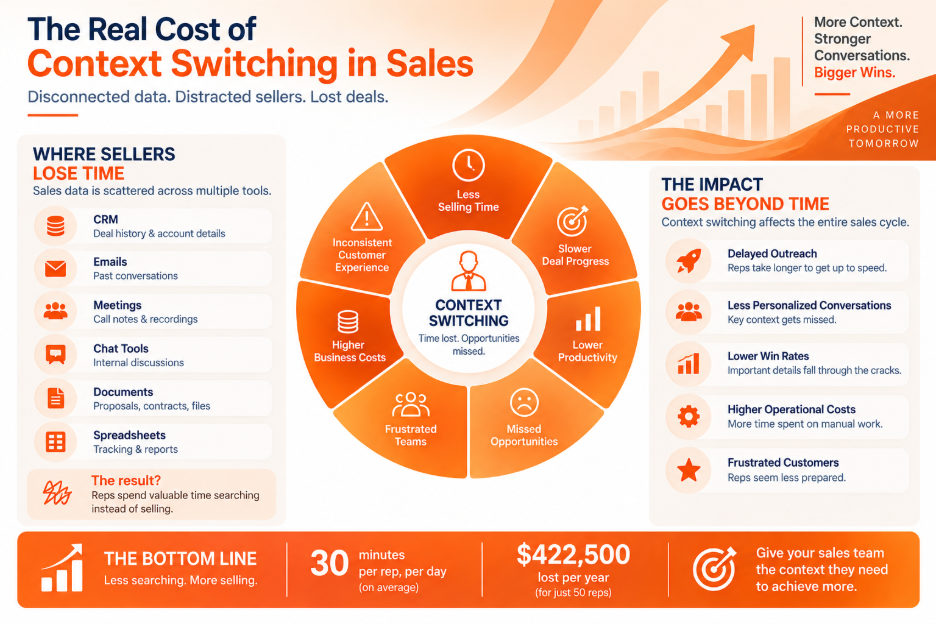
The information a rep needs rarely lives in one place. Deal history sits in the CRM. Buyer sentiment lives in email threads and call recordings. Internal deal discussion happens in Slack. Product usage or support signals sit in yet another system entirely. None of these systems talk to each other by default, which means the rep becomes the integration layer, manually stitching together a full picture every time they need one. That manual stitching is where most of the time, and most of the risk of missing something important, actually lives.
"Sales teams don't lose time looking for information. They lose time because the information isn't where they need it when they need it."
The Investment Gap Behind the Problem
The frustrating part of this story is that most organizations already know it is a problem. 97 percent of leaders say generative AI is transformative to how they will compete. Only 31 percent have invested in it meaningfully enough to operationalize it inside daily workflows like sales prep. Knowing a technology matters and building it into the flow of real work are two very different commitments, and 2026 is the year that gap is becoming impossible to ignore.
PwC's 2026 AI Performance Study puts a sharper number on where that gap leads: nearly three quarters, 74 percent, of AI's economic value is being captured by just one fifth, 20 percent, of organizations. The divide is not about who has access to AI tools. It is about who has actually connected those tools to the real data reps need in the moment they need it.
What This Looks Like in the Middle East
It would be easy to assume this is a problem for slower-moving markets, and MENA has already solved it. The data says otherwise, and the nuance is worth sitting with.
The region is genuinely ahead on AI adoption. PwC found 75% of Middle East employees used AI tools at work in the past year, against a 69% global average, and close to 40% of Middle East CEOs have already adopted AI for demand generation and customer service, nearly double the 22% global benchmark.
Here is the part that matters for this specific problem: high adoption of AI tools is not the same thing as closing the context gap inside day-to-day sales workflows. A region can lead the world on AI sentiment and daily usage, and still have reps manually reconstructing deal history before every call, because the AI they are using and the CRM data that actually describes the deal were never connected. Adoption measures whether people are using AI. It does not measure whether that AI can see the pipeline. For a regional sales organization, the honest question is not "are we behind on AI," the data suggests you likely are not, it is "does the AI our reps already trust actually have access to the deal data that matters."
Putting a Number on It: A Simple Cost Calculation
The clearest way to see this cost is to run the numbers for a single sales team. Take a mid-sized team of 50 account executives, each losing roughly 30 minutes a day gathering context before calls and reviews, a conservative estimate for teams working from disconnected systems. At a blended fully-loaded cost of $65 an hour per rep, that works out to roughly $422,500 a year, in a single team of 50, purely from context-gathering that never should have needed to happen manually. Scale that to a 500-person sales organization, and the same math points toward a figure well into the millions.
(For teams budgeting in AED or SAR, that's roughly AED 1.55 million or SAR 1.58 million, though we'd recommend using your organization's actual loaded cost per rep rather than this blended estimate.)
What Is Changing: The Future of Context in Sales
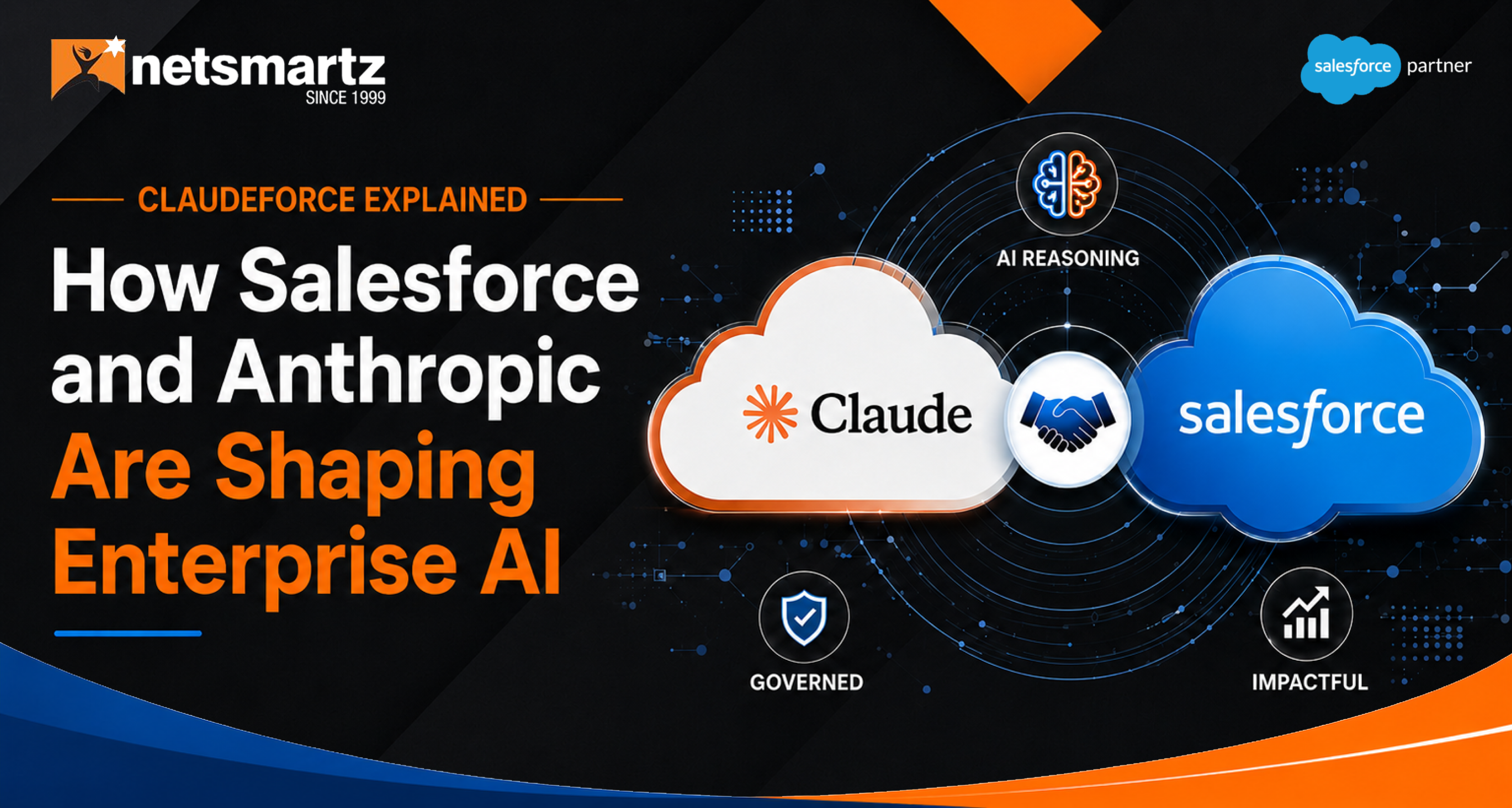
The direction of travel is toward AI that reasons across a company's actual business data instead of a generic prompt with no visibility into it. That is the core idea behind Claudeforce, the expanded partnership between Salesforce and Anthropic, which connects Claude directly to a company's live Salesforce data, workflows, and permissions. Instead of a rep manually reconstructing deal history before every call, that context becomes available instantly, already assembled from real pipeline data, past interactions, and account history. Salesforce in Claude, the first product to launch under this partnership, ships with 37 prebuilt sales skills covering exactly the moments where context switching costs the most: call prep, pipeline review, and forecast narratives. It is currently live with pilot customers, with an open beta planned for September 2026 and further expansion into service, marketing, and revenue functions later in the year.
Conclusion
Context switching has quietly become one of the largest, least visible costs in enterprise sales, not because teams are inefficient, but because the systems holding deal data were never built to talk to each other. The gap between recognizing AI's potential and actually operationalizing it, borne out clearly in PwC's 2026 findings on where AI's economic value concentrates, and echoed in the region's own adoption-versus-integration gap, is exactly where that cost compounds. Closing it is no longer about adding another dashboard or another tool. It is about giving sellers a single, reliable source of context the moment they need it, which is precisely the problem partnerships like Claudeforce are now being built to solve.
Put Every Seller in Context
Connect CRM data, customer interactions, and pipeline insights in one place to help sales teams move faster and close more deals.
Get in Touch.Frequently Asked Questions
The time and mental effort reps spend reconstructing deal context before calls, reviews, or forecasts.
Pipeline volume and buyer complexity have grown faster than the systems connecting sales data.
For a 50-person team losing 30 minutes daily per rep, roughly $422,500 a year in lost selling capacity.
74 percent of AI's economic value is captured by just 20 percent of organizations.
It connects Claude directly to live Salesforce data, giving reps instant context instead of manual research.
No, adoption and integration are different things. PwC data shows the Middle East leads globally on AI usage and sentiment, but high adoption does not automatically mean sales AI is connected to live CRM data. The context-switching cost shows up even in high-adoption markets.
Our Agentforce and Data Cloud practice runs this same cost analysis for clients before recommending any AI investment, so the business case is based on your team's real numbers, not an industry average.

Ready to build smarter? Let's talk.
Our experts are ready to help you turn ideas into production-ready AI, cloud and digital solutions.
Get in touch →Let's Discuss Your Growth Strategy
Let's discuss how we can help you accelerate growth, improve efficiency, and drive real business outcomes.