 AI-First Culture
Why Middle East Businesses Need an Integration Strategy Before It's Too Late
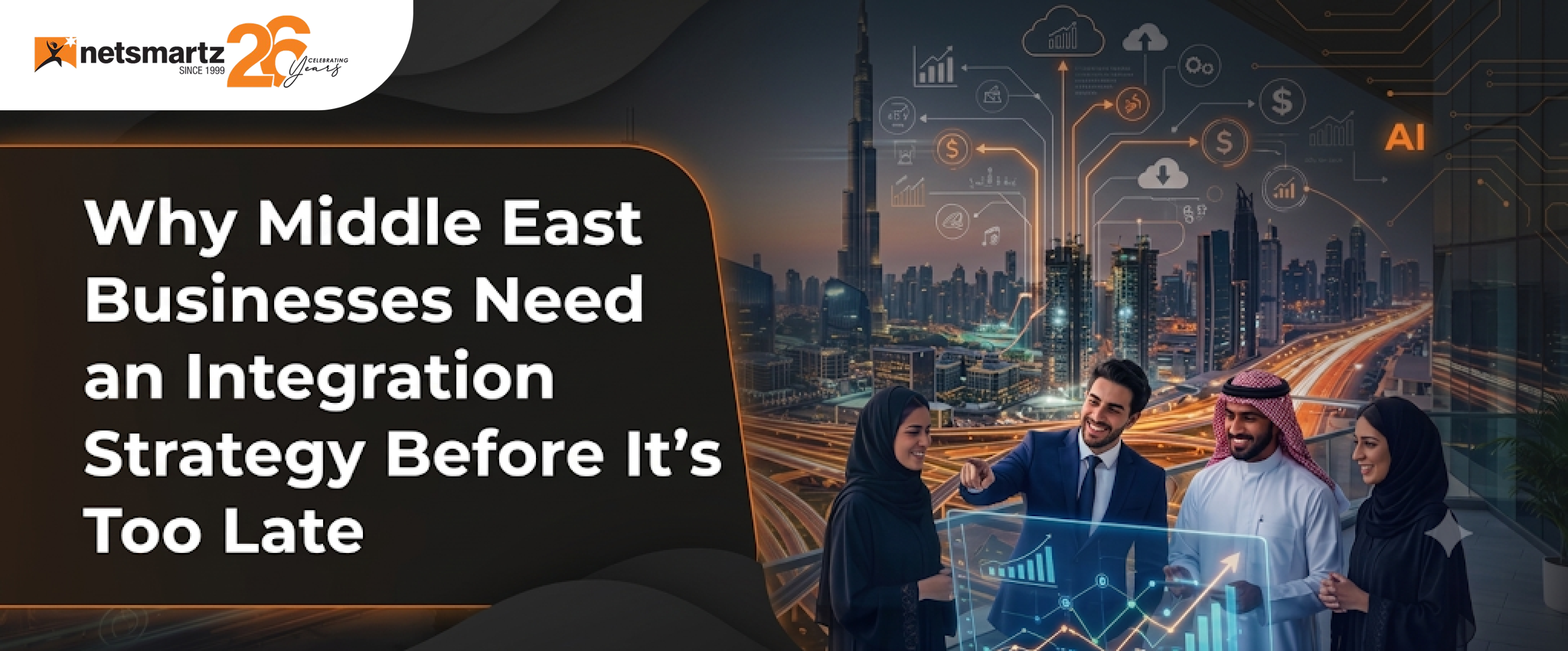
The Middle East Is Investing Billions in Digital Transformation. But There’s a Problem.
New CRM systems. New ERP platforms. New AI tools. New customer portals. Cloud migrations. Data platforms. The investment is real, the ambition is clear, and the national mandates are in place.
But here’s the problem most businesses aren’t talking about: every new system added without an integration strategy makes the business harder to run, not easier.
You end up with ten platforms that don’t talk to each other. Sales can’t see what finance knows. Service agents work from incomplete information. AI tools produce unreliable results because they’re drawing from fragmented, siloed data.
This isn’t a technology problem. It’s an integration strategy problem, and across the Middle East, it’s costing businesses far more than most realize.
The Reality for MENA Businesses in 2026
- MENA IT spending is projected to hit $169 billion in 2026.
- SMEs make up 80% to 90% of private sector businesses in MENA, but most still lack integration expertise.
PwC’s 2026 Global CEO Survey found only 12% of CEOs say AI has delivered both cost and revenue benefits, while companies with strong data foundations lead that pack.
- Digital transformation remains a national strategic priority across the UAE, KSA, Qatar, Kuwait, Bahrain, and Oman.
- Most businesses are still adding new systems without a plan to connect them, creating more silos instead of fewer.
What Is an Integration Strategy and Why Does It Matter?
An integration strategy is a plan for how every technology system in your business shares data with every other one, in real time, reliably, and securely.
Without one, every new system becomes an island. Data gets duplicated. Teams work from different versions of the truth. Automations break. Customers get fragmented experiences. And when you try to deploy AI, it has no reliable data foundation to work from.
With a proper integration strategy built on MuleSoft integration services, your entire technology stack becomes one connected, intelligent system that every team, every tool, and every AI agent can actually draw from.
Why This Is Especially Critical for Middle East Businesses
Middle East businesses face a specific combination of factors that make integration strategy more important here than in almost any other region:
- Rapid growth across multiple markets: UAE, KSA, and Qatar operations need connected data, not three separate systems.
- Multi-language operations: integration keeps Arabic and English data consistent across every platform.
- National Vision mandates for 2030 and 2031: disconnected systems tend to fail compliance audits.
- Legacy systems still in daily use: integration bridges decades-old ERP and finance systems with modern CRMs.
- Multi-entity group structures: GCC holding companies need one connected view across every subsidiary.
- Data residency regulations: Saudi PDPL and UAE data protection law both require governed, auditable data flows.
- AI adoption ambitions: AI cannot work without clean, integrated data underneath it.
“Every system you add without a plan to connect it becomes one more island. Integration is what turns those islands back into one business.”
5 Signs Your Middle East Business Needs an Integration Strategy Right Now
1. Your Teams Are Working from Different Data
Your sales team sees one version of a customer record in Salesforce. Your finance team sees a different version in your ERP. Your customer service team has a third version. Nobody fully trusts the data, so nobody uses it well, and it only gets worse with every new system you add.
2. Your Digital Transformation Projects Keep Stalling
Across the Middle East, plenty of transformation projects stall at the proof-of-concept stage, not because the technology fails, but because the underlying data infrastructure isn’t connected enough to support a scaled rollout. If your AI pilots or CRM rollouts keep hitting the same wall, disconnected systems are usually the root cause.
3. You’re Adding New Systems but Getting Slower
Every new platform should make your business faster. If adding one makes your business slower instead—more manual entry, more reconciliation, more IT maintenance—that’s a clear sign you’re building without a strategy.
4. Your Customer Experience Is Fragmented
Customers across the Middle East expect smooth, personalized, digital-first experiences by default. If your service team can’t see a customer’s full history across every system, that experience will always feel disconnected, no matter how good each tool is on its own.
5. You’re Preparing to Deploy AI, But Your Data Isn’t Ready
This is the most urgent sign in 2026. AI tools, including Salesforce Agentforce, Einstein AI, and custom AI agents, cannot deliver reliable results on fragmented, siloed data. Your AI investment will underperform no matter how powerful the model is, so fix the API layer first.
How MuleSoft Solves the Integration Challenge for MENA Businesses
MuleSoft, Salesforce’s enterprise integration platform, is what connects all of this together. It acts as the central integration layer between every system in your business: CRM, ERP, finance, marketing tools, customer portals, AI agents, and any external data source.
For Middle East businesses specifically, MuleSoft delivers four capabilities that matter most:
- Connect anything to anything: SAP, Oracle, Microsoft Dynamics, local ERP systems, government portals, and payment gateways through one governed platform.
- Real-time data flow: data moves in real time, not overnight batch jobs, so every team works from current, accurate information.
- Data governance and compliance: enforce data residency rules, audit trails, and security policies at the integration layer, critical for PDPL and UAE compliance.
- AI readiness: MuleSoft’s Agent Fabric gives your AI tools access to complete, real-time data from across your stack.
For businesses already using Salesforce, MuleSoft is the native integration layer, connecting Salesforce to your ERP, finance, and HR systems for one complete view of every customer and transaction. That’s the foundation that makes Agentforce and Einstein AI work reliably across the Middle East.
Where to Start: A Simple 3-Step Approach
You don’t need to integrate everything at once. The most successful MENA businesses tend to start with a focused, phased approach:
- Step 1, Map your stack: list every system you use and identify which ones share data today. That’s your integration gap map.
- Step 2, Prioritize by impact: find which disconnected systems cause the most pain right now, and start there—not with the most complex integration, but the most valuable one.
- Step 3, Build for reuse: use MuleSoft’s API-led approach to build integrations as reusable assets, so your capability compounds over time.
The Bottom Line: The Cost of Waiting Is Higher Than You Think
Every month your systems stay disconnected, your teams keep making decisions on incomplete data, your customer experience keeps falling short, and your AI investments keep underperforming. The cost isn’t just operational. It’s competitive.
Across the Middle East, the businesses that lead their industries in 2026 and beyond won’t be the ones spending the most on individual systems. They’ll be the ones that connect those systems into a single, intelligent, integrated platform.
Ready to build your integration strategy?
Talk to Netsmartz about a MuleSoft-powered approach today.
Frequently Asked Questions
Yes, MuleSoft now offers more accessible pricing and low-code tools, and mid-market businesses running five or more connected systems are strong candidates.
It enables real-time data flows, enforces local data residency, and provides the connected foundation AI adoption requires under both national visions.
Mapping systems and designing the architecture typically takes two to four weeks, with the first live integration following four to eight weeks after that.
No. MuleSoft connects to existing systems, including legacy ERP platforms and Arabic-language business applications, without requiring any replacement.
Ready to build smarter? Let's talk.
Our experts are ready to help you turn ideas into production-ready AI, cloud and digital solutions.
Get In Touch →Let's Discuss Your Growth Strategy
Let's discuss how we can help you accelerate growth, improve efficiency, and drive real business outcomes.