 AI-First Culture
Next Month at Community Summit NA 2026: What It Takes to Be an AI-First Enterprise
Most enterprises have started using AI. Far fewer have changed how work actually gets done because of it.
Employees have Copilot. Teams have AI assistants. Businesses are experimenting with agents. But putting AI into an existing process does not make an enterprise AI-first.
An AI-first enterprise starts with a different question: What should AI own?
That question changes the conversation from adding AI tools to redesigning work around what AI can execute. This is where AI Coworkers fit into the AI-first model. They are designed to take on specific responsibilities within a business, using the right data and systems to do the work. The key is not to remove people from the process. It is to give AI a defined role while people stay in control of decisions that require judgment.
That is also the shift Netsmartz is bringing to Community Summit North America 2026. At Booth #1608, the focus is not simply on what AI can do. It is on what happens when AI becomes part of how an enterprise works.
The enterprise is moving beyond AI tools
Copilots, chatbots, and point automations were the starting line, not the destination.
Gartner predicts that 40% of enterprise applications will feature task-specific AI agents by the end of 2026, up from less than 5% in 2025. The shift is toward agents capable of handling more defined, multi-step work rather than simply responding to prompts.
But adoption and transformation are not the same thing.
The harder question is no longer whether AI can perform a task. It is whether the enterprise has redesigned the surrounding process so AI can perform that task responsibly.
That means deciding what an AI worker should access, what it should be allowed to do, and where a person needs to step in.
Technology is advancing quickly. The operating model has to catch up.
So, what actually makes an enterprise AI-first?
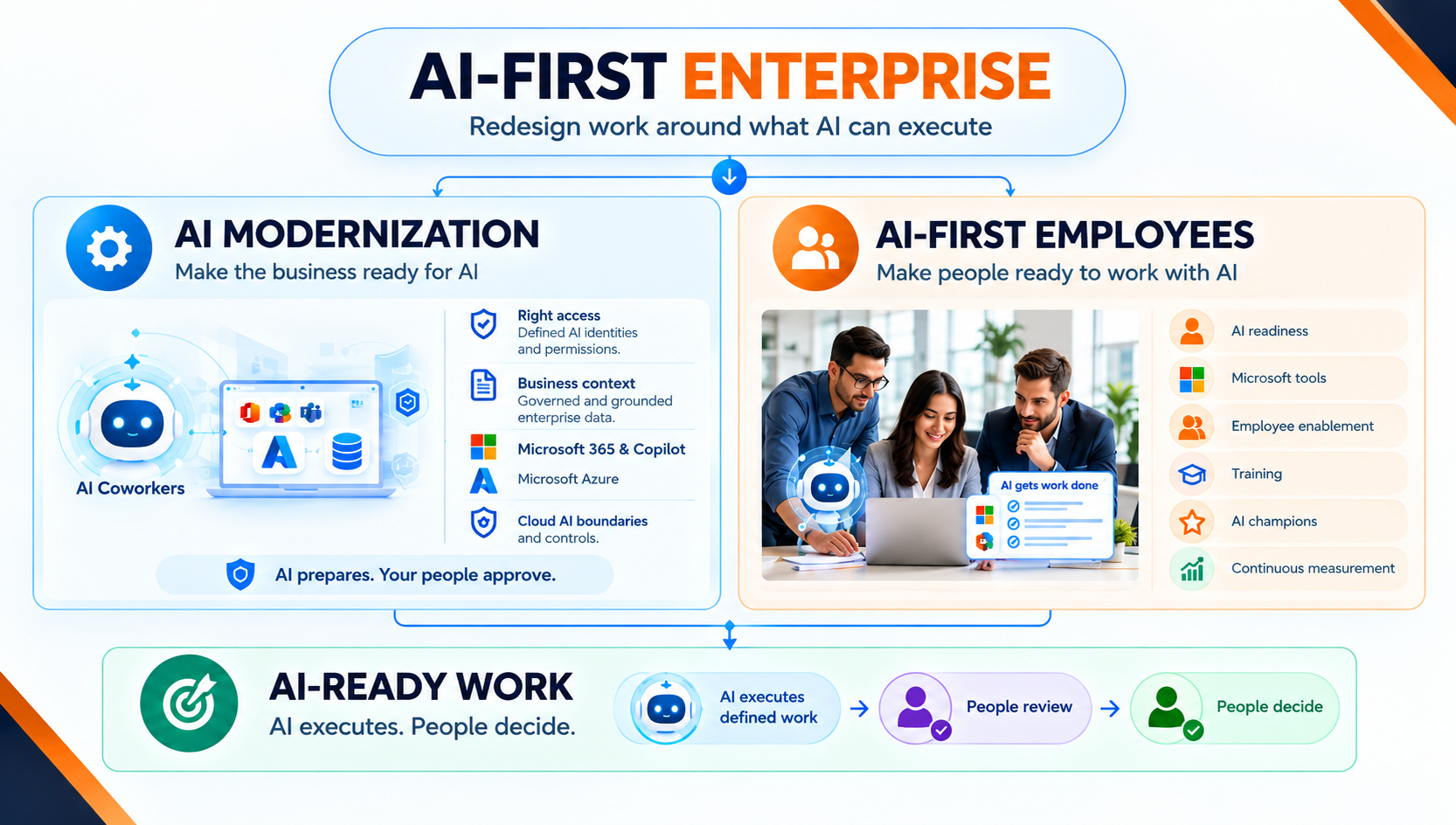
An AI-first enterprise is not the one with the most AI tools. It is the one that has deliberately redesigned work around what AI can execute.
That requires two shifts happening together: AI modernization, which makes the business ready for AI, and AI-First Employees, who know how to work with the technology.
AI modernization starts with the foundation. AI coworkers need defined identities, permissions, and access based on their roles: Right Person. Right Worker. Right Data. They need reliable business context while data remains governed and grounded. And they need clear boundaries around when they can act, and when people must review or approve: AI prepares. Your people approve of it.
For enterprises putting this model into practice, the technology foundation matters. Netsmartz brings together AI Coworkers with Microsoft technologies such as Microsoft 365, Copilot, and Azure to support the environment around AI-enabled work. This gives AI a defined place within the enterprise rather than making it another disconnected application.
Gartner predicts that 40% of enterprises will demote or decommission autonomous AI agents by 2027 because of governance gaps identified after production incidents.
But the technology is only half of the shift.
AI-First Employees need to know where AI fits into their roles and how to use it effectively. That means measuring AI readiness, enabling employees with the right Microsoft tools, and embedding AI through training, champions, and continuous measurement.
Business readiness and employee readiness have to move together. One without the other creates an AI-enabled organization, not an AI-first one.
What that looks like inside the business
Construction makes this model particularly tangible because information moves constantly between the jobsite, office, contractors, project managers, finance teams, and leadership.
Consider what happens when AI workers are designed around those roles.
A field operations AI coworker could turn daily site notes and photos into structured reports, reducing the administrative work required to move information from the jobsite to the office.
A project AI coworker could monitor RFIs, budgets, project information, and billing activity, surfacing items that require attention instead of waiting for someone to manually compile a status update.
A scheduling AI coworker could monitor project information and flag missing updates or potential issues for the person responsible for the schedule.
A finance AI coworker could surface unusual project costs, billing exceptions, or information that requires finance review.
These are not four versions of the same chatbot. They are four defined responsibilities; each connected to a relevant business context and operating within a specific scope.
Gartner’s September 2026 analysis of 107 agentic AI deployments found that the greatest business value comes from focused, domain-specific applications. Gartner predicts that 80% of all tangible ROI from agentic AI will come from specialized applications by 2028.
The implication is straightforward: AI should have a clear purpose within the enterprise. Its value comes from taking responsibility for meaningful work.
What this means for enterprises
The instinct to “AI-ify” everything at once is usually the wrong starting point. Instead, enterprise leaders can look at work role by role:
What does this team spend significant time doing repeatedly?
Which parts require human judgment?
Which parts are structured enough for AI to execute?
What systems contain the context an AI worker needs?
What should it be allowed to access or change?
Where does a person need to review or approve the outcome?
Once that foundation is established, enterprises can apply it to new AI use cases as different functions identify opportunities. The architecture also needs room to evolve. Models, agents, Microsoft capabilities, security requirements, and business processes will continue to change.
The goal is to build an enterprise that can adapt continuously as AI capabilities evolve.
What Netsmartz is Bringing to Community Summit North America 2026
That is the conversation Netsmartz is bringing to Community Summit North America 2026, October 11–15 in Nashville.
At Booth #1608, Netsmartz will showcase AI Coworkers for construction alongside ProjectPro, ProjectPro Field, and Microsoft technologies including Microsoft 365, Copilot, and Azure.
For construction teams, AI Coworkers show what it means to give AI defined responsibilities within real business workflows. ProjectPro provides the construction and financial workflow foundation, while ProjectPro Field brings project information and field processes into a mobile-first experience.
Together, they demonstrate a practical approach to AI adoption: start with meaningful work, give AI a clear role, and provide the business context and controls it needs.
For enterprise leaders, the same principle extends beyond construction. The goal is not to add AI to every process. It is to identify where AI can take responsibility for meaningful work while people retain judgment and decision-making.
Visit Booth #1608 to see the approach in action.
Frequently Asked Questions
An AI-first enterprise designs business processes around what AI can execute instead of simply adding AI tools to existing workflows. AI workers handle defined responsibilities while people retain control over judgment, exceptions, and important decisions.
No. AI-first does not mean removing people from the process. It means deciding which work AI can execute and where human judgment, approval, or accountability remains necessary.
AI assistants typically respond to requests or help users complete individual tasks. AI coworkers are designed around specific responsibilities, with defined access, business context, and actions they can perform within a workflow.
Governance should be built around each AI worker's identity, access, responsibilities, and level of autonomy. Enterprises should define what an AI worker can see, what it can do, when human approval is required, and how its actions are monitored.
Netsmartz will showcase role-specific AI Coworkers, ProjectPro, and ProjectPro Field at Community Summit North America 2026, October 11–15 in Nashville. Visit Booth #1608 to see how AI can become part of enterprise and construction workflows.
Keep reading
Ready to build smarter? Let's talk.
Our experts are ready to help you turn ideas into production-ready AI, cloud and digital solutions.
Get In Touch →Let's Discuss Your Growth Strategy
Let's discuss how we can help you accelerate growth, improve efficiency, and drive real business outcomes.