 AI-First Culture
Agentic Procurement for UAE Manufacturers: Catching Supply Changes Before They Hit Production
11:40 pm. A supplier emails your buyer: only 60% of this week’s order will ship, and the balance follows in three weeks. The buyer reads it at 9 am. By then, production planning has already locked tomorrow’s schedule around material that isn’t coming.
In that familiar scenario, nothing failed except timing. And for UAE manufacturers, timing is getting more expensive. Industrial exports reached AED 262 billion in 2025, and the sector’s GDP contribution has grown 70% since 2021, according to the Ministry of Industry and Advanced Technology. More industrial activity means more supplier commitments, purchase orders, and changes to manage.
The frontier-firm journey in manufacturing begins with procurement, where outside changes first enter your value chain.
In short
A procurement agent turns supplier communication into an operational signal: what changed, what it could affect, and what needs a buyer’s attention. For manufacturers, that creates a measurable starting point for bringing AI into a live workflow.
What “Frontier” Means for a Manufacturer
Microsoft uses “Frontier Firm” to describe organizations where people and AI agents work side by side. Its 2026 Work Trend Index found that 19% of AI users sit in this “Frontier” zone, where individual AI capability and organizational readiness reinforce each other.
For manufacturers, the more useful question is not “How many AI agents do we have?”
It is: “How much faster can we respond when something changes?”
A supplier misses a shipment. A customer changes an order. A material becomes constrained. A price changes. The competitive difference is created in the gap between that signal arriving and someone acting on it. That makes responsiveness a useful test for agentic manufacturing.
If an agent can detect a defined change, connect it to the right operational context, and put the decision in front of the right person before the delay becomes a disruption, AI is no longer sitting beside the workflow. It is changing the workflow.
Why Procurement Is Where Agentic Manufacturing Starts
The first useful manufacturing agent may not sit on the production floor. It may sit in the inbox.
A supplier's revised delivery date, reduced quantity, or changed commitment can alter a production plan before anyone on the shop floor knows there is a problem. Procurement is where those external signals first become operational decisions.
That makes procurement more than a purchasing function. It is an early-warning layer for the factory. Three things make it particularly suited to agentic work:
Supplier communication creates a steady stream of signals. Confirmations, delays, shortages, and changes arrive continuously.
Those signals can be connected to business context. A delivery change means something different when the affected material is tied to a production order, customer commitment, or inventory threshold.
The outcome can be measured. Manufacturers can track how long it takes to move from supplier change to impact assessment to decision.
The opportunity is not to automate procurement's judgment. It is to move that judgment closer to the moment the signal arrives.
What Microsoft’s Procurement Agent Does Today
The Procurement Agent in Dynamics 365 Finance & Supply Chain Management (production-ready preview, per Microsoft’s August 2026 documentation) takes over the inbox work between suppliers and planners:
| Task | Today, in most plants | With the Procurement Agent |
|---|---|---|
| Reading supplier emails | A buyer works through the inbox | Monitors and classifies vendor emails about purchase orders |
| Spotting what changed | Buyer compares the email with the PO | Separates confirmations from change requests and identifies the changed fields |
| Judging the impact | Planner and buyer trade calls | Assesses the effect on inventory, production schedules, and customer deliveries, marked “Has impact” or “No impact” |
| Applying the change | Buyer finds and edits the PO | Purchaser confirms and applies it without opening the PO |
| Chasing suppliers | Manual reminders | Automates outgoing and follow-up communication |
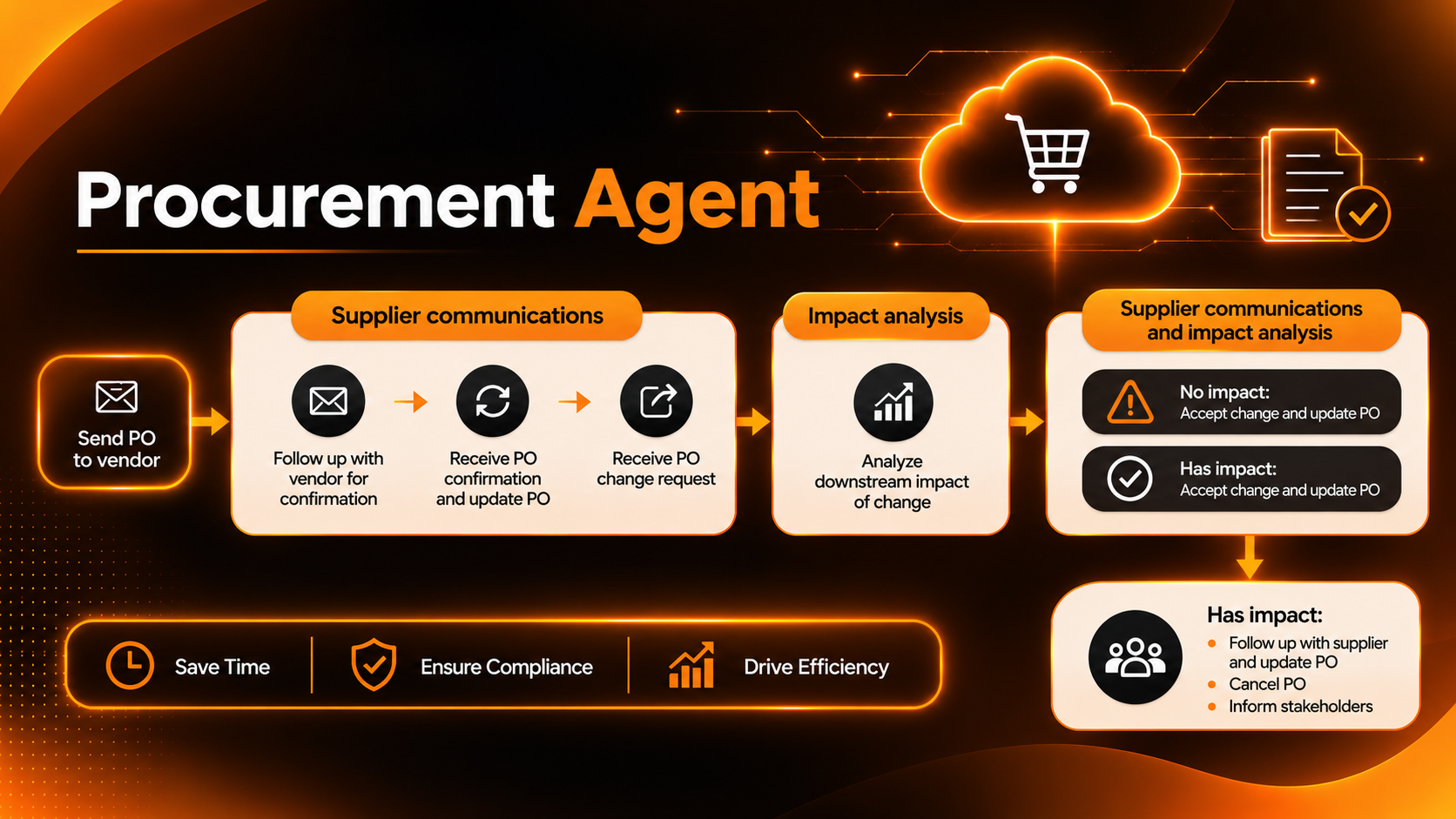
Back to that 11:40 pm email. The agent classifies it as a change request, identifies the reduced quantity, and flags it as “Has impact” on the production schedule. When the buyer logs in at 9 am, the decision is waiting, with its consequences already mapped.
The UAE Angle
Three local factors make agentic procurement especially relevant for UAE manufacturers:
Growth targets: Operation 300bn aims to lift industry’s GDP contribution from AED 133 billion to AED 300 billion by 2031. Scaling toward that means more supplier volume than manual processes can absorb.
In-Country Value: under the National ICV Program, certified suppliers gain advantages in tenders based on their ICV score. That makes sourcing choices strategic, and firmly a human decision.
E-invoicing: the Ministry of Finance requires businesses with revenue of AED 50 million or more to implement e-invoicing by 1 January 2027. Structured supplier data gives procurement agents cleaner information to work with.
The Netsmartz View: Let AI Agents Handle the Routine, Keep People on Strategy
Agentic procurement works when the decision lines are drawn up front. We recommend:
Start with confirmations and change requests. They’re high-volume, low-risk, and easy to measure.
Clean supplier master data and email routing. An agent can’t classify emails it never receives.
Define “impact” for your plant. Set thresholds for quantity, date, and price changes that need a planner’s attention.
Keep sourcing human. Supplier selection, ICV strategy, and renegotiation stay with your team.
Measure the gap. Track the time from supplier email to decision, before and after, and budget for Copilot Studio credits.
The Bottom Line
Frontier manufacturers won’t be defined by how many agents they run. They’ll be defined by how fast they act when a supplier’s promise changes. In the UAE’s growing industrial economy, procurement is where that speed starts.
Talk to Netsmartz, one of the top 1% Microsoft Solutions Partners, about piloting the Procurement Agent in your supply chain.
Frequently Asked Questions
It monitors and classifies supplier emails about purchase orders, separates confirmations from change requests, identifies what changed, assesses the impact on inventory, production, and customer deliveries, and lets purchasers confirm and apply changes. It can also automate supplier follow-ups.
As of Microsoft’s August 2026 documentation, it’s in production-ready preview. Usage is charged through Microsoft Copilot Studio credits, so include that in your pilot budget.
No. It handles supplier communication and impact analysis. Sourcing decisions, including those shaped by ICV scores, pricing, and supplier relationships, stay with your procurement team.
Businesses with annual revenue of AED 50 million or more must implement e-invoicing by 1 January 2027. Smaller businesses must implement by 1 July 2027, according to the Ministry of Finance.
AI agents in UAE manufacturing can monitor supplier communications, identify changes to purchase orders, assess potential impacts on inventory and production, and bring exceptions to the right person for review. The Procurement Agent in Dynamics 365 Supply Chain Management is one example of this approach, with sourcing decisions remaining with the procurement team.
Ready to build smarter? Let's talk.
Our experts are ready to help you turn ideas into production-ready AI, cloud and digital solutions.
Get In Touch →Let's Discuss Your Growth Strategy
Let's discuss how we can help you accelerate growth, improve efficiency, and drive real business outcomes.