AI-First Culture
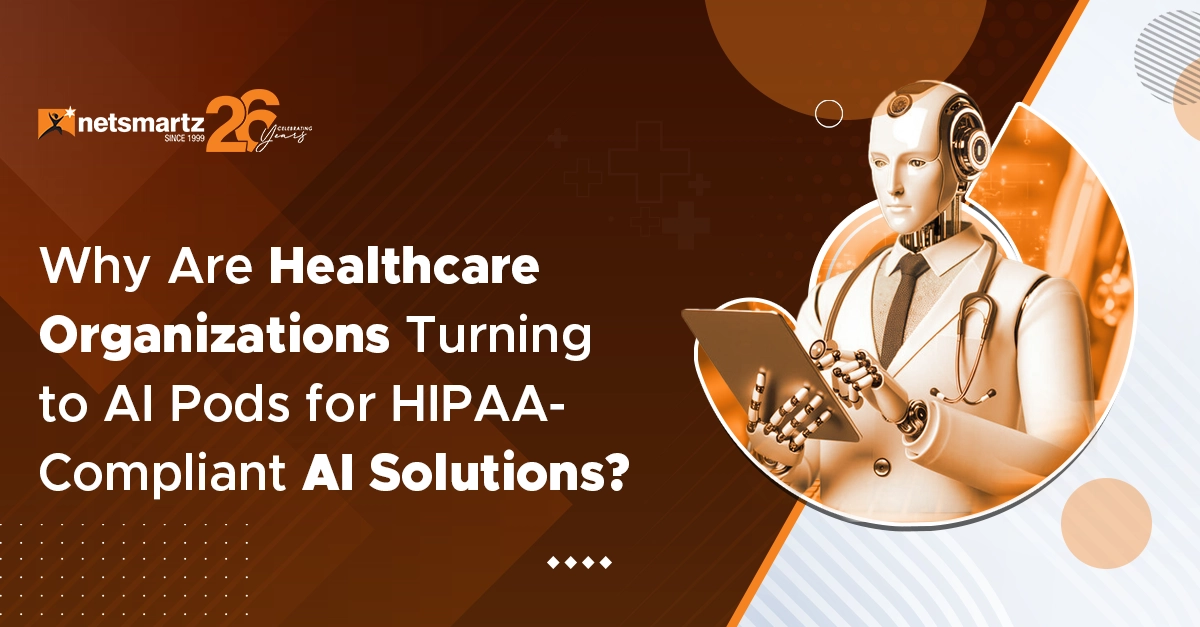
Why Are Healthcare Organizations Turning to AI Pods for HIPAA-Compliant AI Solutions?
- AI adoption in healthcare continues to accelerate as organizations pursue efficiency and better patient outcomes.
- HIPAA compliance is essential when building AI systems that process patient data.
- Custom-built AI tools are often more effective than generic platforms in healthcare environments.
- AI-enabled healthcare platforms can improve diagnostics, automate workflows, and support clinical decision-making.
- For healthcare organizations looking to scale AI responsibly, AI pods offer a focused and efficient development model.
- Dedicated AI pods combine engineering expertise with healthcare domain knowledge to deliver reliable solutions.
Healthcare organizations are sitting on an extraordinary amount of data due to patient records, diagnostic images, clinical notes, treatment histories, and real-time data from connected devices. Hidden within that information are insights that could improve diagnoses, predict disease progression, reduce hospital readmissions, and even save lives. AI promises to unlock that value. Yet for many business leaders, the real challenge isn’t understanding AI’s potential—it’s figuring out how to execute AI without failing.
Here, healthcare AI systems must comply with strict regulations, protect sensitive patient data, integrate with legacy clinical systems, and deliver results doctors can actually trust. That combination of complexity often slows innovation. This is why many healthcare organizations are moving toward a more focused approach: AI Pods—a specifically designed AI team for healthcare companies developing HIPAA-compliant healthcare AI solutions.
Let’s explore why this model is gaining traction across the healthcare ecosystem.
The Growing Momentum of AI in Healthcare
Healthcare industry leaders are no longer arguing over the adoption of AI in the industry; they are more focused on how they can harness the technology for the betterment of the industry. Several factors are showing the significant growth of AI in the industry:
- The global AI healthcare market is expected to exceed $505.59 billion by 2033, growing at a CAGR of 38.90% from 2026 to 2033.
- Studies suggest AI could generate $200–$360 billion annually in cost savings for the U.S. healthcare system by improving efficiency and reducing administrative overhead.
- More than 60% of healthcare organizations are already using AI in some capacity, from revenue cycles to operational analytics.
Despite this enthusiasm, many organizations find that building healthcare AI solutions internally is not straightforward. Healthcare environments are notoriously complex. Systems such as Electronic Health Records (EHRs), imaging platforms, billing infrastructure, and patient portals must all work together.
Introducing AI into this ecosystem requires careful planning, robust security frameworks, and strict adherence to privacy regulations like HIPAA. This is where AI pods for healthcare innovation are proving particularly valuable.
What Are AI Pods for Healthcare?
An AI pod is a small, highly specialized team responsible for developing and deploying a specific AI capability. Unlike traditional project teams that often operate in silos, pods bring together multiple skill sets into one tightly coordinated unit.
A typical AI pod may include:
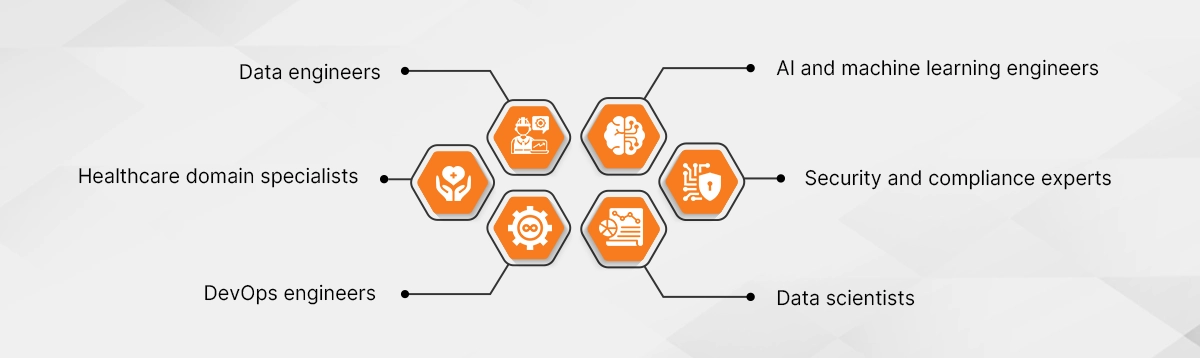
The team works as a focused unit with a clear objective—for example, building a predictive patient monitoring model or developing an AI-powered clinical documentation system. Because pods operate with clear ownership and cross-functional expertise, they can deliver healthcare AI services faster while ensuring regulatory compliance and system reliability.
Case study: Discover how a US-based healthcare provider deployed an AI Pod to streamline patient identification for oncology trials while improving enrollment rates and physician efficiency. Find the full case study here.
Why Are Healthcare Organizations Turning to AI Pods?
Healthcare AI projects are often unsuccessful not because the technology cannot work but because AI execution at scale is fragmented. The reason for the fragmentation is that different teams are responsible for handling different aspects of the AI system. AI pods address this challenge by consolidating expertise and accountability.
Below are some of the primary reasons why healthcare organizations are adopting this approach.
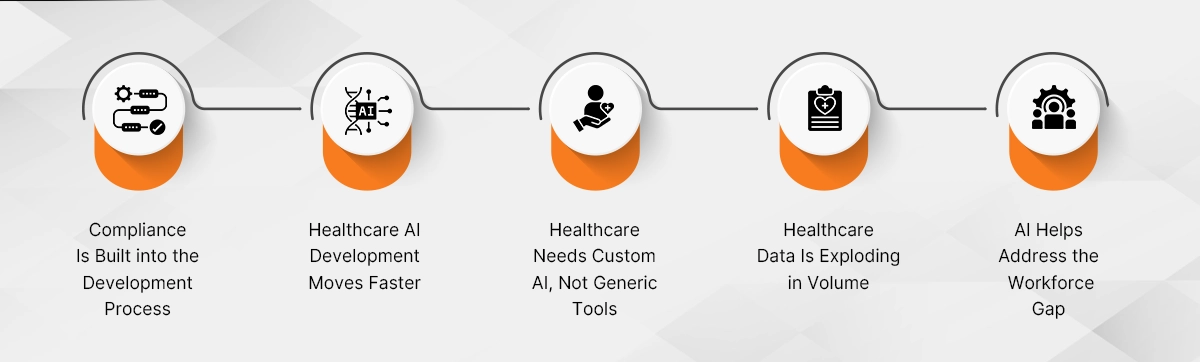
Compliance Is Built into the Development Process
Healthcare data management is not optional; rather, it is mandatory from a legal and ethical perspective. The Health Insurance Portability and Accountability Act (HIPAA), for example, clearly defines the rules that must be followed for the storage, access, and processing of patient data.
An AI system that uses patient data must adhere to these rules. If the rules are introduced too late in the development process, the development team might have to go back and redesign the system, leading to increased costs.
AI pods take a different approach, where compliance specialists work alongside engineers from the very beginning, ensuring the system is designed for HIPAA-compliant workflows. This typically includes:
- Secure data ingestion pipelines
- Encryption of patient data both in transit and at rest
- Access control and role-based permissions
- Data anonymization for AI training
- Detailed audit logs for regulatory review
Healthcare AI Development Moves Faster
Healthcare innovation is hindered by the long development process and the difficulties of coordination between different departments. This is where AI pods help. Since they function in a closed environment, decisions can be made and implemented in no time.
Unlike the traditional scenario, which involves the coordination of different departments, the AI pods move forward in unison. This is the right way of developing AI-enabled healthcare platforms, where rapid experimentation and continuous improvement are essential.
For example, AI-driven clinical documentation tools can reduce administrative workload for physicians by 30–50%, freeing up valuable time for patient care.
Healthcare Needs Custom AI, Not Generic Tools
The healthcare industry is quite diverse. A telemedicine platform catering to the needs of remote patients will be quite different from that of a hospital. A medical imaging company will have different data challenges compared to a health insurance company.
Off-the-shelf AI tools often struggle to adapt to these nuances. Whereas AI pods enable organizations to build custom AI solutions for healthcare providers that reflect real clinical workflows.
Key examples include:
- AI models that analyze radiology scans
- Predictive tools for hospital resource management
- Intelligent triage systems for patient intake
- AI-powered patient engagement assistants
- Automated coding and billing systems
Healthcare Data Is Exploding in Volume
Healthcare organizations produce massive amounts of data, including medical images and electronic health records, as well as information from wearable technology. Estimates indicate that the total amount of data worldwide reached over 175 zettabytes in 2025.
So, it is impossible for humans to manually manage large amounts of data. AI technology is best for analyzing large amounts of data and obtaining insights that humans might not get from the data.
AI pods help organizations design platforms capable of:
- Analyzing patient histories to detect disease patterns
- Predicting potential complications or readmission risks
- Supporting physicians with diagnostic recommendations
- Personalizing treatment strategies based on data insights
-
AI Helps Address the Workforce Gap
Healthcare systems worldwide are facing an acute shortage of medical professionals. According to global health organizations, the industry could face a shortfall of nearly 11 million healthcare workers by 2030. AI is increasingly being used to help bridge this gap.
AI pods help build automation tools that can assist with tasks such as:
- Clinical documentation
- Patient scheduling and triage
- Insurance claims processing
- Medical coding and billing
While AI can’t replace clinicians, it can significantly reduce administrative burdens. By leveraging healthcare AI services and pods, providers can ensure medical professionals spend more time treating patients and less time managing paperwork.
Build Healthcare AI with Netsmartz
At Netsmartz, we help healthcare companies bridge that gap. Our dedicated AI pods bring together data scientists, engineers, and healthcare specialists to design and deploy HIPAA-compliant healthcare AI solutions that align with real clinical workflows. So, whether you’re developing predictive analytics tools, intelligent patient platforms, or advanced automation systems, our teams can help you build secure and scalable AI-enabled healthcare platforms.
Ready to accelerate your healthcare innovation journey?
Explore how Netsmartz AI Pods can help!Frequently Asked Questions
An AI pod is a dedicated team of specialists responsible for designing and implementing healthcare AI solutions. The team typically includes AI engineers, data scientists, healthcare experts, and compliance professionals who collaborate to build secure and scalable systems. .
HIPAA regulations ensure that patient data is protected. Any AI system that processes medical records or health information must follow strict privacy and security guidelines to prevent data breaches and maintain regulatory compliance.
AI pods can develop solutions such as predictive patient monitoring systems, medical imaging analysis tools, automated clinical documentation platforms, patient engagement chatbots, and hospital operations analytics systems.
Because AI pods combine multiple skill sets within one team, they eliminate coordination delays between departments. This allows healthcare organizations to build, test, and deploy AI solutions faster. For more details, feel free to connect with us at +1-888-661-8967 or [email protected].