AI-First Culture
Beyond the Pilot: Why AI Execution Fails and How AI Pods Bridge the Gap
For today’s business leaders, artificial intelligence is no longer optional. The question in the boardroom is not “if” but “when” production-ready AI solutions will be delivered to drive specific business value. However, for most businesses, this is where the journey ends.
The transition from a successful pilot to a trusted, governed, and integrated AI solution in production is filled with unforeseen hurdles. This is the AI execution gap.
Why Do Most AI Initiatives Fail to Scale?
It’s a frustratingly common story: a data science team builds a promising model, initial results look great, but the initiative never translates into real-world impact. Based on our work helping enterprises operationalize AI, the failure isn't typically technological. It’s executional. That's one of the reasons why 95% of generative AI pilots fail.
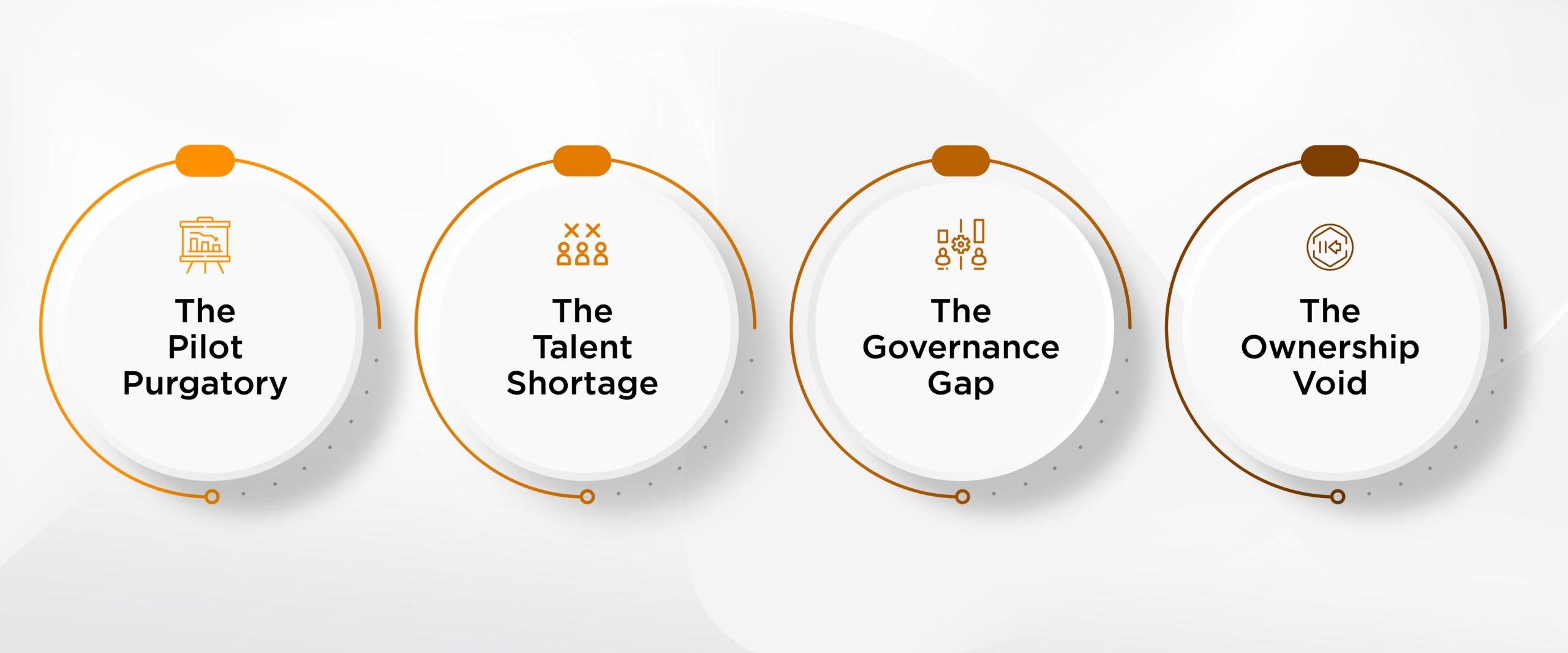
Traditional models for building AI simply don't apply. The challenges are distinct:
Introducing AI Pods: An Outcome-Driven Execution Model
To fill the execution gap, there is a need for a new model of delivery—one that goes beyond resource delivery and focuses on actual outcomes. This is the essence of the Netsmartz AI Pod, a small, self-contained, and cross-functional team that is collectively responsible for the delivery of a production-ready AI capability.
Unlike the traditional staff augmentation approach, where you are essentially managing a group of individual contributors, an AI Pod is a single, integrated delivery unit. It easily integrates with your existing workflows, infrastructure, and teams, taking complete ownership of the outcome from concept to delivery and beyond.
A typical AI Pod includes everything needed to take a project from ideation to live deployment without handoff friction. It usually consists of:
- Dedicated Pod lead
- AI/ML engineers
- Data scientists
- MLOps specialists
- QA experts
How Do AI Pods Address the Core Causes of Failure?
An AI Pod model is specifically designed to solve the very problems that derail most AI initiatives. The result? Organizations working with AI Pods consistently report faster time-to-value, reduced rework, and a significant improvement in AI accuracy and reliability.
| Common AI Challenge | How the AI Pod Model Fixes It |
|---|---|
| AI stuck in PoC cycles | Production-first mindset: Pods are built and optimized for their ability to provide live, integrated AI, rather than just demo-ware. |
| Shortage of full-stack AI talent | Dedicated, cross-functional team: You immediately have access to a full team of experts, removing the delay of hiring. |
| Integration complexity | Native integration: Pods are built to integrate with your current tech stack, data flows, and CI/CD pipelines from day one. |
| Governance & compliance gaps | Built-in enterprise controls: Security, audit trails, and compliance (HIPAA/SOC 2) are integrated into the workflow from day one. |
| Slow decision cycles & no clear ownership | Outcome-owned delivery: A pod lead is assigned as a single point of accountability, ensuring alignment with your objectives. |
Why Are Businesses Turning to AI Pod Solutions?
The adoption of AI Pod solutions isn’t a trend but rather a reaction to the realities of business. Business leaders are recognizing that the traditional approach to building AI (hiring isolated data scientists, embarking on open-ended pilots, or treating AI as a pure R&D play) is simply not providing ROI quickly enough.
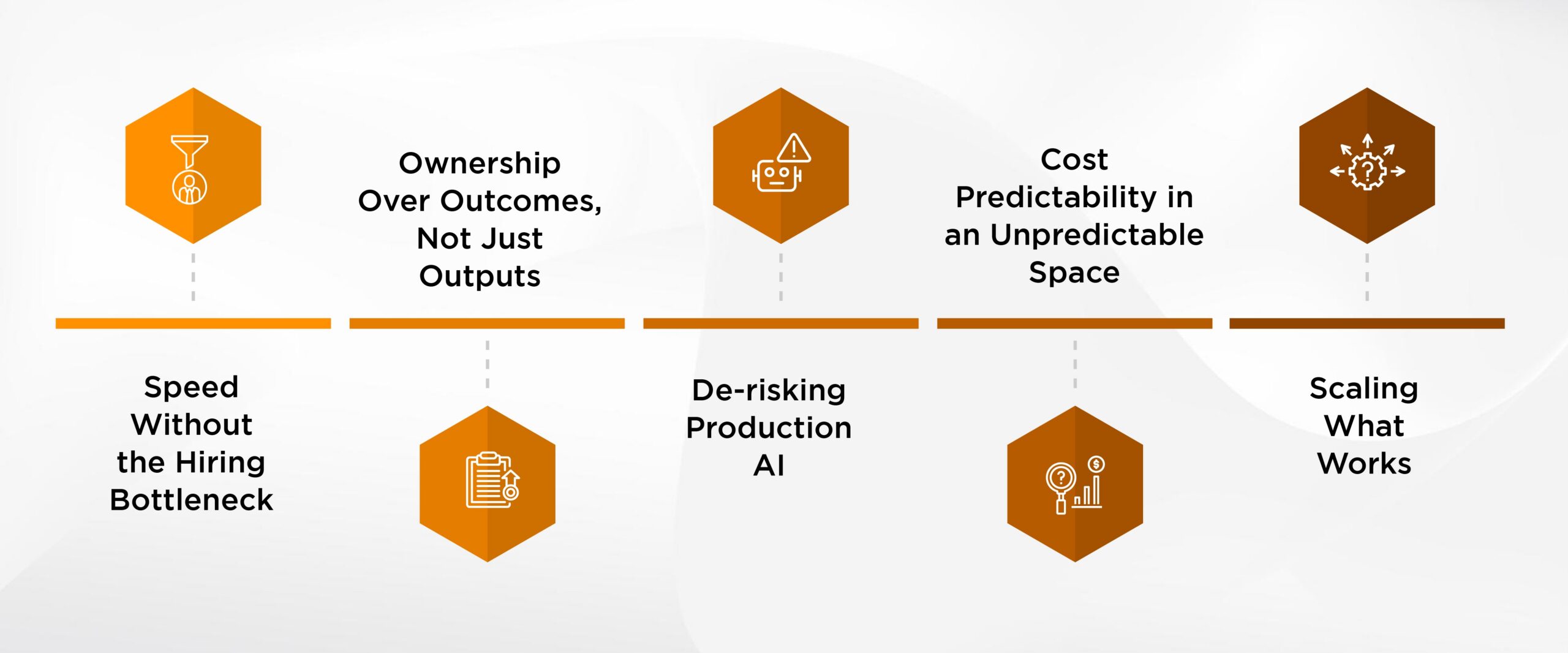
Here’s why many businesses are making the switch to AI Pods:
Speed Without the Hiring Bottleneck
The war for AI talent is real. It can take 6–9 months to recruit, hire, and ramp a single senior AI engineer. Businesses turning to AI Pods bypass this entirely. They gain an instant, integrated team that is operational from day one, delivering production-ready AI in weeks, not quarters.
Ownership Over Outcomes, Not Just Outputs
In a traditional staffing model, you track hours logged or lines of code written. With an AI Pod, you own a business outcome. The Pod is structured, staffed, and incentivized to deliver a working, integrated AI capability—not just a model that works on a laptop. This shift from activity to accountability is a primary driver for CTOs and CIOs.
De-risking Production AI
The hardest part of AI isn't building a model; it's getting it into production safely. AI Pods for SaaS embed governance, MLOps, and security practices from day one. This means fewer surprises during compliance reviews (like SOC 2 or HIPAA audits) and a dramatically lower chance of the initiative stalling right before launch.
Cost Predictability in an Unpredictable Space
AI initiatives are notorious for budget overruns. The experimental nature of AI makes fixed-bid projects difficult. The AI Pod model offers a solution: predictable, fixed-scope execution. Businesses know what they are spending, what they are getting, and when they will get it. This financial clarity is a powerful draw for CFOs and executive stakeholders.
Scaling What Works
After the first successful use case from an AI Pod, the model can be copied. Companies are not stuck with one experiment. They can launch new Pods for other departments, use cases, or regions, making it a repeatable and scalable engine for AI innovation across the entire company.
Netsmartz recently helped a SaaS company operationalize AI initiatives using dedicated AI Pods, bringing structure, speed, and accountability to its AI roadmap. View the case study.
Navigating Your AI Execution Roadmap
Transitioning to a pod-based model requires a strategic first step. It begins not with coding but with assessment. Understanding your organization's AI readiness—your data infrastructure, your team's capabilities, and your highest-impact use cases—is critical to de-risking the journey.
For a CTO, CIO, or Head of AI, the choice of execution model is a strategic one. Continuing with fragmented, project-based AI work is a business risk. It leads to technical debt, security vulnerabilities, and missed market opportunities.
Adopting an AI Pod model means choosing a scalable, governed, and predictable path to AI-powered transformation. It's about treating AI delivery with the same rigor as your core software development, ensuring that every investment in AI drives tangible, long-term value.
Seeking a deeper framework on AI execution, we are hosting a CXO discussion on how leading enterprises structure their AI execution roadmap. Access this executive briefing now.
In Conclusion
The enterprises that will shape the next decade are not the ones with the most AI experiments. They are the ones who have achieved mastery in the art of AI execution. They develop the operational strength to deliver AI intent safely and quickly to business impact. By using models such as AI Pods, you are no longer at risk of stalled pilots and are poised to unlock the full transformative power of AI—reliably, responsibly, and at scale. Ready to explore how an AI Pod can help you close your specific execution gap?
Frequently Asked Questions
An AI Pod is a small, autonomous, cross-functional team accountable for delivering a specific production-ready AI outcome. Traditional models provide individual resources that you must manage and integrate. Whereas, an AI Pod operates as a self-contained unit with its own lead, owns the end-to-end delivery, and is measured by successful deployment—not hours worked.
AI Pods are versatile and have been successfully deployed across a wide range of applications, including:
- RAG & Intelligent Knowledge Systems
- AI Assistants & Copilots
- Semantic Search & Discovery Engines
- Task-Oriented AI Agents
- AI Operations & Monitoring
Yes. The architecture is scalable. After proving the concept with an initial pod, organizations can replicate the architecture by creating additional pods for different products, workflows, or business units. This enables a repeatable and governed AI execution environment across the enterprise.