AI-First Culture
Managed Detection and Response (MDR): How It Works, Key Components, and When You Need It
Cyber threats today are faster, stealthier, and increasingly automated. Most organizations don’t fail because they lack security tools; they fail because they cannot detect and respond on time.
This is precisely where managed detection and response becomes a strategic necessity, not just a security add-on.
For organizations evaluating security maturity, the real question isn’t whether you need a managed detection and response service; it’s whether your current setup can detect, investigate, and contain threats before they escalate.
What is Managed Detection and Response (MDR)?
Managed Detection and Response is a cybersecurity service that combines advanced threat detection technologies with human-led investigation and response.
Unlike traditional tools, MDR services don’t just generate alerts—they actively validate, investigate, and respond to threats in real time.
This is a critical distinction. Most enterprises already have security tools in place. What they lack is continuous monitoring, skilled analysts, and a rapid response capability.
How Managed Detection and Response Works
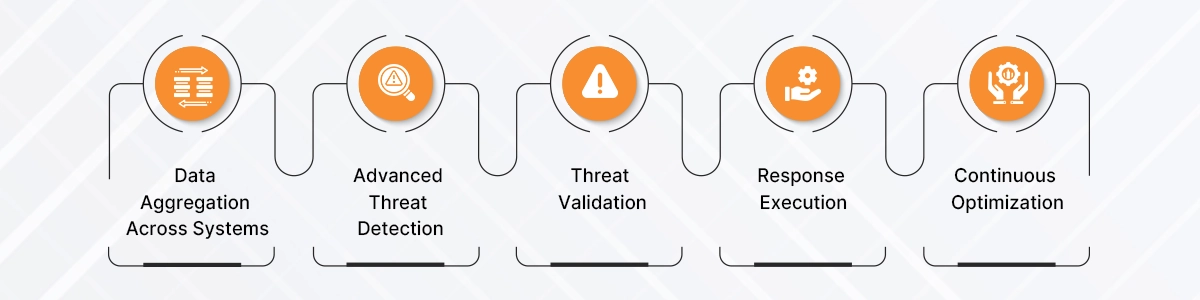
A mature managed detection and response service operates as a continuous lifecycle:
Data Aggregation Across Systems
Signals are collected across endpoints, networks, cloud environments, and identities. This includes capabilities like managed endpoint detection and response and managed network detection and response.
Advanced Threat Detection
Behavioral analytics and threat intelligence identify anomalies that traditional systems miss.
Threat Validation
Security experts investigate alerts to eliminate false positives and confirm real threats.
Response Execution
Once validated, response actions are taken—isolating systems, blocking access, or neutralizing threats.
Continuous Optimization
Detection models improve over time, strengthening your overall security posture.
Key Components of MDR Services
Not all MDR providers deliver the same level of capability. Strong Managed detection and response offerings include:
- Endpoint Visibility via Managed Endpoint Detection and Response
- Network Monitoring through Managed Network Detection and Response
- Unified Detection with Managed Extended Detection and Response
- 24/7 SOC Operations
- Threat Intelligence Integration
- Human-Led Incident Response
Where Most Security Setups Fall Short
Most organizations don’t lack security tools; they lack the ability to act on what those tools surface. Alerts are generated constantly, but very few are properly investigated, leading to fatigue and missed threats.
This creates a false sense of security where activity is visible but not controlled. Many threat detection and response solutions stop at detection, leaving response dependent on already stretched internal teams.
The bigger issue is fragmentation. Endpoint, network, and cloud signals operate in silos, making it difficult to connect the dots across an attack lifecycle. As a result, even when threats are identified, the response is delayed or inconsistent.
This gap between detection and action is where Managed detection and response become critical; it ensures threats are not just seen but actively handled.
Where Do You Actually Need MDR?
Organizations typically realize the need for Managed detection and response when their internal teams can no longer keep up with alerts or respond with confidence.
As environments grow more complex, especially with hybrid and cloud adoption, visibility gaps increase, and response times slow down. At this stage, relying on disconnected tools or limited resources starts to introduce real risk.
The need becomes more urgent when businesses cannot clearly answer how quickly they can detect and contain a threat. This is where a unified managed detection and response service, supported by capabilities like managed endpoint detection become essential.
How to Evaluate MDR Providers
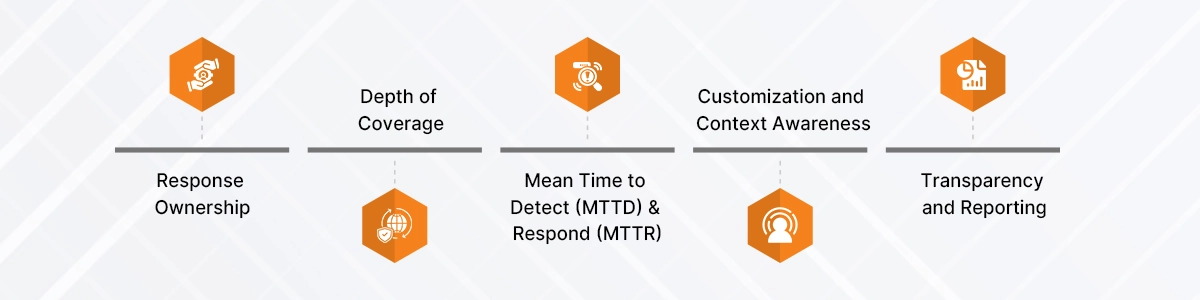
If you’re actively evaluating MDR providers, this is where decisions are won or lost. Most buyers make the mistake of comparing features instead of response capability. Use this framework instead:
Response Ownership
Do they:
- Only notify your team?
- Or actively contain and remediate threats?
A true managed detection and response service should reduce your team’s workload, not add to it.
Depth of Coverage
Ensure the provider supports:
- Managed Endpoint Detection and Response
- Managed Network Detection and Response
- Managed Extended Detection and Response
Partial visibility = incomplete security.
Mean Time to Detect (MTTD) & Respond (MTTR)
Ask for actual benchmarks, not marketing claims. If a provider cannot clearly articulate response timelines, that’s a red flag.
Customization and Context Awareness
Generic detection models create noise. Strong MDR services adapt to your environment and business context.
Transparency and Reporting
You should have clear visibility into:
- Incidents detected
- Actions taken
- Risk posture improvements
Conclusion
If your current security approach is reactive, tool-heavy, and resource-constrained, you’re already operating at a disadvantage.
Managed detection and response transforms security from a fragmented function into a continuous, intelligence-driven operation.
The real ROI of MDR services isn’t just threat detection; it’s risk reduction at speed and scale.
If you are looking for an ideal Azure migration service partner, you need to look beyond migration expertise. Try to collaborate with a partner that helps minimize operational risks, secures up-time, and ensures long-term cost optimization.
Ready to partner with MDR Provider
Connect us todayFrequently Asked Questions
A managed detection and response service provides continuous monitoring, threat detection, investigation, and active response through a combination of advanced tools and expert analysts.
MDR services reduce risk by detecting threats early, validating them quickly, and responding in real time, minimizing potential damage and reducing dwell time.
Managed extended detection and response expand MDR by integrating data from endpoints, networks, cloud, and identity systems for more comprehensive threat visibility.
Yes. MDR providers offer enterprise-grade security capabilities without requiring organizations to build and manage their own SOC.
When evaluating MDR service companies, focus on response capability, coverage across systems, transparency, and measurable detection and response performance.