 AI-First Culture
Trusted Enterprise AI: Building an AI-Ready Foundation on Salesforce
"The success of AI is not determined by the intelligence of the technology, but by the strength of the foundation behind it."
In MENA, corporate leaders have transitioned from debating the merits of AI investment to determining the ways of implementing the technology in their work practices. In UAE, banks, telecom businesses in Saudi Arabia, and retail enterprises in Gulf economies are currently experimenting with such solutions as Agentforce and Salesforce Data Cloud to increase efficiency. However, simply introducing AI technology does not make one ready for it, which is where the majority of AI implementation failures take place.
Why AI Initiatives Stall Even After Investing in Salesforce
There's a common assumption that AI readiness comes bundled with Salesforce itself. It doesn't. Owning a CRM is not the same as having clean, connected, governed data feeding it. A few issues tend to show up again and again, no matter the industry:
- Incomplete or duplicate customer records across regions
- Data silos separating sales, service, and marketing teams
- Manual processes that AI simply cannot speed up on its own
- Weak integration between Salesforce and other enterprise systems
- No clear owner for AI-related decisions and outcomes
A Gulf-based logistics firm ran into this directly. A lead-scoring pilot underperformed, not because the model was weak, but because customer records across three regional systems flatly disagreed with each other. AI does not fix organizational gaps on its own. It tends to make them louder.
The New Competitive Advantage: An AI-Ready Salesforce Ecosystem
Businesses across MENA are using AI to accelerate sales cycles, personalize interactions, and support faster decisions. But the companies actually pulling ahead usually aren't the ones running the most AI tools. They're the ones with a disciplined foundation sitting underneath, built before any agent gets deployed into a live environment.
What separates the two groups is fairly consistent: The advantage of possessing reliable and synchronized client information, effective communication systems, preserved processes, and an efficient governance framework . The benefits include quick response times and stable customer services in various locations. To put it plainly, the advantage was never AI itself, but what lies behind it.
Four Foundations of Trusted Enterprise AI
A Trusted Enterprise AI Harness across a Salesforce environment rests on four connected pillars. Skip one, and it tends to surface later as inconsistent AI behavior or low user trust.
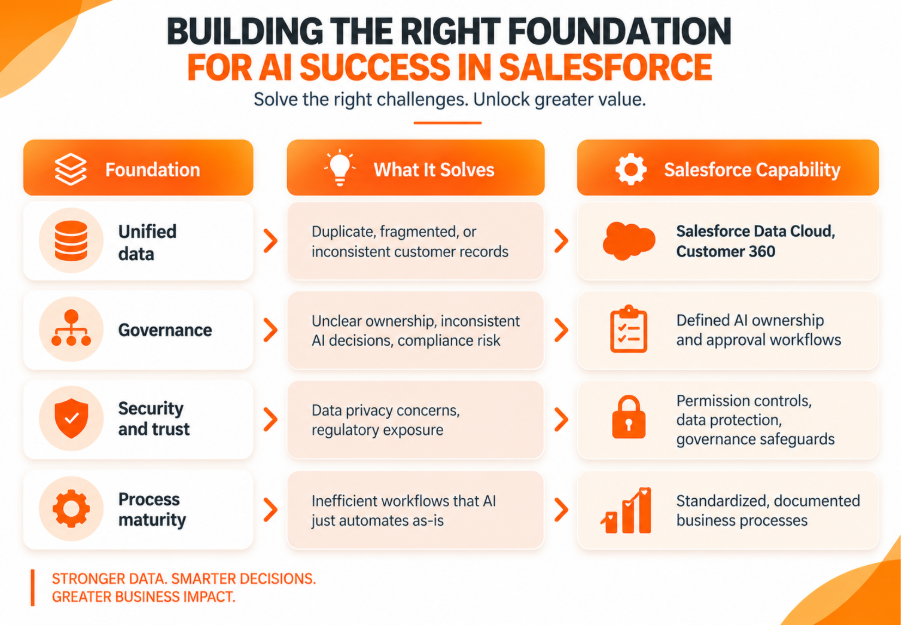
Unified data
- AI is only as accurate as the data behind it, so duplicate records and fragmented sources weaken recommendation quality no matter how advanced the model is.
- Salesforce Data Cloud and Customer 360 bring customer fragments into one real-time view, which is especially important across MENA operations spanning multiple markets and languages.
- As per McKinsey, 44 percent of organizations now report that AI is scaling across the enterprise, up from 38 percent a year earlier; unified data is often what separates the two groups.
Governance
- Without clear rules for AI ownership, approval, and auditability, organizations risk inconsistent outcomes and compliance exposure.
- This is especially important as data regulation continues to move quickly across MENA markets.
- Salesforce AI governance structures give teams a defined way to manage risk without slowing down legitimate AI use cases.
Security and trust
- Built-in permission controls and data protection safeguards help keep AI interactions secure and governed within the platform.
- These controls help employees act on AI output with more confidence instead of second-guessing every recommendation.
- Trust becomes practical when security, privacy, and access governance are built into the same environment where AI decisions are made.
Process maturity
- AI performs only as well as the process it sits on.
- An inefficient lead-qualification workflow, automated as-is, simply produces inefficiency faster.
- Standardizing the process first allows automation to reduce effort instead of relocating the same problem downstream.
How Connected Salesforce AI Capabilities Deliver Greater Value Together
Salesforce AI delivers stronger outcomes when data, automation, and decision-making work together as one connected environment rather than as separate tools or isolated initiatives.
- A shared data foundation helps teams work from a more complete and consistent customer view.
- AI capabilities become more useful when they are connected to real business workflows instead of operating in isolation.
- Automation creates greater value when it reduces manual handoffs, improves response times, and supports more consistent customer experiences.
- High CRM adoption across teams, not just one department
- Clean, consistent customer data across regions
- Connected enterprise systems rather than isolated silos
- Strong security controls and defined compliance requirements
- Clearly scoped, business-specific AI use cases
- Executive sponsorship that reaches beyond IT
- A working governance framework already in place
- Alignment between business teams and the Salesforce Center of Excellence
- Data readiness: fragmented records, integration gaps, and inconsistent quality limit how confidently AI can support decisions.
- Governance maturity: undefined ownership, unclear approval paths, and weak accountability make it harder to scale AI responsibly.
- Technology direction: disconnected priorities and an unclear roadmap can slow down high-value Salesforce AI use cases.
- Organizational adoption: change resistance, process gaps, and skills shortages often keep AI pilots from becoming business-wide capabilities.
As per Gartner, 84 percent of respondents in its 2026 CIO and Technology Executive Survey expect their enterprise to increase generative AI funding this year, which makes getting this layering right more urgent, not less.
Signs Your Organization Is Ready to Scale AI
Before scaling further, it helps to check a few signals together rather than any one in isolation:
Readiness was never just about the technology stack. It depends just as much on people and process maturity, and on how far customer data has actually been unified behind the scenes.
Where Most Organizations Need Help
Even organizations with strong Salesforce investments often discover that the real barriers to AI scale are not tool-related. They sit deeper in the operating model, where data, governance, technology direction, and adoption need to work together.
That is where a partner like Netsmartz can add measurable value. By combining Salesforce consulting, data strategy, integration expertise, and change enablement, we helps organizations move beyond isolated pilots and build an AI-ready Salesforce foundation that can scale across markets, teams, and compliance environments.
A Practical Roadmap to Becoming AI-Ready
This approach tends to resemble one that is often seen in most companies. Begin with an honest assessment of the data's current quality, integration, and governance maturity level. Next, coordinate the data so that a common view of the customers can be created through Salesforce Data Cloud, given that almost everything depends on this step. After this, implement some high-value use cases, such as service automation or sales support, and only then scale successful initiatives to other groups and customer flows.
Conclusion: AI Success Depends on What You Build Before Deployment
AI offers genuine possibilities in the areas of sales, services, marketing, and operations. Nevertheless, the tools were not the deciding factor. Rather, factors such as reliable data, clear governance, well-established security, and mature processes determine whether your AI initiatives will take off or fail. Organizations that build this foundation now will get better benefits from Agentforce and Salesforce Data Cloud in the future. Whether this is your first time looking into the use of AI, or if you have already implemented some initial initiatives, assessing your Salesforce AI platform readiness is the first practical action you need to take to get measurable results.
Prepare Salesforce for Trusted AI
Assess your data, governance, security, and processes to build an AI-ready foundation designed for scalable business impact.
Assess Your AI ReadinessFAQs
Having reliable data, integrated systems, established governance framework, strong security measures, and specified use cases that work together and not only using the technology.
The process of AI is the use of company data for generating reports, which means that any errors in data in terms of duplication will lead to inaccurate or wrong recommendations.
Data Cloud plays the role of the source of customer data, as it collects information from multiple sources, thus creating a complete picture of the customer for AI purposes.
They help in creating security measures for data and following authorization practices.
team should consider working on repetitive tasks that can be measured in terms of their business efficiency, such as summary creation or qualification of a lead.
Issues with data quality, broken systems, lack of governance, and undefined ownership cause the most trouble when scaling. In fact, the technology is actually the least problematic aspect of AI scaling.
Ready to build smarter? Let's talk.
Our experts are ready to help you turn ideas into production-ready AI, cloud and digital solutions.
Get In Touch →Let's Discuss Your Growth Strategy
Let's discuss how we can help you accelerate growth, improve efficiency, and drive real business outcomes.