 AI-First Culture
Claudeforce Explained: How Salesforce and Anthropic Are Shaping Enterprise AI
"When enterprise data meets intelligent reasoning, AI moves from answering questions to driving governed action."
On August 26, 2026, Salesforce and Anthropic announced Claudeforce, an expanded partnership bringing Claude's reasoning directly into the Salesforce platform. Claude becomes a default reasoning model across Salesforce, while Salesforce becomes accessible from inside Claude through a new plugin called Salesforce in Claude.
Marc Benioff called it a fusion of the world's number one AI and number one CRM, where the interface itself becomes intelligent. Dario Amodei added that companies can now point Claude at the business context they have already built inside Salesforce for years.
What Exactly Is Claudeforce
Claudeforce is the name Salesforce and Anthropic gave their expanded partnership, built to merge Claude's reasoning with Salesforce's trusted enterprise data, workflows, and governance. The partnership exists because intelligent reasoning alone cannot run a business, and structured enterprise systems alone cannot reason on their own. Together, they turn real-time judgment into governed, enterprise-ready action.
Worth noting: this isn't Claude's first appearance in Agentforce. Claude has been available there as a model option since late 2025. What Claudeforce changes is scope and defaults - Claude becomes the default reasoning model across several core surfaces, and a new plugin brings Salesforce itself into the Claude interface for the first time.
It also didn't appear out of nowhere - it builds on Headless 360, announced earlier in 2026, which exposed Salesforce's data, workflows, and business logic as APIs, MCP tools, and CLI commands. Claudeforce is, in large part, the governed, enterprise-ready packaging of plumbing that was already being built.
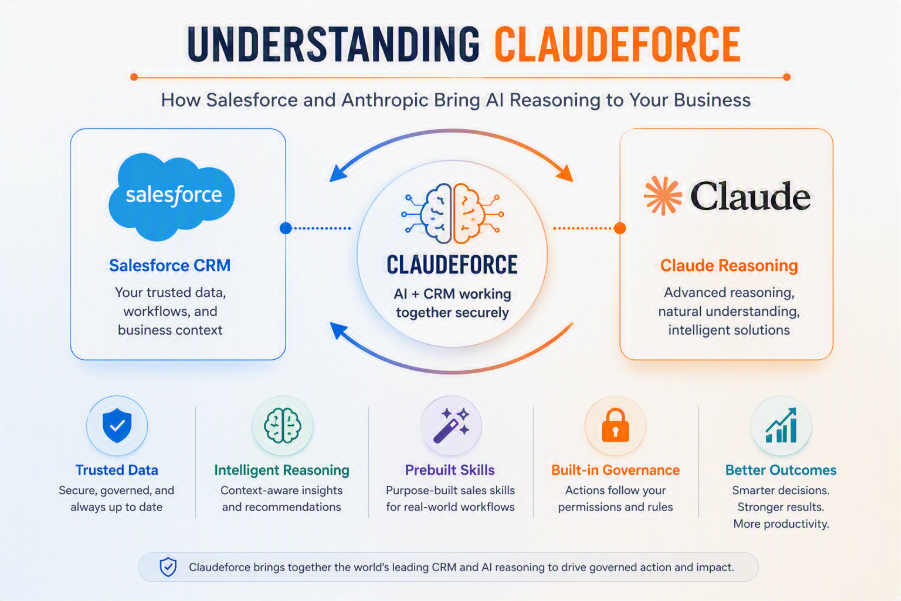
Claudeforce vs. Agentforce vs. Salesforce in Claude: What's the Difference?
These three names are already getting used interchangeably, and that's causing confusion. They're not the same thing.
| Name | What It Is | Where the Work Happens | Status |
|---|---|---|---|
| Claudeforce | The partnership itself — the umbrella term covering everything below | Everywhere | Announced Aug 26, 2026 |
| Agentforce | Salesforce's agent-building platform, now using Claude as a reasoning model | Inside Salesforce | Live |
| Salesforce in Claude | A plugin bringing your CRM into Claude, with 37 prebuilt sales skills | Inside Claude | Pilot now; open beta Sept 2026 |
The simplest way to hold it: Agentforce is your agents working inside Salesforce. Salesforce in Claude is your people working inside Claude, with Salesforce behind them. Claudeforce is the agreement that makes both possible.
What Salesforce in Claude Actually Does
The plugin ships with 37 prebuilt sales skills covering meeting preparation, deal health review, and pipeline review. It was engineered specifically for how sellers work, not as a generic add-on. A few design choices shape what this looks like day to day for a sales team:
- Purpose-built skills. Engineered to draw on Claude's reasoning and agentic tool use, not generic prompts wrapped around a CRM API.
- Automatic onboarding. The plugin reads a seller's context across Salesforce, Slack, and other connected tools, then generates a live dashboard without manual setup.
- Governed actions. Every action routes through Salesforce, so existing permissions and business rules apply automatically, with no separate access model to configure.
- One-time setup. An admin connects the plugin at the org level, and every user's access is scoped to permissions that already exist, so individual sellers do not need separate onboarding.
- Interactive, generated views. Dashboards are assembled dynamically from live data rather than built once and left static, so what a seller sees stays current without manual refreshes.
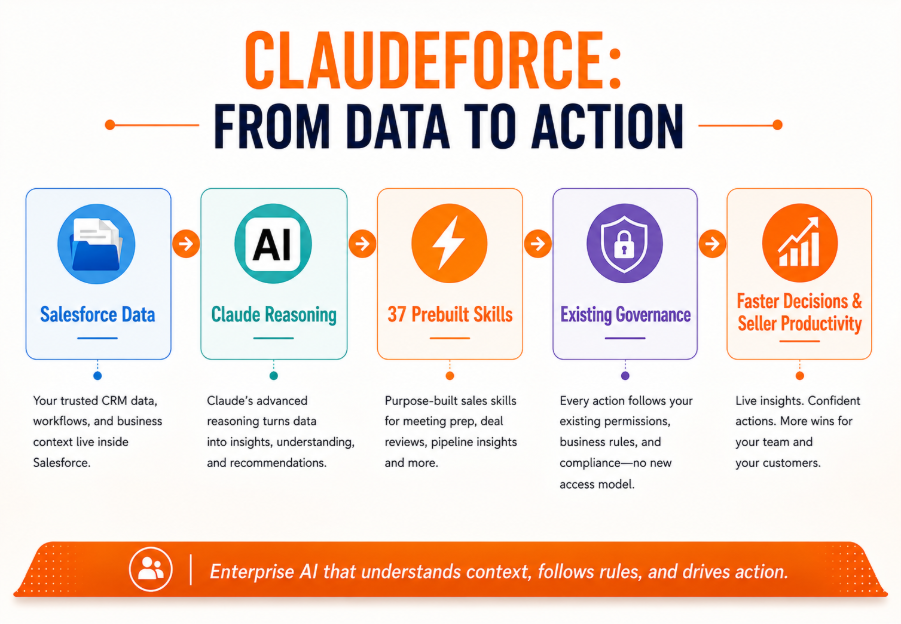
How the Architecture Actually Works
Underneath the product name, Salesforce in Claude runs on Model Context Protocol (MCP) - the open standard, introduced by Anthropic in late 2024, that lets an AI model discover and call a specific, permissioned set of tools instead of being handed raw credentials. Claude doesn't get a blanket connection to your org - it gets a small, deliberate surface: search for the right operation, read its specification, then call it.
Two connection routes matter here, with different security postures. Salesforce Hosted MCP Servers (what Salesforce in Claude runs on) use per-user OAuth - every call executes as the actual person making the request. Claude Tag's Slack-based connection uses an OAuth 2.0 client-credentials flow with a dedicated integration user instead - the credential belongs to the agent, not to any one person. Worth knowing before you scope a pilot, since it changes who's accountable in your audit trail.
Where Claude Shows Up Across the Platform
Claudeforce is not limited to the sales plugin. It touches three distinct parts of the Salesforce ecosystem, each with its own role:
- Inside Salesforce. Claude is the default reasoning model for the Atlas Reasoning Engine, Agentforce Vibes, and Agentforce Coworker, and is selectable directly in Agent Builder for teams that want model flexibility.
- Inside regulated environments. Claude runs through Amazon Bedrock within the Salesforce Trust Boundary, keeping inference inside Salesforce's existing security perimeter rather than routing outside it.
- Inside Slack. Claude now powers Slackbot by default, along with Claude Tag for team collaboration and Slack Code for multiplayer development work.
Internally at Salesforce, the Claude-powered Slackbot has been tied to roughly 8.1 million hours of annualized productivity gains, growing more than twofold quarter over quarter. That internal number matters because it reflects real usage inside Salesforce itself, not a projection aimed at customers, and it gives an early signal of what this pairing can do once it reaches a wider audience.
Is Our Salesforce Data Safe if We Connect It to Claude?
This is the first question any CIO will ask, and it deserves more than "governance is built in."
Because every action routes back through Salesforce, an agent operating on a user's behalf inherits that user's existing access. Your sharing model becomes your AI access-control model. That's reassuring if your sharing model is clean, and a real exposure if it isn't - a messy org has historically gotten away with that because a human absorbed the confusion. An agent won't; it reasons over whatever it's given, faithfully and at speed, and acts on the conclusion.
A few practical realities worth knowing before you pilot:
- Writes still trigger your existing automation. Validation rules, Flows, and Apex triggers all fire exactly as they always have, and the same governor limits apply — an agent updating 200 opportunities at once can trip the same limits a Data Loader job would.
- Over-provisioned permission sets become a real risk once they sit behind an agent that can traverse an edge case in milliseconds instead of a human rarely stumbling into it.
- Zero data retention has been committed across the Claude models used here, with more controls around data residency and access review reportedly in joint development.
Should You Pilot Claudeforce Now?
Most organizations fall into one of three buckets:
Pilot now if your org is on a recent API version, your permission sets are reasonably well-maintained, and you have a clear revenue-ops use case where inconsistent manual process is already costing real time. Start read-only, with a small cohort.
Prepare first if your org has permission sprawl, unaudited profiles, or legacy automation nobody fully trusts. The right first move isn't connecting an AI agent - it's a data and permissions audit.
Wait and observe if your use case sits outside Sales (the initial 37 skills are sales-only), or your org is mid-migration on something unrelated where adding a beta-stage integration would add too many moving parts to troubleshoot cleanly.
Risks Worth Naming
- Costs are usage-based, not zero.
- Pricing is tied to consumption rather than per-seat licensing — instrument actual token usage before committing to a wider rollout.
- Shadow IT can creep back in. If individual teams stand up their own MCP connections alongside the official, governed plugin, you can quietly recreate the integration sprawl this architecture was built to eliminate. Decide who owns the connector list before the first pilot.
- Beta means beta. The plugin, the underlying MCP server, and Claude Tag are all at pilot or beta maturity. A mission-critical, quarter-end revenue process isn't the right first candidate.
No pricing or packaging has been disclosed. If you're building a business case this quarter, model the readiness work - which you control and which has standalone value - rather than a license cost you can't yet know.
What This Means in Practice: A Partner's View
At Netsmartz, we work inside Salesforce orgs every day, and Claudeforce reflects problems we already help clients solve. A few common scenarios illustrate why this shift matters to teams beyond the announcement itself:
- A sales team losing an hour each morning to manual prep. Reps reconstruct deal status from emails, activity logs, and scattered notes before making a single call. A live, auto-generated pipeline view removes that reconstruction step entirely, which is the same principle we apply when configuring Agentforce dashboards for clients today.
- Inconsistent pipeline reviews across a growing team. When every rep interprets "deal health" differently, forecasting accuracy suffers and leadership loses confidence in the numbers. Skill-based reasoning that applies the same logic across every seller keeps reviews consistent regardless of who runs them.
- Concerns about AI touching sensitive CRM data. Enterprises reasonably ask what stops an agent from overstepping its boundaries. An approach where every action inherits the user's existing Salesforce permissions, rather than introducing a separate access model, is standard practice we apply on every Agentforce deployment we run.
- Slow onboarding for new hires joining the sales floor. New reps typically need weeks to understand account history and pipeline context. Automatically generated dashboards that assemble that context on day one shorten this ramp-up considerably.
None of this requires Claudeforce specifically to be useful advice. It reflects how AI should be layered onto production business data generally, and it is the same discipline our team brings to every Salesforce engagement, regardless of which AI model sits underneath it.
How to Get Your Org Ready
Work you can start this week, none of which is wasted if the timeline slips:
- Audit account and product data for duplicates and fragmentation, starting with your highest-revenue accounts.
- Document your sharing model and remove exceptions you can't justify.
- Move business rules out of spreadsheets and into the platform - anything ungoverned there, an agent won't enforce.
- Decide your action boundaries - unattended, human-confirmed, or off-limits — before you need to.
- Pick one workflow and define what good looks like, with a baseline measurement before you start.
Our Takeaway
Claudeforce is still early. The plugin is in pilot, the open beta is weeks away, and the skill catalog will keep expanding through 2026. What is already clear:
- Sellers get context assembled automatically instead of hunting for it across scattered tools.
- Actions stay governed by rules that already exist in the org, with no new permissions model to build.
- Setup effort sits with one admin, not every individual user, which shortens time to value.
- The direction points toward AI becoming part of the core CRM workflow rather than a separate layer bolted on top.
That's a meaningful shift in how CRM-driven AI gets adopted at scale. We'll be following the September beta closely and sharing what we learn.
Frequently Asked Questions
A strategic partnership combining Claude's reasoning with Salesforce's data, workflows, and governance.
A plugin with 37 prebuilt sales skills that lets sellers act on live Salesforce data from within Claude.
It is in pilot now, with open beta expected in September 2026.
Salesforce and Anthropic, announced jointly on August 26, 2026.
Yes, Claude powers the Atlas Reasoning Engine, Agentforce Vibes, and Agentforce Coworker.
Yes, Claude is the default model across Slack, including Slackbot and Claude Tag.
Yes, additional prebuilt skills are expected to launch in late 2026.
Yes, through Amazon Bedrock inside the Salesforce Trust Boundary.
Every action inherits the user's existing Salesforce permissions automatically.
Our Agentforce practice already applies the same governed, context-first principles Claudeforce is built on.
Ready to build smarter? Let's talk.
Our experts are ready to help you turn ideas into production-ready AI, cloud and digital solutions.
Get in touch →Let's Discuss Your Growth Strategy
Let's discuss how we can help you accelerate growth, improve efficiency, and drive real business outcomes.