 AI-First Culture
What Microsoft's Leader Placement in IDC's AI-Enabled ERP MarketScape Means for Buyers
IDC has put Microsoft in the Leaders category of its 2026 MarketScape for AI-enabled ERP. The announcements went out fast, and nearly all of them stop at the logo. That's a shame, because the report has more to offer buyers than the ranking does.
So here's a different read. What follows is split into what IDC concluded, what Microsoft says about its own products, and the questions neither of them can answer for you. If you're putting together an ERP shortlist this year, that last pile is the one worth your time.
What IDC actually evaluated
The report is called IDC MarketScape: Worldwide AI-Enabled Operational ERP 2026 Vendor Assessment (IDC #US54134726, September 2026). Pay attention to the word "operational." IDC is looking at ERP for product-centric companies, meaning manufacturers, distributors and retailers, where orders, assets, production and supply chain data flow straight into the general ledger. To make the cut, vendors needed that type of ERP, AI in the product or a believable plan for it, recent wins that called for AI, and global support.
Each vendor lands on two axes. Up and down is Capabilities, which covers what the vendor delivers today. Left to right is Strategies, which covers how well its plans for the coming three to five years line up with what buyers will want. Bubble size shows market share in the segment. One caveat comes from IDC itself: the weightings and scores are its analysts' judgment, shaped by interviews and surveys. So it's a well-researched opinion.
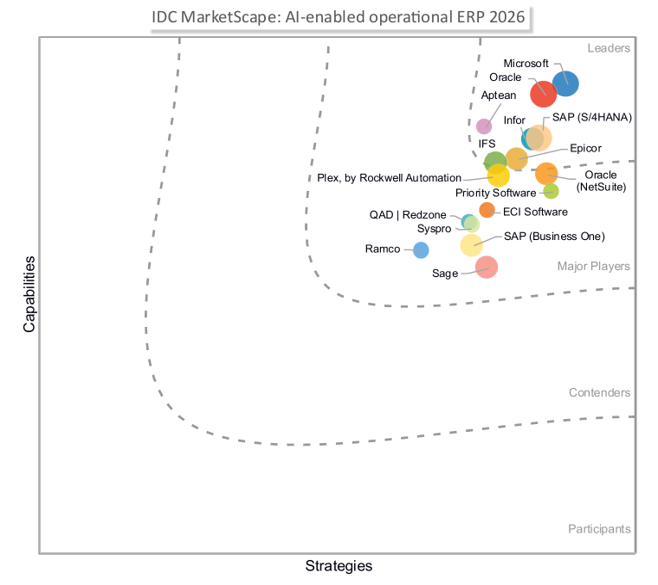
IDC MarketScape: Worldwide AI-enabled operational ERP vendor assessment.
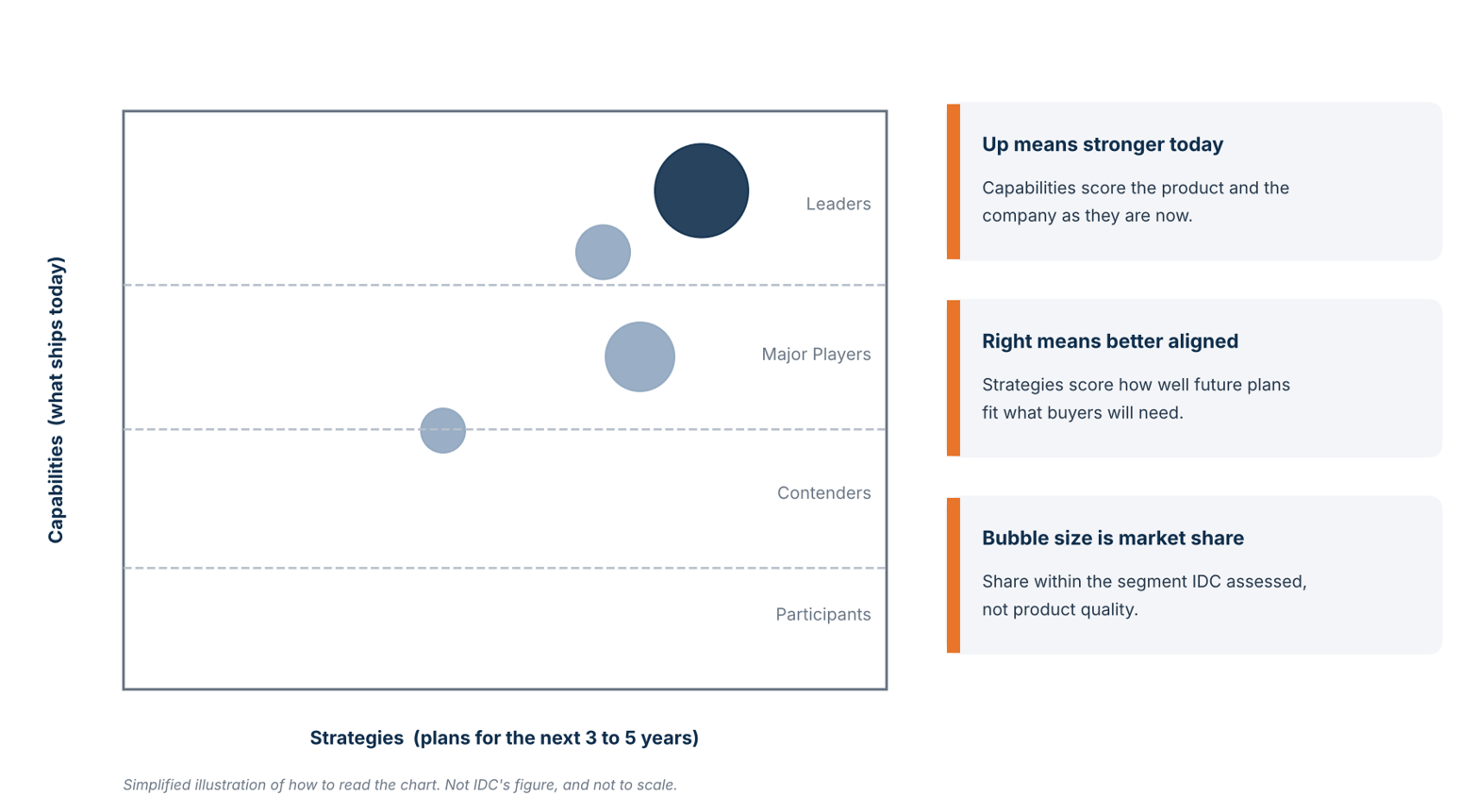
How to read the chart above. Original illustration, simplified.
Microsoft is in the Leaders area. Aptean says it is too, in its own announcement. IDC's excerpt for Microsoft doesn't list everyone's tier in words, so don't trust any list of Leaders until you've checked the chart and each vendor's release.
Also keep in mind that IDC runs more than one ERP MarketScape. Epicor, for instance, announced a Leader spot in a 2025 report on large-enterprise AI-enabled ERP. If a vendor tells you it's a Leader, ask which report.
Why buyers are asking about AI in ERP right now
IDC's numbers come from its own surveys. In April 2026 it polled 2,845 organizations, and 39.7% said they intend to put money into ERP applications within one to 24 months. The same survey put 22.7% in the ready-to-switch camp, especially if the next release has no generative AI, while 21% said they'd stay with their current vendor if it does.
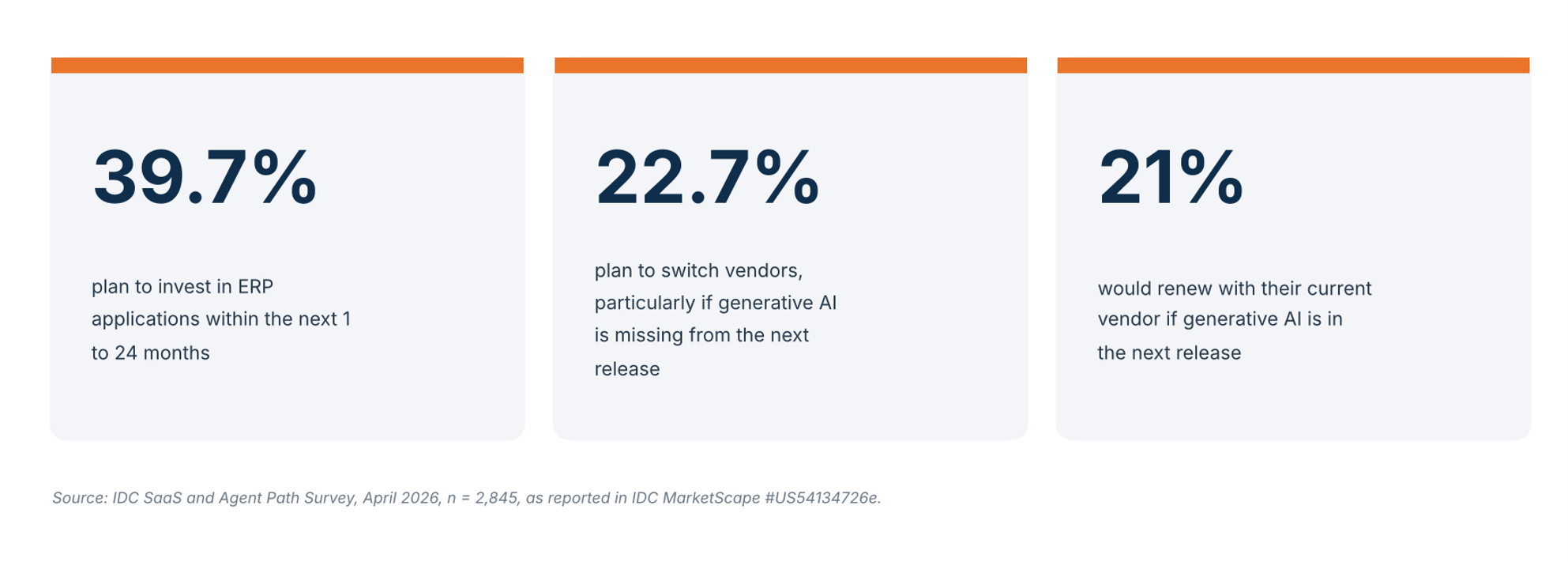
IDC survey figures as reported in the MarketScape excerpt.
A second IDC survey, from May 2025, asked what buyers weigh most when they pick AI-enabled applications. A trusted brand and a solid data security model top the list. After those come how easy the rollout is, how the product feels to use, how clear the pricing is, whether training exists, and how visible the road map is.
Notice what's missing. Nobody put model performance on the list. My read, and it's mine rather than IDC's, is that buyers want to trust the vendor and the rollout before they care how clever the feature is.
Why IDC puts Dynamics 365 where it does
IDC names three strengths.
One platform
Dynamics 365 plugs natively into Microsoft 365, Power Platform, Azure and Dataverse. If your people already live in Outlook, Teams and Excel, ERP data and actions can show up there, under the same identity and security setup. IDC's customer references liked running everything, from productivity tools through to ERP, on a single platform.
A controlled way for agents to reach ERP
IDC calls Microsoft's approach MCP-first. MCP is the Model Context Protocol, an open standard that gives AI agents a consistent way to reach tools and data. Microsoft's Dynamics 365 ERP MCP server and its Copilot Cowork plugin are both generally available, per Microsoft's September 23 update. In practice an agent can read ERP records, take actions and handle attachments through one governed entry point, with no custom integration for each use case.
Updates, speed and licensing
Updates arrive automatically and often. IDC reports that over a third of customers are live inside six months, and most of the others make it within a year. Licensing comes in user, device and transaction flavors, so cost can follow actual use.
Add those up and the bet is clear. ERP remains the system of record, and Copilot and agents become how people and software get at it. Microsoft's own post says much the same: the more agents do, the more the record underneath them matters.
What IDC says Microsoft still has to work on
IDC lists three, and each one hands you a question for the vendor meeting.
Industry depth. Reference customers wanted finer detail for some process manufacturing needs, like catch-weight tracking and shelf-life rules in food and beverage. IDC says Microsoft has since added deeper quality and warehouse functions for that sector. Whatever you make, ask to see your own process run end to end.
Licensing and road map pace. Customers said there was little room to negotiate price, and they wanted new capabilities sooner. IDC advises buyers to pin down commercial terms and confirm timing for anything they rely on. It helps that Microsoft now publishes an always-on AI at Work roadmap instead of release waves, with highlights through March 2027.
Copilot or Dynamics 365 AI? Customers can't always tell where one ends and the other begins, and some fear paying for more than they use. IDC expects Microsoft to ship a tool for this. Until then, ask for each AI capability in a proposal to be listed with its license and how it's metered. Microsoft's Work IQ announcement links to usage-based billing documentation, so consumption charges belong in your cost model.
What's shipping and what's still preview
IDC scores strategy as well as current capability, so part of a Leader placement is a vote on the roadmap. That's why status matters. Here's how Microsoft's own posts label things as of October 19, 2026.
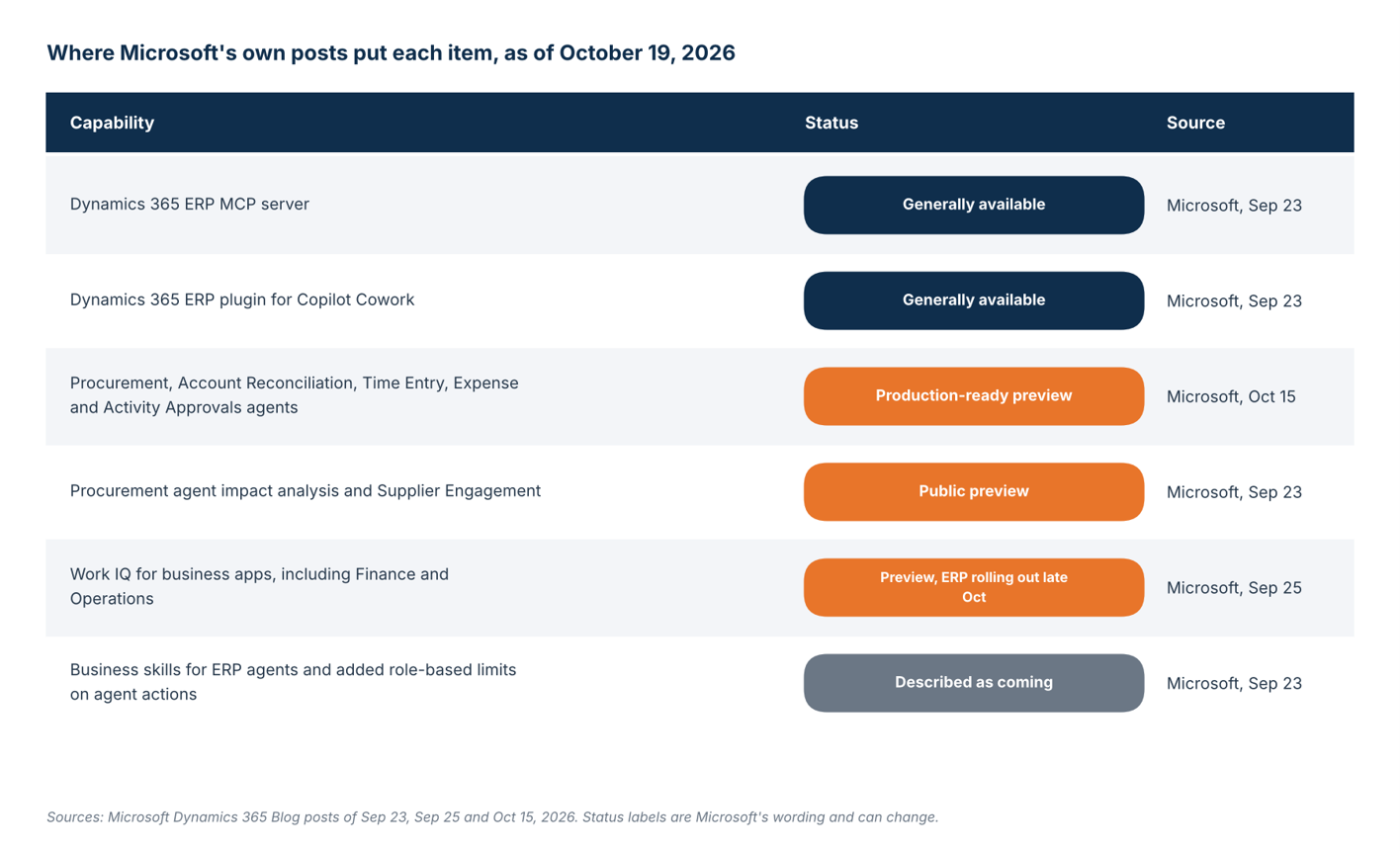
Status labels come from Microsoft's posts of September 23, September 25 and October 15, 2026.
Microsoft calls the five named agents' production-ready preview, which isn't general availability. IDC's profile also names a few of them differently from Microsoft's October post. Use Microsoft's current names and labels in your requirements document.
Governance comes before autonomy
IDC treats AI governance as an operating discipline: repeatable controls that keep risk, ownership and transparency in view from the first idea for a use case until it's retired. It argues AI brings risks older IT didn't have. Outputs can vary from run to run, models drift, decisions are hard to explain and data lineage gets murky. Its June 2026 survey of 876 organizations found that companies with more mature governance had fewer processes left manual or partly manual.
Auditors and regulators care about the same thing. IDC says explainable AI has drawn more attention inside ERP software over the past 26 months. The goal is a model that can show how it reached a conclusion or why it flagged an anomaly.
For tooling, Microsoft points to Agent 365 for observing and governing agents. Don't mix it up with data governance. Agent 365 covers agents, and Microsoft Purview covers data. Different jobs.
Tools only help if a person owns the result. Crystal Ahrens, writing for Dynamics Communities in June 2026, says autonomy has to be earned in stages. Agents suggest first. Then they take reversible steps with human sign-off. Only later do they act alone, inside tight limits. She also wants every agent to have a named business owner, a defined scope, explicit prohibitions and an off switch. Her shorthand: "Agents are amplifiers." Messy vendor records and inconsistent posting habits get automated faster, not fixed.
Before any pilot, try this. Can you say in one sentence who owns the agent, what it may touch and how to stop it? If not, you're not ready.
Who should take a hard look
IDC's advice is to look closely at if your company sits in the upper midmarket or is a global enterprise. It matters most if you've already standardized the Microsoft cloud and productivity stack and want shared processes fast in finance, supply chain and manufacturing, plus agents built into everyday tools. The profile centers on Dynamics 365 Finance and Dynamics 365 Supply Chain Management, aimed at organizations of roughly 1,000 to 100,000-plus employees. The industry list runs from discrete and process of manufacturing through distribution and retail to healthcare and architecture and construction.
If you're smaller, read the placement carefully. IDC describes Dynamics 365 Business Central as aimed at organizations of 10 to 500 employees, and its customer estimate of 10,000-plus leaves it out. So the Leader placement speaks to the Finance and Supply Chain Management family. If Business Central is your likely fit, judge it on its own evidence.
If you're buying in MENA or ANZ
The excerpt is global. It doesn't break results out by region and never names MENA or ANZ. What it gives you is two facts and two good questions. The facts: Dynamics 365 is in use across 210-plus countries and regions, with out-of-the-box localization for 58 and more coming from partners. The questions come from IDC's buyer advice. Does the vendor grasp which rules apply to your business, how are they reflected in the product today, and how will they change, including digital sovereignty requirements? And is support available where you operate?
Local compliance is where those questions get concrete. In the UAE, mandatory e-invoicing starts January 1, 2027 for businesses with annual revenue of AED 50 million or more. Smaller businesses follow on July 1, 2027 and government entities on October 1, 2027, according to KPMG's July 2026 summary. In Australia, Peppol e-invoicing is mandatory only for Commonwealth agencies right now and voluntary for private business, and the tax office accepts compliant Peppol invoices as valid tax invoices, per Avalara's guide.
The report can't say whether a particular localization covers a particular rule. Ask the vendor or partner for release notes for your country, who maintains the local layer when rules change, and where your data will be hosted. "58 countries" answers none of that.
A buyer's checklist for AI-enabled ERP
IDC's buyer advice is long. Here are eight questions that cover most of it, plus the status and cost points above.
| # | Question to ask | Basis |
|---|---|---|
| 1 | What problem are we solving, and how will we measure it in KPIs? | IDC |
| 2 | Can the vendor run a hands-on AI demo with our own live data? | IDC |
| 3 | Which AI capabilities are generally available today, and which are in preview? Get dates in writing. | Microsoft status labels |
| 4 | Which license and which meter does each AI capability need? | IDC challenge, our addition |
| 5 | How do the APIs, MCP access and low-code tools fit our integration set? | IDC |
| 6 | Who owns each agent, what can it touch, and how do we stop it? | IDC governance, practitioner view |
| 7 | Is our implementation partner using AI to shorten delivery, and does it know our industry and size? | IDC |
| 8 | Does the product meet our country's rules today, and who maintains local compliance? | IDC, our addition |
If you take one thing into a vendor meeting, make it IDC's request for a hands-on demo with your own live data. Watch how your invoices, approvals, and exceptions behave. A ranking won't show you that.
Frequently Asked Questions
It's IDC's label for ERP with AI built into the product or a clear plan to add it. Every vendor in the assessment has some, and IDC says a few are further along than the rest.
Probably not. IDC's excerpt for Microsoft doesn't list every vendor's tier, and Aptean has announced its own Leaders placement. Check the chart and each vendor's announcement.
IDC's profile centers on Dynamics 365 Finance and Dynamics 365 Supply Chain Management, and its customer count leaves Business Central out. The report makes no Leader claim for Business Central.
Some are. Microsoft lists the ERP MCP server and Copilot Cowork plugin as generally available, while several named agents are production-ready preview. Check the AI at Work roadmap before you plan around a date.
About the author. Tim Tucker is VP of Microsoft & Construction Solutions at Netsmartz, a Microsoft Solutions Partner. If you're weighing Dynamics 365 options and want a second set of eyes on your requirements, you can start a conversation with the Netsmartz team.
This article is independent analysis. IDC and Microsoft have not reviewed or endorsed it, and IDC does not endorse Netsmartz. Figures attributed to IDC come from the excerpt of IDC MarketScape #US54134726e. Status and pricing details can change, so confirm them with the vendor.
Keep reading
Salesforce Agentforce Use Cases: AI Agents for Sales, Service and Business Operations

AI Platform for UAE Contractors: E-Invoicing Will Audit Your Records Before Any Agent Does

AI Agent Governance for Construction: Containment Is Not a Credit Memo
Ready to build smarter? Let's talk.
Our experts are ready to help you turn ideas into production-ready AI, cloud and digital solutions.
Get In Touch →Let's Discuss Your Growth Strategy
Let's discuss how we can help you accelerate growth, improve efficiency, and drive real business outcomes.