 AI-First Culture
The ERP Scope Trap: How to Vet Dynamics 365 Partners Before Budgets Explod
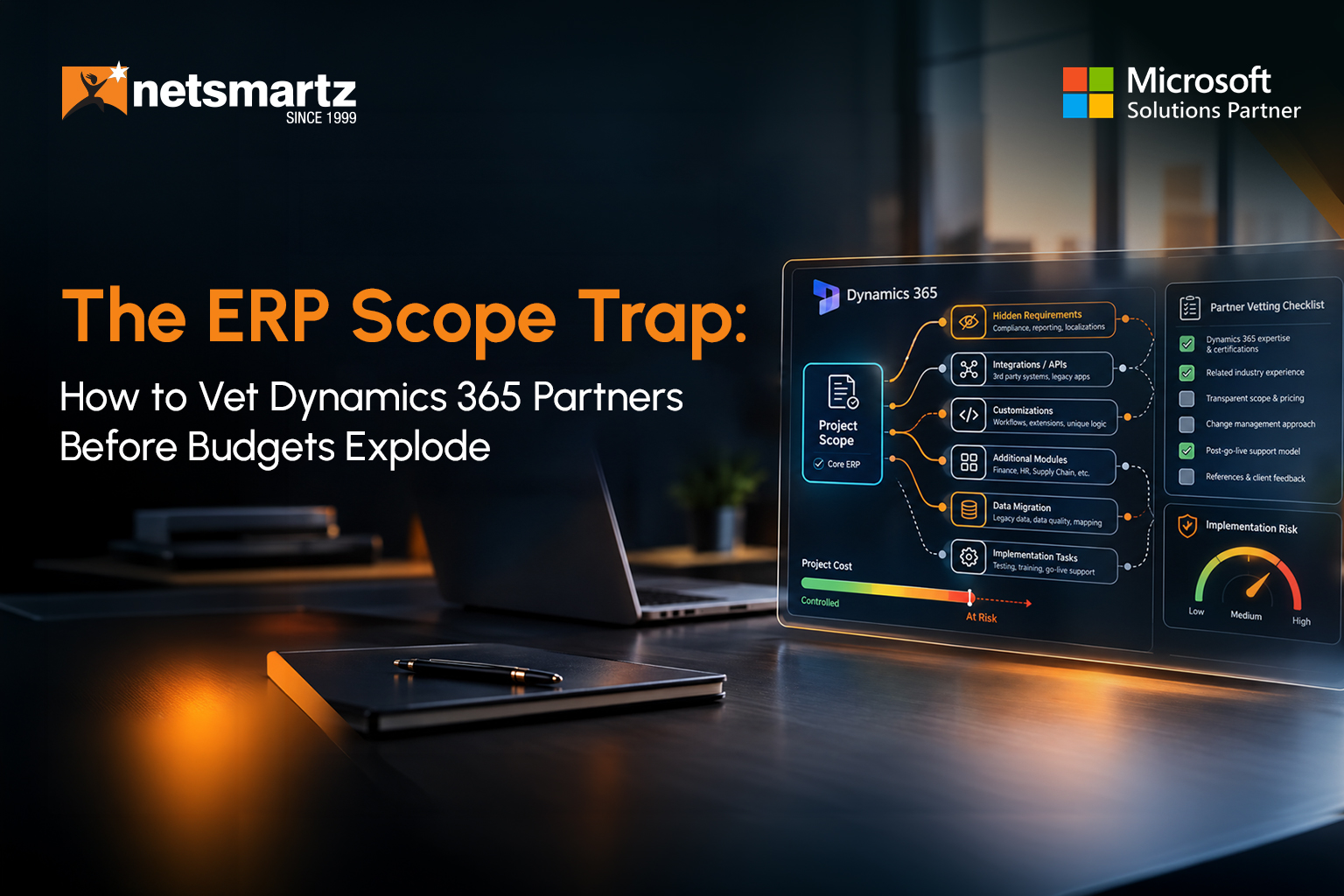
The most expensive ERP mistakes often begin before implementation starts. A business selects a partner based on credentials, project counts, and an attractive proposal. Months later, it discovers that the solution does not fit its processes, the scope was incomplete, or the delivery team lacks the required experience.
By then, changing course is expensive. Panorama Consulting Group’s 2026 ERP Report found that more than a quarter of organizations exceeded their project budgets, with additional technology needs cited as the leading cause. Panorama’s Chris Devault tied that to a specific pattern: organizations discover fatal misfits late, then respond with additional technology, scope expansion, and custom builds.
Evaluate how a Microsoft Dynamics 365 implementation partner arrives at its proposal before you evaluate the proposal itself. Look at its discovery process, relevant experience, delivery approach, and how it identifies implementation risks.
The Selection Sequence Many Companies Get Wrong
A typical Dynamics 365 partner evaluation starts with credentials and case studies, moves to an RFP, and ends with proposal and price comparisons.
Credentials → Case studies → RFP → Proposals → Price → Contract → Detailed discovery
The problem is the order. By the time detailed discovery happens, the partner has already been selected.
That leaves important questions unanswered:
Does the proposed solution fit your business processes?
Which integrations, data dependencies, or customizations could affect the project?
What risks does the partner see that you may not have considered?
A better approach treats partner evaluation as an early part of the implementation process.
What a Microsoft Solutions Partner Designation Tells You
Microsoft’s Solutions Partner designation for Business Applications is a useful starting point when building a shortlist. Partners need at least 70 out of 100 points across performance, skilling, and customer success, based on measures including customer adds, certifications, usage growth, and qualifying deployments.
That provides meaningful evidence of a partner’s Microsoft ecosystem capability. But it does not tell you whether the consultants assigned to your project have handled a business like yours, how they approach difficult requirements, or how they respond when an implementation moves off plan.
Use credentials to build the shortlist. Use delivery evidence to make the decision. Ask shortlisted partners which Dynamics 365 applications they have implemented in businesses similar to yours, what those projects involved, and whether you can speak with the customers behind them.
The question is not simply, “Can this partner implement Dynamics 365?” It is “Can this partner implement Dynamics 365 in an environment like ours?”
Buy the Discovery Before You Buy the Implementation
One of the strongest ways to evaluate a partner is to see how it approaches discovery before you commit to the full implementation.
What to evaluate: How thoroughly does the partner examine your business before proposing a solution, timeline, and price?
A proposal based on thin requirements can leave difficult processes, integration dependencies, data issues, and customization needs unresolved until later.
Ask each shortlisted partner:
What are the three biggest risks you see in our implementation?
Which of our current processes would you recommend changing rather than reproducing in Dynamics 365?
What information do you still need before you can confidently scope the project?
These questions force the partner to show its thinking rather than repeat what is already in the RFP.
For complex implementations, consider making discovery a defined engagement before committing to the full project. It gives both sides a clearer view of requirements, risks, working style, and likely scope.
Use Microsoft's Framework as a Yardstick
Microsoft’s Success by Design framework provides guidance for Dynamics 365 implementations across areas such as solution architecture, testing, performance, integration, data migration, change management, and go-live readiness.
You do not need to require a partner to use Microsoft’s terminology word for word. Use the framework to test how the partner approaches implementation.
Ask:
- How will you validate the solution architecture before build begins?
- Who owns data migration planning and validation?
- How will testing and go-live readiness be managed?
You can also ask whether your project is eligible for Microsoft FastTrack support and how the partner would work with the Dynamics 365 Implementation Portal.
The important question is whether the partner can show how those practices will be applied to your implementation.
Verify the Team That Will Work on the Project, Not Just the Company
The people presenting the proposal are not necessarily the people delivering the project.
Ask for the names and roles of the proposed solution architect, functional leads, and technical leads. Understand their expected allocation and how substitutions will be handled. Then test their experience against your project.
Ask References About Difficult Moments
Do not ask only whether the customer was satisfied. Ask:
What changed between the original scope and final delivery?
What was the first major problem during implementation?
How did the partner respond?
A useful reference is not necessarily a perfect project. You want to understand how the partner behaves when the project becomes difficult.
Compare ERP Implementation Partners’ Proposals by Their Assumptions
Once you have tested the partners, compare their proposals. Do not start with the final price. Start by normalizing what each proposal assumes.
Look at:
Data migration scope
Integration ownership
Testing and training
Customer responsibilities
Go-live and hypercare coverage
Exclusions and change-request terms
If one proposal costs significantly less, find the assumption that explains the difference.
Ask each partner:
Which assumption in this proposal are you least confident about?”
That answer can reveal more about the proposal’s risk than the total implementation price. The goal is to understand what you are actually buying from each partner.
Evaluate the Partner’s Post-Go-Live Commitment
Partner evaluation should not stop at implementation.
Microsoft’s Dynamics 365 guidance recommends planning the support model during the Implement phase, testing it before user acceptance testing, using it during the Prepare phase, and having it fully operational by the Operate phase. Microsoft guidance on transitioning to support models
Ask:
- Who handles issues after go-live, and what does hypercare include?
- What are the response and escalation expectations?
- How are Microsoft updates, enhancements, and ongoing support handled?
Your implementation team and long-term support team may not be the same people. Make sure the transition between them is part of the plan.
Choose the Right ERP Implementation Partner Based on Evidence, Not Presentation
A strong ERP implementation partner should be able to show how it will reduce risk in your specific implementation. That gives you a stronger basis for selection than comparing logos, certifications, or day rates.
If you are evaluating ERP implementation partners, start with a free ERP assessment from the Microsoft Dynamics team at Netsmartz to pressure-test your processes, integrations, and implementation assumptions before you commit to a delivery approach.
Frequently Asked Questions
There is no useful universal number. Relevance matters more than volume. Ask for implementations involving applications, processes, integrations, and business complexity similar to yours, then speak with the customers behind them.
Give both partners the same requirements and normalize their assumptions before comparing price. Review migration scope, integration ownership, testing, training, customer responsibilities, go-live support, and exclusions. A lower price may simply reflect narrower scope.
Industry experience can be valuable when your processes, regulations, reporting, or integrations are specialized. But an industry logo is not proof of expertise. Ask what the partner learned from comparable implementations and how that experience would influence your project.
A strong proposal should clearly define the solution scope, implementation approach, data migration, integrations, customer responsibilities, testing, timeline, assumptions, exclusions, and post-go-live support. If these details are vague, the price alone won't tell you what you're actually buying.
Evaluate potential partners before the final proposal stage, while requirements, solution design, and implementation assumptions are still being shaped. Early evaluation gives you a chance to test the partner's discovery approach, technical thinking, and understanding of your business before you commit to a delivery model.
Ready to build smarter? Let's talk.
Our experts are ready to help you turn ideas into production-ready AI, cloud and digital solutions.
Get in touch →Let's Discuss Your Growth Strategy
Let's discuss how we can help you accelerate growth, improve efficiency, and drive real business outcomes.