 AI-First Culture
From Salesforce AI Pilot to Production: How to Scale Agentforce
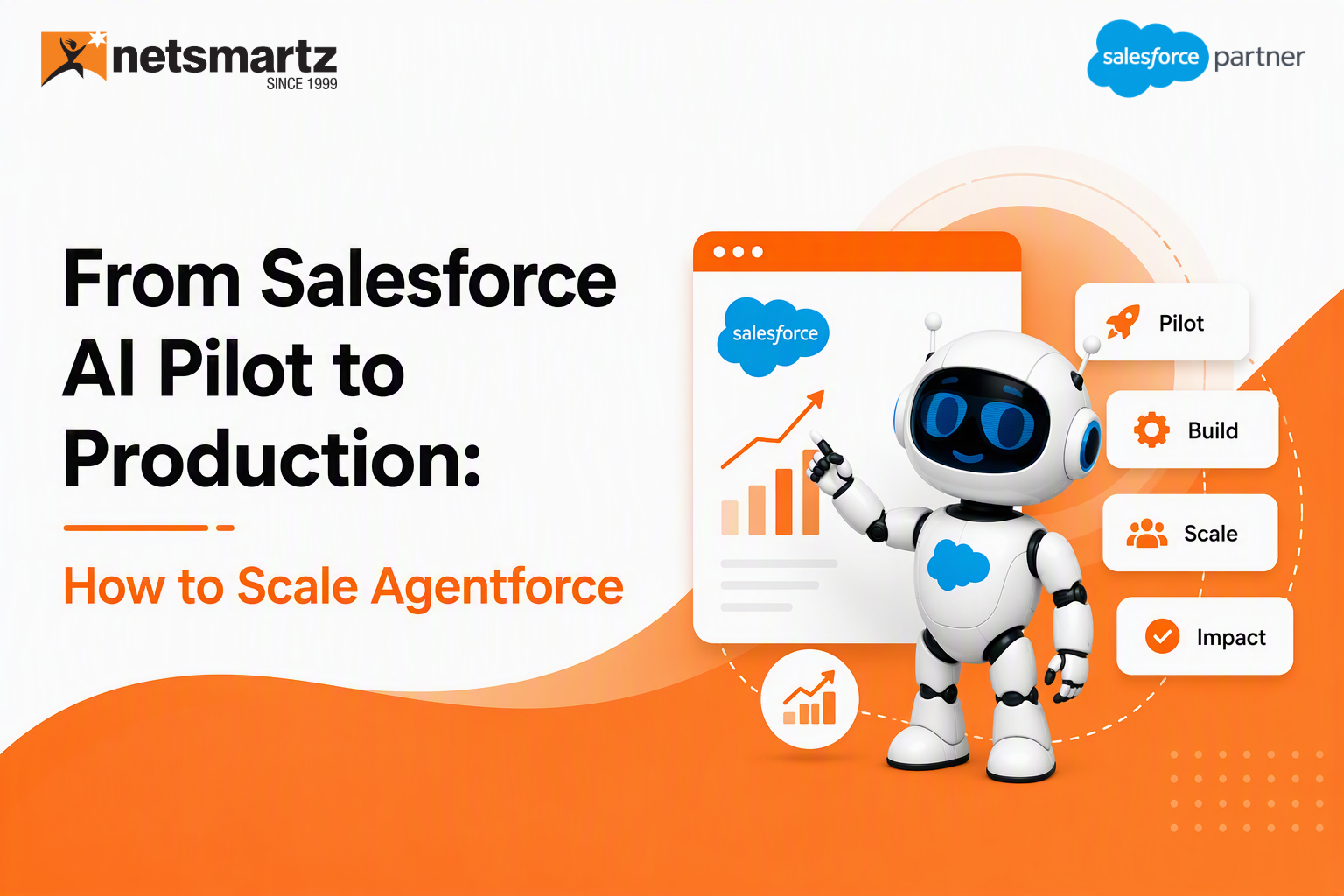
"So your Salesforce pilot went well, the demo landed, leadership is impressed." Now what?
That's the part nobody plans for properly. Across the UAE and KSA, this is exactly where a lot of promising Agentforce pilots quietly stop, not because the idea failed, but because nobody mapped what production actually demands. Success was never about launching a pilot. It's about what happens once real customers, real data, and real teams are involved.
Why Most AI Pilots Never Reach Production
That gap between "the pilot worked" and "it's running at scale" is where most Agentforce deployment efforts stall, and it's rarely one single failure. It's usually a handful of small gaps that a contained test never exposed:
- An implementation strategy that was never fully defined past the pilot
- Data quality issues that a small test dataset happened to mask
- No governance model for who approves or owns AI decisions
- Limited alignment between IT, business teams, and leadership
- Security concerns that only surface once real customer data is involved
- No agreed success metrics to judge production performance against
Across MENA, this shows up often in organizations mid-way through broader digital transformation programs, where an AI pilot looks impressive in a steering committee deck but never quite turns into measurable business value. A pilot proves potential. Production proves it.
What Changes When Agentforce Moves into Production?
That last point, proving it, is exactly what changes once the environment shifts. A pilot typically runs with a handful of users, a controlled dataset, and one narrow use case, which keeps risk low by design. Production looks nothing like that: enterprise-wide adoption, multiple teams and workflows, live customer interactions, and governance requirements a pilot was never built to handle. Scaling Agentforce is less a technical upgrade and more a shift from experimentation to operational discipline, where the same agent now has to behave consistently no matter which team is using it. Assessing Agentforce readiness before this transition helps organizations identify the gaps that could affect a successful production rollout.
The Five Pillars of Production-Ready Agentforce
That shift in discipline is really a shift across five specific areas, and every organization that has successfully moved past pilot purgatory tends to have addressed all five, whether they framed it that way or not.
Data Readiness
This pillar covers clean CRM data, unified customer profiles, connected systems, and a solid Salesforce Data Cloud foundation. AI agents are only as effective as the data they can actually see, so fragmented or duplicate records that barely mattered at pilot scale become a production-breaking problem once volume goes up.
Governance and Trust
Building on that data foundation, this means defined AI ownership, clear approval processes, and risk management set up from the start rather than bolted on later. Across the UAE and Saudi Arabia specifically, this also means accounting for the UAE PDPL, Saudi PDPL, and any industry-specific regulation the business already operates under.
Security and Access Controls
Governance and security tend to move together in practice. User permissions, data protection, and secure AI interactions matter far more once an agent is customer-facing. The Einstein Trust Layer and role-based access controls give teams a way to keep every interaction governed without slowing delivery down.
Testing and Validation
None of the above holds up without ongoing verification. Scenario testing, prompt testing, output validation, and performance benchmarking shouldn't stop once the pilot wraps. Continued Agentforce testing is what catches the edge cases a small pilot group never encountered, before customers do.
Change Management and User Adoption
Even a technically flawless setup falls flat here if this last pillar gets skipped. Employee training, stakeholder engagement, and a real feedback loop matter as much as the technology itself. Plenty of sound Agentforce implementation projects have stalled purely because the people expected to use the agent day to day were never brought along.
Recent research backs up how wide this gap still is in practice. As per McKinsey, among organizations with a billion dollars or more in revenue, 40 percent now report scaling AI agents somewhere in the enterprise, up from 27 percent in the firm's prior survey, which shows real movement but still leaves most companies short of true scale.
How Agentforce Fits Into an AI-First Salesforce Strategy
Those five pillars matter most once Agentforce stops operating as a standalone tool and starts connecting to the rest of the Salesforce ecosystem. It's designed to work alongside Salesforce Data Cloud, Einstein AI, Sales Cloud, Service Cloud, and Marketing Cloud, which is what lets an agent act on a customer's full history rather than a single, isolated interaction. An AI-first organization uses AI across the entire customer journey instead of confining it to one team's use case. Connected to trusted enterprise data and mature business processes, Agentforce delivers noticeably more value than the same tool deployed in isolation. Organizations looking to assess their Agentforce readiness can identify the key requirements before moving from a pilot to production.
Change management around this shift matters just as much as the architecture behind it. As per Deloitte, 65 percent of respondents in its 2026 agentic AI research agreed their organization is taking a holistic, enterprise-wide approach to AI agents, transforming people, processes, and technology together rather than treating the rollout as a pure IT project.
Signs You're Ready to Scale Agentforce
Given everything above, it's worth pausing before committing to a full rollout and checking a few signals together:
- Strong existing Salesforce adoption across teams
- Clearly defined AI use cases, not a vague ambition to "use AI more"
- Connected business systems rather than isolated data sources
- High-quality, consistent CRM data
- An established security framework
- Governance controls already in place, not planned for later
- Executive sponsorship beyond the initial pilot team
- Clear, agreed success metrics for production
Assessing this honestly before expanding, rather than after something breaks, tends to separate the organizations that scale smoothly from the ones that end up rebuilding mid-rollout.
Common Challenges When Scaling Agentforce
Even organizations that look ready on paper can run into friction once Agentforce moves beyond a controlled pilot. The challenges usually show up in four connected areas:
- Data challenges: Duplicate records and inconsistent customer information make it harder for Agentforce to understand context accurately once real CRM data is involved.
- Operational challenges: Manual processes and complex workflows can slow adoption, especially when Agentforce has to work around messy handoffs instead of streamlined processes.
- Technology challenges: Integration gaps limit what Agentforce can access, while limited visibility makes it harder to monitor performance and troubleshoot issues.
- Organizational challenges: Resistance to change and skills shortages can slow adoption if teams are not trained, aligned, and confident using Agentforce in daily work.
Identifying these gaps early helps teams reduce deployment risk and accelerate ROI before the rollout expands.
A Practical Roadmap for Scaling Agentforce
With those risk areas mapped out, most successful transitions from pilot to production follow a similar sequence from here:
- Assess pilot outcomes. Review the KPIs from the initial pilot and be honest about what did and didn't work.
- Strengthen data foundations. Improve data quality, connect fragmented systems, and activate Salesforce Data Cloud properly.
- Establish governance. Create clear policies, define who owns what, and put real controls in place before scaling further.
- Expand to high-impact use cases. Prioritize sales assistance, service operations, or customer engagement rather than everything at once.
- Monitor and optimize. Track adoption, measure performance against the metrics set earlier, and refine the experience as real usage data comes in.
Organizations that scale gradually through this kind of Agentforce implementation roadmap consistently land more sustainable results than those that push for an enterprise-wide launch in one step.
Conclusion: Moving Beyond AI Experimentation
Bring all five pillars, the roadmap, and the readiness checks together, and the picture is fairly simple: a successful Agentforce pilot is only the beginning. Scaling it into production takes trusted data, governance, security, ongoing testing, and a genuine adoption plan, not just a green light from the pilot team. Organizations that invest in Agentforce production readiness now are far better positioned to get long-term value from their Salesforce AI investment. The move from pilot to production was never just a technical exercise. It's an organizational one.
Ready to move Agentforce beyond the pilot stage?
Assess your AI readiness, identify scaling gaps, and build a production roadmap that delivers measurable business outcomes.
Assess Your Agentforce ReadinessFAQs
Clean, unified data, defined governance, strong security controls, continuous testing, and a workforce that's actually been trained to use it.
Strong existing Salesforce adoption, clean CRM data, defined use cases, and governance controls already in place rather than planned for later.
Agents act on whatever data they can see, so duplicate or fragmented records that a small pilot masked become production-breaking at real volume.
It unifies customer data into one real-time view, giving agents the context they need to act accurately across every interaction.
By tying agent performance to CFO-legible outcomes agreed before launch, such as cost per resolved case or cycle time reduction, not after the fact.
Defined AI ownership, an approval process, risk management policies, and compliance alignment with regulations like UAE PDPL or Saudi PDPL.
Ready to build smarter? Let's talk.
Our experts are ready to help you turn ideas into production-ready AI, cloud and digital solutions.
Get In Touch →Let's Discuss Your Growth Strategy
Let's discuss how we can help you accelerate growth, improve efficiency, and drive real business outcomes.