AI-First Culture
Azure Migration Services: A Strategic Roadmap for Secure and Scalable Cloud Adoption

To companies across North America and the globe, migrating to the cloud is no longer a strategic decision, but an operational requirement. Today’s aging infrastructure, increased threats, and need for scalable operations is making businesses act.
Azure migration services gets you the organized framework of execution needed to shift workloads to the Azure cloud without putting your organization at risk.
This blog will take you through the strategic roadmaps under which businesses are migrating to the Azure cloud safely and at scale.
Why Azure Is the Preferred Enterprise Cloud Platform
Microsoft Azure remains at the forefront in cloud adoption because of its innovative and hybrid features, a security posture, certification, and allows integration with the larger Microsoft ecosystem
Besides, with Azure, there is the added benefit of improved regional capabilities, which, in turn, supports data residency. This is crucial in the case of the finance, healthcare, and government industries.
Some of the major motivations behind organizations choosing the Azure cloud are:
- Retiring aging infrastructure
- Improving scalability for fluctuating workloads
- Enhancing disaster recovery posture
- Reducing capital expenditure
- Strengthening cybersecurity controls
- Supporting AI and advanced analytics initiatives
However, Azure migration without a well-thought-out plan tends to result in higher costs, performance problems, and security misconfigurations. That’s why you need expert Azure migration services for your migration journey.
The Strategic Roadmap for Azure Cloud Migration
Discovery and Readiness Assessment
Before any workload is moved, organizations must build a clear understanding of their current environment. This includes mapping application dependencies, analyzing server utilization, evaluating licensing models, and reviewing network architecture, compliance obligations, and data gravity constraints.
This phase is typically powered by Azure Migrate, which provides centralized discovery, dependency mapping, cost estimation, and right-sizing recommendations. A structured readiness assessment ensures that migration decisions are based on data, not assumptions; reducing downstream risk.
Migration Strategy and Wave Planning
Once the environment is assessed, workloads are aligned to appropriate migration strategies such as rehost, replatform, refactor, replace, or retire. The goal is to match each application with the most efficient path to Azure based on business value and technical feasibility.
Wave planning then defines the sequence of migration based on criticality, interdependencies, and downtime tolerance. For enterprises, this structured sequencing is essential to prevent cascading failures, maintain compliance, and ensure operational continuity during transition.
Secure Execution and Workload Migration
Execution is where strategy meets operational discipline. Workloads are migrated using Azure-native capabilities, with continuous replication minimizing downtime during cutover and ensuring business continuity.
Security must be embedded throughout this phase, not treated as an afterthought. This includes implementing network segmentation, strengthening identity controls, configuring RBAC, enforcing Azure policies, and enabling logging and monitoring alongside governance frameworks.
Database and Application Modernization
Databases often represent the most sensitive and complex layer of any migration. Moving them requires careful planning to avoid data loss, performance degradation, or disruption to business-critical applications.
Using Azure Database Migration Service, organizations can securely migrate systems like SQL Server, Oracle, MySQL, and PostgreSQL with minimal downtime. Enterprise-grade migration approaches include schema validation, performance benchmarking, transactional integrity checks, and post-migration tuning to ensure stability and scalability.
Optimization and Cost Governance
Migration is only the midpoint of the journey—real value is realized during optimization. Once workloads stabilize, organizations must focus on rightsizing infrastructure, optimizing storage tiers, implementing autoscaling, and continuously reviewing security posture.
Without structured governance, cloud costs can quickly spiral. Mature Azure migration services incorporate FinOps practices, real-time cost visibility, continuous monitoring, and proactive optimization to ensure long-term financial and operational efficiency.
Risk Factors Businesses Must Address
For organizations operating under strict regulatory and security expectations, migration introduces both opportunity and exposure. Requirements such as HIPAA, SOC 2, PCI DSS, data residency laws, and Zero Trust alignment must be embedded into the migration strategy from the outset.
Without governance, cloud adoption can amplify risk rather than reduce it. Structured Azure migration services mitigate this through controlled migration waves, security-by-design architectures, Infrastructure as Code (IaC), and audit-ready documentation that ensures compliance and operational resilience.
What to Look for in an Azure Migration Partner
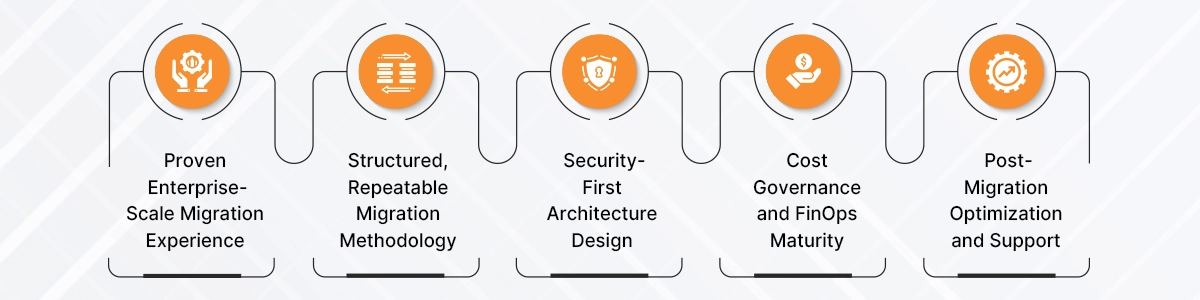
If you are looking for an ideal Azure migration service partner, you need to look beyond migration expertise. Try to collaborate with a partner that helps minimize operational risks, secures up-time, and ensures long-term cost optimization.
Proven Enterprise-Scale Migration Experience
Migration complexity increases exponentially with:
- Application interdependencies
- Compliance requirements
- Legacy database structures
- Multi-region operations
The partner you choose should have proven experience in planning and executing large-scale Azure migration projects across various industries, rather than just pilots. You should look for:
- Case studies with measurable outcomes
- Downtime metrics achieved
- Cost optimization benchmarks
- Security and compliance validation results
Structured, Repeatable Migration Methodology
Azure enablers like Azure database migration service are tools and not strategies. A competent migration partner must operate with a formalized methodology that entails:
- Discovery and dependency mapping
- Risk modeling and impact analysis
- Migration wave planning
- Rollback strategy documentation
- Post-migration validation protocols
If the provider cannot clearly articulate their migration framework, execution risk increases.
Security-First Architecture Design
Cloud migration without embedded security design introduces new vulnerabilities. A credible Azure migration partner must incorporate:- Zero Trust principles
- Identity and access hardening
- Network segmentation
- Azure Policy enforcement
- Continuous monitoring setup
Security configuration should be integrated during migration, not retrofitted after go-live.
Cost Governance and FinOps Maturity
Cloud cost overruns are one of the most common post-migration challenges. A strong Azure cloud migration services partner will provide:
- Detailed cost forecasting models
- Rightsizing recommendations based on performance data
- Reserved instance and savings plan strategies
- Ongoing FinOps governance dashboards
Post-Migration Optimization and Support
Many providers disengage after cutover. Enterprise-grade Azure migration services include:
- Performance tuning
- Security posture reviews
- Architecture optimization
- Scalability planning
- Ongoing managed support
Ready to Migrate to Azure with Confidence?
If your organization is looking to adopt the Azure cloud, you need to understand that the difference between an effortless transition and a costly disruption is execution discipline.
This is why you must partner up with experienced Azure cloud migration services to ensure your cloud move is regulated, optimized, and future-proof.
Plan a Secure Azure Migration Today
Talk to an Azure Migration ExpertFrequently Asked Questions
Azure Migration services comprise of assessment, workload migration, database migration with the use of Azure database migration service, security configuration, and post-migration optimization. Professional Azure cloud migration services ensure low downtime, alignment of compatibility, and cost management.
Azure Migrate assists in determining the infrastructure preparedness, mapping dependencies, and estimating the cost of running on Azure in advance. With structured Azure migration services, it minimizes risk and enhances migration precision.
Data center migration timelines are based on the complexity of workloads, dependencies of an application, and compliance needs. Through established Azure cloud migration services, businesses can carry out staged migrations with planned migrations and less cutover.