 AI-First Culture
MuleSoft Agent Fabric: What GCC Enterprises Should Know
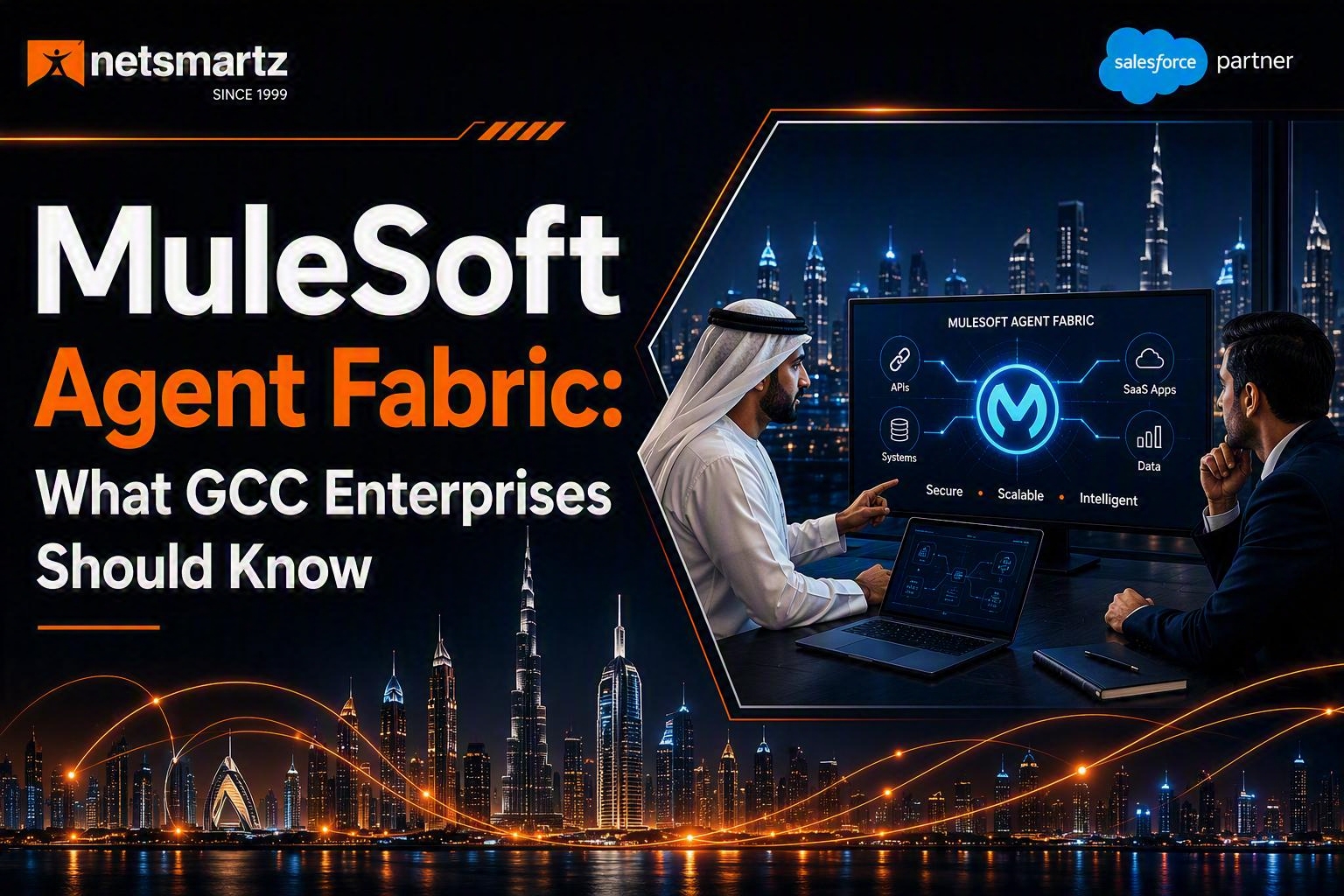
MuleSoft Agent Fabric GCC enterprises are starting to encounter in 2026 is a governance and orchestration layer from Salesforce that discovers, connects, and monitors every AI agent running across an enterprise, regardless of which platform built it, so that a growing digital workforce of independent agents can be managed as one coordinated system instead of dozens of disconnected tools. For GCC enterprises moving quickly into agentic AI this year, that single sentence is the difference between agents that create real operational value and agents that quietly become an unmanaged risk nobody can fully account for.
This piece answers the more basic question first: what is this thing, why does it exist, and does it actually matter for your organization.
What Is MuleSoft Agent Fabric
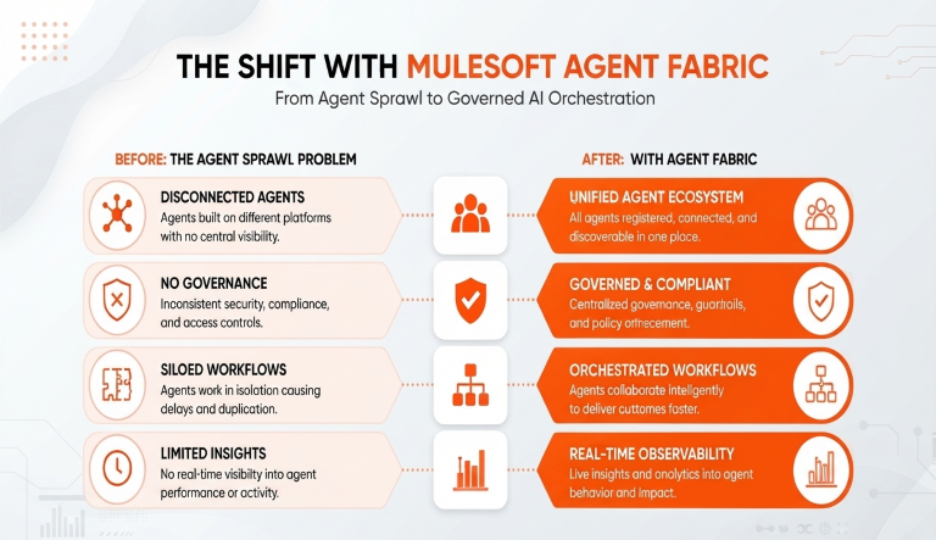
Salesforce describes Agent Fabric using an analogy that is genuinely the clearest explanation available: think of it as an air traffic controller for AI agents. Just as air traffic control does not fly any individual plane but makes sure every aircraft from every airline can take off, land, and share the same airspace safely, Agent Fabric does not replace any individual AI agent. Instead, it sits above all of them, whether they were built on Agentforce, AWS Bedrock, Azure AI Foundry, or somewhere else entirely, and gives an enterprise one place to register, orchestrate, govern, and observe every one of them.
Launched by Salesforce in September 2025 and expanding through 2026 with new deterministic orchestration capabilities, Agent Fabric is built around four core pillars: a Registry that catalogs every agent, a Broker that intelligently routes tasks across agents, Governance that applies security and compliance guardrails to every interaction, and a Visualizer that gives IT teams a live map of how agents are actually behaving.
Why Agent Fabric Exists: The Agent Sprawl Problem
The plain language version of why this platform exists is simple. Enterprises are adopting AI agents faster than they are building the systems to manage them. Different teams build or buy agents independently, a customer service agent here, a finance automation agent there, a sales assistant somewhere else, and within months no single person can say with confidence how many agents are running, what data each one can access, or who is actually accountable for what they do.
This pattern, commonly called agent sprawl, is not a hypothetical concern. According to the Gartner 2026 CIO and Technology Executive Survey, only 17 percent of organizations have deployed AI agents so far, yet more than 60 percent expect to do so within the next two years, making agentic AI the most aggressive adoption curve of any emerging technology Gartner currently tracks. Adoption is accelerating faster than governance can keep pace, and that gap is exactly what Agent Fabric was built to close.
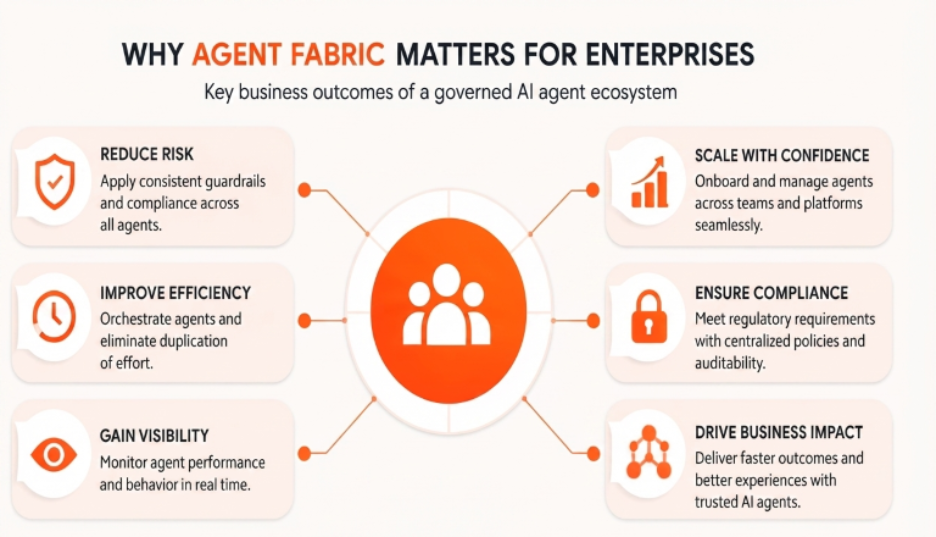
The cost of ignoring that gap is not abstract either. According to a Gartner press release from May 2026, uniform governance applied blindly across all AI agents, regardless of their autonomy level or scope of access, is itself a leading cause of enterprise AI agent failure, and Gartner predicts that by 2027, 40 percent of enterprises will be forced to demote or decommission autonomous agents after governance gaps surface through actual production incidents rather than being caught beforehand. A separate 2026 survey from McKinsey adds another data point to the same picture: only 33 percent of enterprises currently meet governance standards for autonomous agents, even as agentic AI adoption accelerates across nearly every industry and function. Put the two findings together and the pattern is unmistakable; most organizations are deploying agents well ahead of the governance maturity needed to manage them safely.
When Should a GCC Enterprise Consider Agent Fabric
The honest answer is earlier than most organizations think. Agent Fabric becomes relevant the moment more than one team in an enterprise is independently building or deploying AI agents, which in practice describes most mid-sized and large GCC organizations by 2026. Waiting until a formal AI strategy document exists usually means waiting until sprawl has already happened. The better trigger point is simpler: if your CX team, your finance function, and your operations team could each independently answer yes to "are we using an AI agent for something right now," a registry and governance layer is already overdue, not a future consideration.
Who Is Already Using It
This is not a theoretical product with no real deployments behind it. Salesforce has named a range of enterprise customers already running Agent Fabric in production, including Barco, a global technology company, r.Potential, Rush University System for Health, and the Wynn and Encore properties in Las Vegas. These are large, complex organizations with exactly the kind of multi-vendor, multi department agent sprawl problem that smaller or newly agent curious GCC enterprises are only beginning to encounter. The pattern across these early adopters is consistent: they did not wait for a perfect strategy; they needed visibility and control over agents that were already running.
Where Agent Fabric Fits in Your Stack
Agent Fabric does not require an enterprise to standardize entirely on Salesforce's own Agentforce platform, which matters for GCC organizations already running a genuinely multi-vendor technology environment. It extends Agentforce to orchestrate with third party agents that were never built inside the Salesforce ecosystem at all, meaning an agent built on AWS Bedrock or Azure AI Foundry can still be registered, governed, and monitored through the same layer as an internally built Agentforce agent. For most GCC enterprises, this positions Agent Fabric less as a replacement for existing AI tools and more as the coordination layer that sits above whatever agents already exist across departments and vendors.
The Four Core Capabilities
Each of the four pillars does a specific, distinct job, and understanding them individually makes the overall platform, and the broader question of MuleSoft AI governance, far easier to evaluate.
- Registry: a centralized, searchable catalog of every AI agent across the enterprise, so no agent can operate as an unknown quantity outside a documented inventory.
- Broker: an intelligent, LLM powered router that directs tasks to the right agent across domains, enabling cross functional workflows without manual handoffs between systems.
- Governance: enterprise grade guardrails, security, compliance, and policy controls, applied consistently to every agent interaction regardless of which platform built the agent.
- Visualizer: a live, dynamic map of the entire agent ecosystem, showing how agents connect, interact, and perform, turning what used to be black box AI behavior into something IT can actually observe and audit.
Why Not Just Build Governance In-House
A reasonable question at this point is why an enterprise would need a dedicated platform for this at all, rather than building spend limits, access controls, and monitoring internally as agents are deployed. The honest answer is that most organizations already tried the internal route first, and it is exactly what produced agent sprawl in the first place. Each team building its own governance rules for its own agents means an enterprise ends up with as many different governance standards as it has teams building agents, which is functionally no standard at all. A dedicated enterprise agent orchestration GCC organizations can point every team toward, rather than each function inventing its own rules, is what actually closes the gap rather than adding one more inconsistent layer on top of an already fragmented picture. This is also the practical difference between a point solution and an AI agent management platform built to sit above every existing and future agent an organization deploys, regardless of which team built it or which vendor's model powers it.
Agent Fabric is not the only vendor addressing this space, and enterprises evaluating options should expect to compare it against other emerging governance and orchestration tools. What differentiates it for organizations already running on Salesforce infrastructure is that it extends naturally from tooling many GCC enterprises already have in place, rather than requiring an entirely new platform investment layered on top of existing systems.
What This Means for GCC Enterprises Specifically
The global case for Agent Fabric is strong on its own, but the regional case is arguably stronger. GCC enterprises are adopting AI agents inside sectors, finance, real estate, and government services among them, where regulators are already tightening oversight in 2026, and an unregistered, ungoverned agent is not just an internal management headache, it is a potential compliance exposure with a specific regulator's name attached to it.
That's exactly where this piece hands off. Deploying AI Agents Securely on MuleSoft covers the operational side in full UAE data residency requirements, sector-specific compliance overlays, and a practical pre-deployment checklist for anything you're about to put into production.
Conclusion
MuleSoft Agent Fabric GCC organizations are beginning to adopt is not another AI agent competing for attention in an already crowded market, it is the coordination layer that makes every other agent an enterprise already has, or is about to build, manageable, governable, and observable as one system rather than a growing pile of disconnected tools. For GCC enterprises, the urgency is not hypothetical. Adoption curves are accelerating faster than governance frameworks can keep up, and the gap between the two is exactly where compliance incidents and operational failures tend to happen. Understanding what Agent Fabric actually is, plainly and without vendor jargon, is the first step before any technical deployment conversation should even start.
Ready to move from understanding Agent Fabric to actually governing your organization's AI agents?
Talk to a Netsmartz specialist about what a MuleSoft Agent Fabric assessment could look like for your current agent landscape.
Frequently Asked Questions
It is a governance and orchestration layer that registers, coordinates, and monitors every AI agent across an enterprise in one place, regardless of which platform built the agent.
No, it does not replace individual agents, it sits above them, coordinating and governing agents built on Agentforce as well as third-party platforms like AWS Bedrock or Azure AI Foundry.
Agent sprawl happens when independently built agents accumulate across teams with no central inventory, making it impossible to know how many agents are running, what data they access, or who is accountable for them.
Salesforce launched MuleSoft Agent Fabric in September 2025 and has continued expanding its capabilities through 2026, including new deterministic workflow orchestration features.
No, any organization where more than one team is independently building or deploying AI agents can benefit, which by 2026 describes most mid-sized and large GCC enterprises, not just multinational corporations.
Ready to build smarter? Let's talk.
Our experts are ready to help you turn ideas into production-ready AI, cloud and digital solutions.
Get in touch →Let's Discuss Your Growth Strategy
Let's discuss how we can help you accelerate growth, improve efficiency, and drive real business outcomes.