 AI-First Culture
Deploying AI Agents Securely on MuleSoft in the Middle East
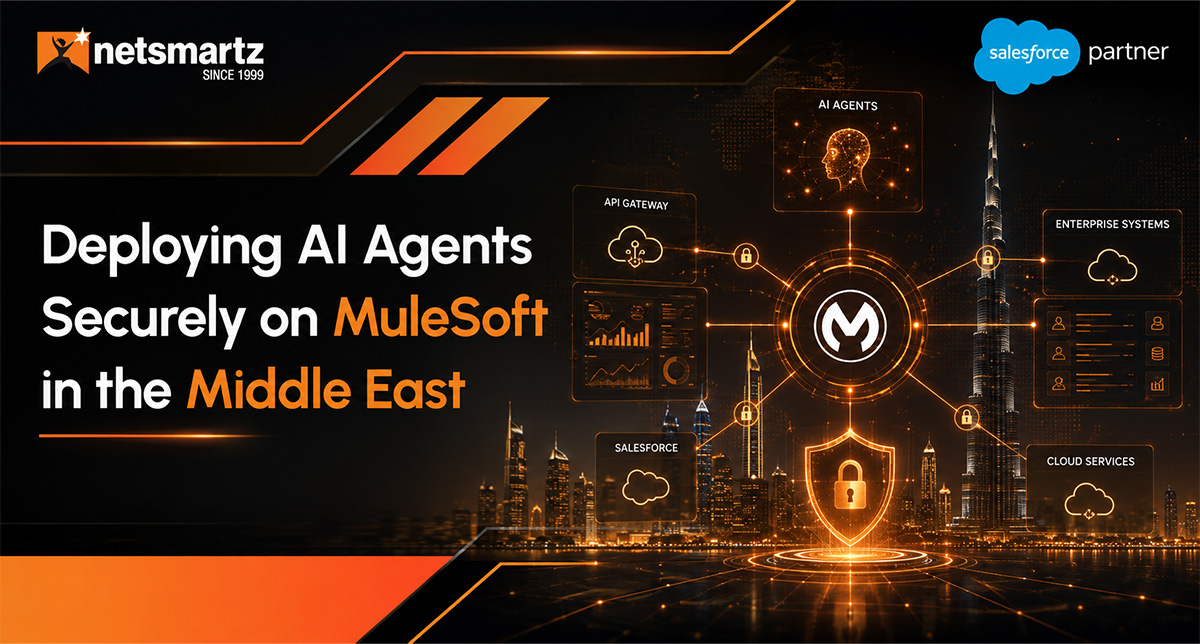
GCC enterprises are deploying AI agents faster than most are governing them. Here is what actually secures that gap on MuleSoft and what the region regulators now expect you to have in place.
"The safest AI agent is not the one that never acts. It is the one whose every action can be explained."
Regulators across the GCC are not waiting for enterprises to slow down and ask permission before deploying AI agents, and most enterprises are not waiting either. That mismatch is the real story behind an agent's sprawl. By 2026, Gartner research indicates that 60 percent of enterprises will have deployed multiple autonomous AI agents, yet less than half will have proper governance frameworks in place to manage them. In regulated GCC sectors like finance and real estate, that gap is not a minor operational headache; it is a compliance exposure with a regulator name already attached to it.
Agent sprawls happen quietly. A CX team launches a service agent on one platform. RevOps builds something similar over a weekend on another. Finance quietly automates invoice review with a third tool entirely. None of these individual choices are reckless, but together they create a landscape where no single person, not security, not IT, not the compliance officer, can say with confidence how many agents are running, what data they can touch, or who approved them. MuleSoft Agent Fabric was built specifically to close that gap, and in a region where sector regulators are actively tightening AI oversight in 2026, closing it early matters more than almost anywhere else.
Why "Agent Sprawl" Is a Bigger Risk in Regulated GCC Sectors
The pace of AI adoption across the UAE and wider GCC is genuinely fast, faster in many cases than the governance frameworks meant to sit underneath it. Financial institutions are working against a real deadline, the New CBUAE Law that came into force in September 2025 carries a one-year regularization period ending in September 2026, and it now embeds cybersecurity and technology oversight directly into primary financial legislation. Real estate and government sector data is increasingly treated as sovereign, with the Central Bank of the UAE launching the region's first sovereign financial cloud infrastructure earlier this year. Layer an ungoverned AI agent, one nobody registered or scoped properly, on top of that regulatory environment, and a routine automation project turns into an audit finding.
This is why agent sprawl carries more weight in the GCC than in markets with a single, unified AI statute. Here, an unregistered agent is not just a governance gap, it is potentially a breach of the UAE PDPL, a violation of DIFC Data Protection Regulation 10, which moved to full enforcement on January 1, 2026, governing personal data processed through autonomous and semi-autonomous systems, or a CBUAE compliance failure, depending on which entity built it and what data it touched.
How MuleSoft Agent Fabric Addresses Security
MuleSoft Agent Fabric approaches this the same way MuleSoft has always approached fragmented enterprise systems, by turning scattered assets into a managed, governed network — but that network is only as strong as the enterprise-ready MuleSoft APIs underneath it. Four capabilities do most of the work.
- Agent Registry: a centralized catalog of every AI agent across the enterprise, regardless of which platform built it, whether Agentforce, AWS Bedrock, Azure AI Foundry, or a custom build, so no agent operates outside of a known inventory.
- Governance and budget or LLM routing controls: spend limits, request routing, and centralized visibility into token usage and costs through AI Gateway, so AI spend does not spiral unnoticed across dozens of disconnected tools.
- Observability: full visibility into agent activity across the ecosystem through the Agent Visualizer, including confidence scores, bottleneck detection, and hallucination risk flagged in one place rather than scattered across team dashboards.
- Deterministic workflow control: the ability to choose predictable, rule bound execution over full autonomy on a per workflow basis, giving compliance teams a lever for high-risk processes without switching off AI everywhere else.
Together, these turn a sprawling, undocumented mess of independent agents into something closer to what MuleSoft has always specialized in, a managed, auditable network of enterprise assets.
Middle East Specific Considerations
Deploying this in a GCC enterprise adds a layer that a purely global rollout does not need to think about as carefully. The table below summarizes the main considerations.
| Consideration | What It Means Here |
|---|---|
| Data residency | Regulated data (financial, government, healthcare) increasingly needs to stay in region, reinforced by the CBUAE's new sovereign cloud infrastructure launched in 2026. |
| Sector compliance overlays | Financial entities face the New CBUAE Law and CBUAE Model Management Standards; DIFC entities face Regulation 10, and onshore entities fall under the UAE PDPL, often simultaneously. |
| Free zone versus mainland status | DIFC and ADGM operate under separate data protection frameworks from onshore UAE, so the same agent may face different obligations depending on where the entity is registered. |
| Arabic language and localization risk | Agent outputs generated or translated into Arabic carry added risk of miscommunication in customer facing or compliance sensitive contexts if not specifically tested and validated. |
| Audit trail completeness | Recent research shows a third of organizations lack evidence quality audit trails entirely; a gap regulators are increasingly testing for directly during supervisory review. |
A Practical Security Checklist Before Deploying Agents
Before any agent goes into production in a GCC enterprise, these questions deserve a documented answer, not an assumed one.
- Where does the data live? Confirm whether prompts, logs, and embeddings are processed and stored in region, and whether that satisfies the specific regulator governing this entity.
- Who can access this agent, and under what identity? Every agent in action should be traceable to a specific, authorized identity rather than a shared service account.
- Is there a complete audit log? Confirm logs capture agent decisions, not just outcomes, since regulators are increasingly asking for the reasoning trail, not just the result.
- Is there a kill switch or override? Every autonomous agent needs a documented, tested way for a human to pause or override it immediately if it behaves unexpectedly.
- How are third party and vendor agents handled differently from in-house builds? A vendor agent operating inside your environment still needs to be registered, scoped, and governed like any other.
- Has this agent been tested in Arabic as well as English? Localization testing should be a deployment gate, not an afterthought fixed after a customer complaint.
Netsmartz's MuleSoft services can address all of these challenges together, from registry and observability through to the region-specific compliance overlays that a generic global rollout would miss entirely.
Getting agent governance right the first time is far cheaper than retrofitting it after a regulator asks for an inventory you do not have. Enterprises that treat Agent Fabric as infrastructure, not an afterthought bolted onto existing agent projects, are the ones that will scale past the pilot stage without a compliance incident forcing a pause.
Conclusion
Agent sprawl is not a hypothetical risk for GCC enterprises in 2026; it is already showing up in the gap between how fast AI agents are being deployed and how slowly governance frameworks are catching up. MuleSoft Agent Fabric closes that gap with registry, governance controls, observability, and deterministic workflow options built for exactly this kind of scale. Layered with the region's data residency rules, sector overlays, and audit expectations, secure agent deployment in the GCC is achievable today, but only with the right architecture from the start.
Secure and Scale AI Agents in the GCC
Ensure governance, cost control, and compliance with MuleSoft-led AI agent deployment tailored to GCC regulations.
Frequently Asked Questions
Agent sprawl is the uncontrolled growth of independently built AI agents across an enterprise with no central inventory, ownership, or governance.
Agent Fabric supports region deployment architecture, but compliance ultimately depends on how an enterprise configures data residency and hosting for its specific regulator.
Register every third-party agent in a central inventory like Agent Registry and apply the same identity, access, and audit policies used for in-house agents.
Deterministic workflows follow fixed, predictable rules for high-risk processes, while autonomous workflows allow the agent more flexibility to decide its own next action.
Automated translation or generation in Arabic can introduce meaning shifts that are easy to miss in English language testing alone, creating risk in customer facing or compliance contexts.
Ready to build smarter? Let's talk.
Our experts are ready to help you turn ideas into production-ready AI, cloud and digital solutions.
Get In Touch →Let's Discuss Your Growth Strategy
Let's discuss how we can help you accelerate growth, improve efficiency, and drive real business outcomes.