 AI-First Culture
Construction Margin 2027: Three Clocks Your Finance Office Controls

Much of the work you will build in the first half of next year was probably priced before August. The cost of building it is arriving now, one invoice at a time. If you are planning construction margin 2027, that is the awkward part: margin is set by prices agreed long ago and costs that show up later, and the finance office is the one place where the two meet.
So before the plan hardens into a spreadsheet, it is worth reading what the latest numbers say about the cost side.
What the latest releases say
Four sources, all published this summer or fall, and each reported separately in the trade press. Read side by side, they lean the same way.
Spending. The Census Bureau's August data, released October 1, puts construction spending at $2,203.1 billion at a seasonally adjusted annual rate. That is 0.9 percent above July and 1.7 percent below August 2025. Coverage describes the monthly gain as within the margin of error, so it reads as flat.
Input prices. ABC's analysis of the producer price index, released September 10, has construction input prices up 1.2 percent in August and 8.9 percent over twelve months. AGC's analysis of inputs to new nonresidential construction also lands at 8.9 percent for the year, with diesel up 77.8 percent, aluminum mill shapes up 27.3 percent and steel mill products up 23.4 percent.
Margin. The Construction Financial Management Association's 2026 Benchmarker, reported by ENR, puts average net income before taxes at 6.8 percent for fiscal 2025, up from 6.7 percent the year before, across 1,359 firms.
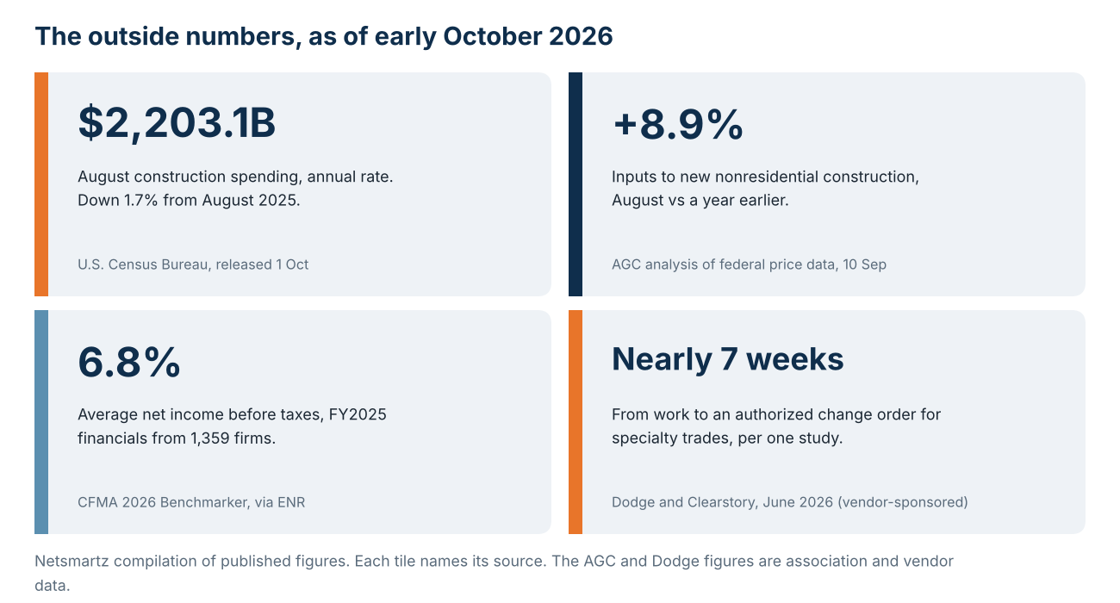
The outside numbers are as of early October 2026. The AGC and Dodge figures are association and vendor data.
What they do not say
None of these numbers is your margin. They are market-wide figures, and your own costs can run well above or below them.
What they support is narrower, and it is our inference: costs are moving faster than the dollars they sit against. Spending is down on a year ago and input prices are up almost nine percent. When prices climb and volume does not, margin tends to leak through gaps between events, not through one bad decision.
A point of margin is bigger than it looks
Here is arithmetic, not research. If the average contractor keeps 6.8 percent before taxes, one point of margin is about 15 percent of the profit. Lose one point to a late cost, a billing error or an unsigned change order and you have lost roughly a seventh of what the job was supposed to earn.
Construction margin 2027: three clocks that run on every job
This is our framework, not a published statistic. Each of the three runs on a clock that your finance office controls.
Cost capture. How many days pass between a supplier invoice arriving and that cost sitting against the right job and cost code? A price increase you see on day two can be questioned with the supplier, passed on to the client or absorbed on purpose. One you first see at month-end close is just a result.
Billing. How many days pass between work being done and the pay application going out, and how often does it come back? Siteline's 2026 survey, a vendor survey of 492 finance and operations professionals, found errors or omissions on pay applications are the top internal cause of late payment. It also found 43 percent of subcontractors wait over 90 days for final payment and retainage. A slow or wrong bill does not change margin on paper. It does mean you carry the cost yourself for longer, while prices are rising.
Change orders. When a cost increase or scope change is real, is it written up, priced and signed? Or discussed on site and meant to be sorted out later? In the Dodge and Clearstory research, 77 percent of specialty trades said they write off unapproved or downward-negotiated change orders as bad debt. Same caveat: vendor-sponsored, no sample size stated. The direction is what matters.
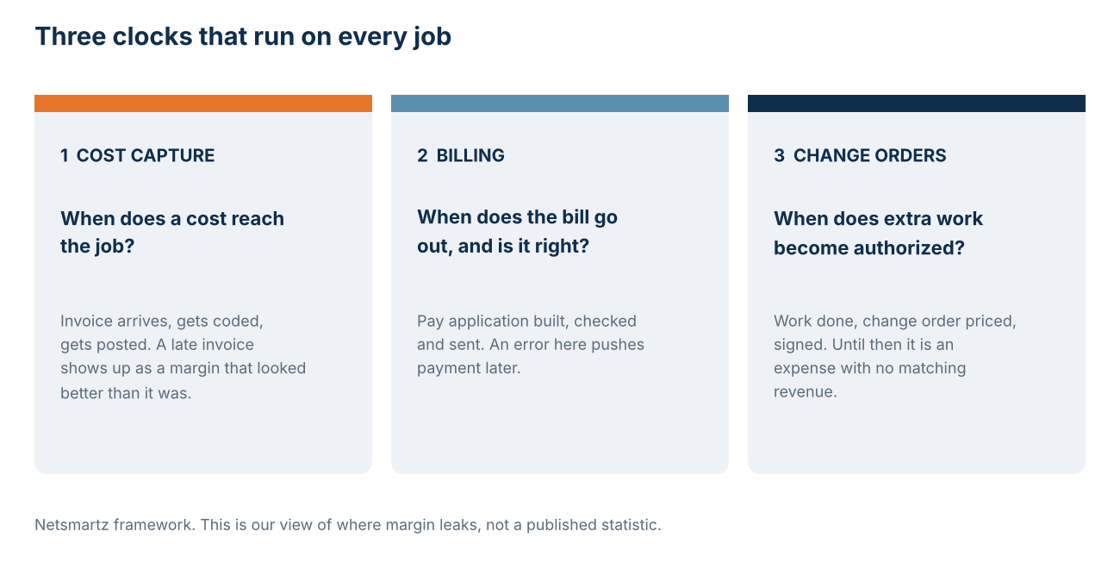
Three clocks that run on every job. Netsmartz framework.
Three numbers to pull from your own books this week
None of them needs new software.
1. The median number of days from supplier invoice received to cost posted against a job, and the slowest ten invoices.
2. The number of days from period end to pay application sent on your five largest jobs, and how many applications were sent back or corrected in the last 90 days.
3. Change orders waiting for a signature: how many, what value and how old.
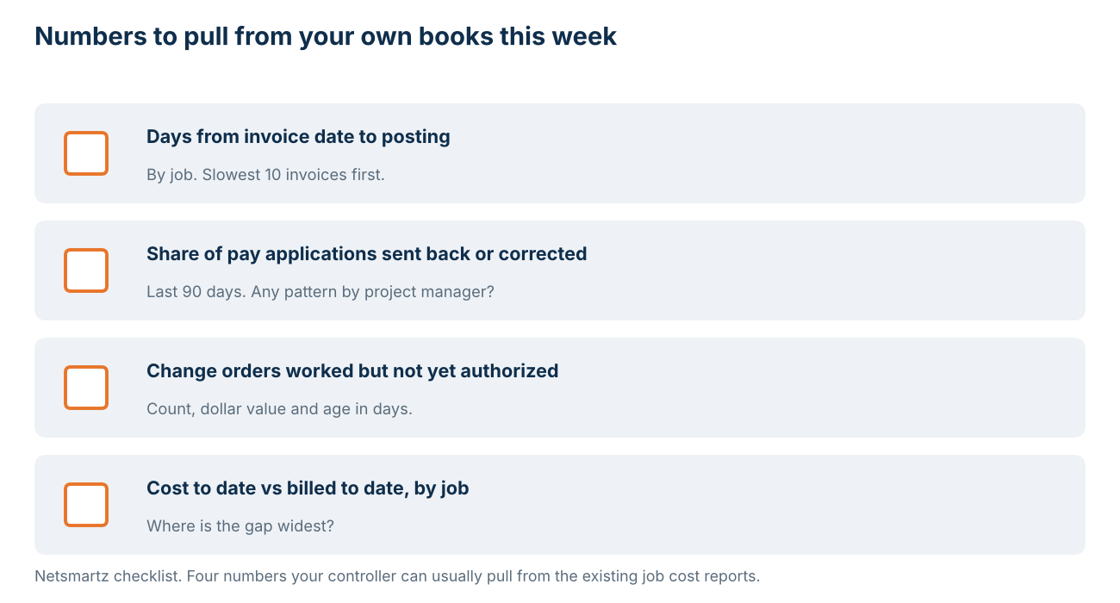
A checklist for your controller. Four numbers usually available from existing job cost reports.
If you can pull all of them in an afternoon, you have a picture. If one takes a week, that is your finding, and it is better to learn it in October than in March.
Where Netsmartz for Construction fits
Each clock has a place where it usually breaks, and we work on all three. ProjectPro is built natively on Business Central. Its progress billing supports AIA billing on G702 and G703 forms. Its contracts module generates change orders from job card data and carries bid items through to billing once they are approved, and its subcontract management tracks retainage, lien waivers and certificate of insurance alerts. Our Business Central implementation team wires those into your approval chain, so a cost, a bill or a change order does not sit waiting for someone to notice.
Where agents help, we apply one rule: a written scope and a named human approver for every agent task. Faster is only useful if you can still say who signed.
What this is not
It is not a forecast, and it is not a claim that 2027 will be a bad year. National averages hide a lot of variation by sector and company, and plenty of contractors will do well. The point is smaller than that. The cost side of 2027 is already arriving, and what happens to it depends on how quickly your office can see it, bill against it and recover it.
Want to tighten the three clocks before 2027?
Talk to our Business Central and ProjectPro team about cost capture, billing and change orders in one system.
Frequently Asked Questions
ABC's analysis of the producer price index, released September 10, 2026, has construction input prices up 1.2 percent in August and 8.9 percent over twelve months. AGC's analysis of inputs to new nonresidential construction also shows 8.9 percent for the year.
The Census Bureau data shows $2,203.1 billion at a seasonally adjusted annual rate, 0.9 percent above July and 1.7 percent below August 2025. Coverage describes the monthly change as within the margin of error.
CFMA's 2026 Benchmarker, reported by ENR, puts average net income before taxes at 6.8 percent for fiscal 2025 across 1,359 firms.
Start with days from supplier invoice to job cost, days from period end to billing and how often pay applications are corrected, and the count, value and age of change orders awaiting signature.



Ready to build smarter? Let's talk.
Our experts are ready to help you turn ideas into production-ready AI, cloud and digital solutions.
Get in touch →Let's Discuss Your Growth Strategy
Let's discuss how we can help you accelerate growth, improve efficiency, and drive real business outcomes.