 AI-First Culture
Unifying the Shop Floor: Why Business Central is the Ultimate Manufacturing Engine

Manufacturers today face constant pressure. Rising raw material costs, supply chain disruptions, stricter quality standards, and tighter customer delivery expectations all compete for attention. Without the right manufacturing ERP software to manage these moving parts, inefficiencies grow quickly, and operational costs rise alongside them.
Microsoft Dynamics 365 Business Central for manufacturing helps businesses connect production, inventory, finance, and supply chain operations within a single platform. Unlike disconnected spreadsheets and legacy systems that fragment data across departments, Business Central delivers real-time visibility, faster decision-making, and more coordinated operations across the business.
The Real Cost of Manufacturing Complexity
Manufacturing is inherently complex. You manage bills of materials, production schedules, multiple warehouse locations, supplier relationships, quality standards, and financial reporting all at once. When these processes don’t communicate, the impact spreads quickly across operations. A material shortage halts production. The inventory sits in the wrong location. Financial reports lag weeks behind reality.
Over time, these inefficiencies become expensive. Delayed production affects customer commitments; excess inventory increases carrying costs, and disconnected reporting limits decision-making. Most mid-sized manufacturers eventually reach a breaking point where manual processes and legacy systems can no longer support growth.
This is why many organizations are adopting Dynamics 365 Business Central for manufacturing to improve visibility, streamline operations, and reduce the operational cost of complexity.
What Business Central Does for Manufacturing
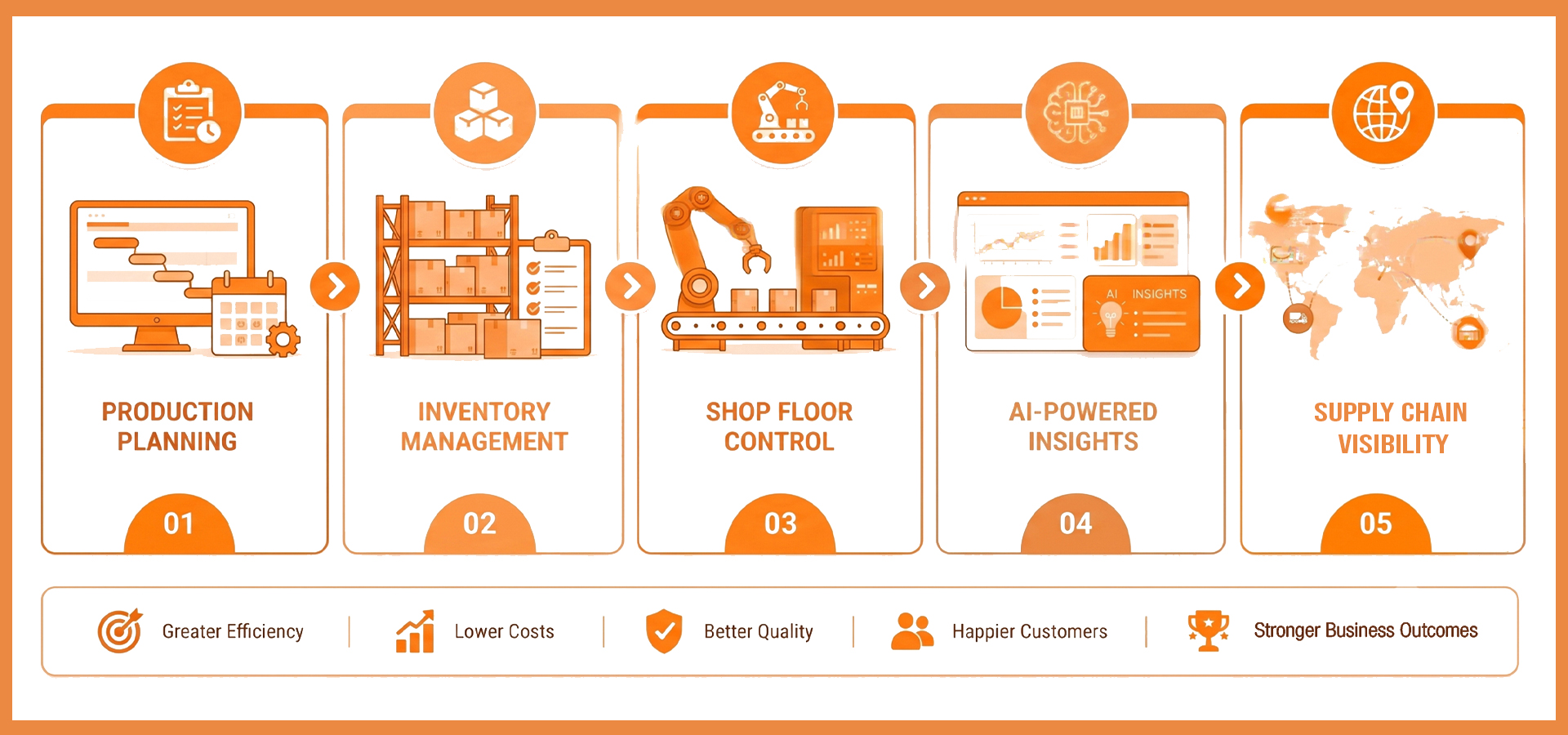
Production planning that actually works
Production planning in Business Central for manufacturing starts with real-time data. The platform automatically generates production schedules based on your sales orders, inventory levels, and machine capacity. You define the resources available: labor hours, machine capacity, and set-up times. Business Central then calculates realistic timelines.
This matters because most manufacturers run into bottlenecks not because they lack equipment but because they can't see the constraints until it's too late. Dynamics 365 Business Central’s manufacturing capabilities help teams identify production issues earlier, before operations stall.
By automating production plans, manufacturers reduce downtime and allocate resources where they're needed most. This is more effective than allocating resources based on assumptions alone.
You can also build complex bills of materials with multiple levels, manage version control so product changes don't disrupt ongoing production, and track consumption and scrap in real time. When demand spikes, you adjust the schedule in minutes, not days.
Inventory management that stops the guessing game
Real inventory visibility is rare in manufacturing. Most companies rely on spreadsheets, memory, or outdated reports. Business Central tracks inventory across all your locations: warehouses, the shop floor, and in-transit goods. It shows you the actual picture at any moment.
This helps prevent two costly problems: stockouts that halt production and excess inventory that ties up working capital. Business Central for manufacturing also helps businesses forecast demand using historical data, so materials are ordered based on actual production requirements rather than assumptions. When connected with supplier operations, manufacturers can move closer to just-in-time inventory management and reduce carrying costs significantly.
Better still, automated warehouse management tools streamline picking, packing, and shipping. When customers get orders right and on time, satisfaction increases, and you free up teams to focus on more critical work.
Shop floor control and quality that matter
What happens on the shop floor determines everything. Microsoft ERP for manufacturers lets you track work orders, monitor machine performance, and record actual production time against planned time. If a machine falls behind, you see it immediately and can adjust upstream.
Quality checks happen at defined points in your production workflow. Non-conformance issues trigger corrective actions, and every step is documented for compliance and continuous improvement. If you operate in regulated industries like medical devices, automotive, or food manufacturing, this audit trail is invaluable.
AI-powered insights for smarter decisions
Dynamics 365 Business Central for manufacturing includes built-in Copilot capabilities that automate repetitive data entry, generate forecasts based on trends, and create reports without manual compilation. This matters because data-driven decisions are only valuable if you can actually use the data quickly.
Your production manager can ask Copilot to predict lead time issues next month. Your finance team can get inventory cost reports in seconds. Your supply chain team can see demand patterns and adjust procurement automatically.
Supply chain visibility that prevents disruptions
Supply chain surprises like late deliveries, material quality issues, and carrier delays hit your bottom line fast. Business Central integrates procurement, supplier relationships, and logistics into one view. You see inbound shipments, track supplier performance, and manage lead times systematically.
With AI-powered forecasting, you can identify risks early. If a key supplier is slowing delivery, you can adjust orders or find alternatives before production stalls. This kind of proactive management separates resilient manufacturers from reactive ones.
Why Manufacturers Choose Business Central
It's scalable.
Whether you operate one facility or many, Business Central scales with you. Add warehouses, product lines, or geographic locations without replacing your core platform.
It integrates with what you already use.
Business Central works with Microsoft 365, Power BI, Excel, Teams, and dozens of third-party applications. Your data flows where it needs to go without manual rework.
It's cloud-based.
You don't maintain servers or manage infrastructure. Updates happen automatically, and you access the platform from anywhere: the office, the shop floor, or while traveling.
Getting Started with Business Central
Implementing Business Central for manufacturing typically involves planning, data migration, configuration, testing, training, and go-live support. Most manufacturers see value within the first few months once teams are trained and familiar with the workflows.
The key to success is engaging your teams early. Your production managers, plant accountants, and supply chain coordinators need a voice in how the system is configured. As a Microsoft Solutions partner, we work with manufacturers on these projects together, and adoption happens naturally, and benefits compound faster.
It’s better to define clear implementation goals upfront, assign an internal project sponsor, and plan for comprehensive training before go-live. This approach turns potentially disruptive changes into a collaborative improvement initiative.
Take the Next Step
Manufacturing complexity isn't going away. But your response to it can change. Dynamics 365 Business Central is built for manufacturers who want real-time visibility, faster decisions, and operations that scale efficiently.
Want to see how Business Central can transform your manufacturing operation? Talk to an Expert
Frequently Asked Questions
1. Can Business Central handle multi-location manufacturing?
2. Does it work with our existing systems?
3. How long does implementation take?
4. What about data security and compliance?
Keep reading

Business Central Features for CFOs: Are You Using What You Already Have?
Business Central MCP Server: Why Construction's Biggest AI Use Case Is the Back Office
Accounts Payable Automation Software and the 34-Point Gap in Who Gets Paid on Time in Construction
Ready to build smarter? Let's talk.
Our experts are ready to help you turn ideas into production-ready AI, cloud and digital solutions.
Get In Touch →Let's Discuss Your Growth Strategy
Let's discuss how we can help you accelerate growth, improve efficiency, and drive real business outcomes.