 AI-First Culture
API Integration for VAT Compliance in UAE and Saudi Arabia

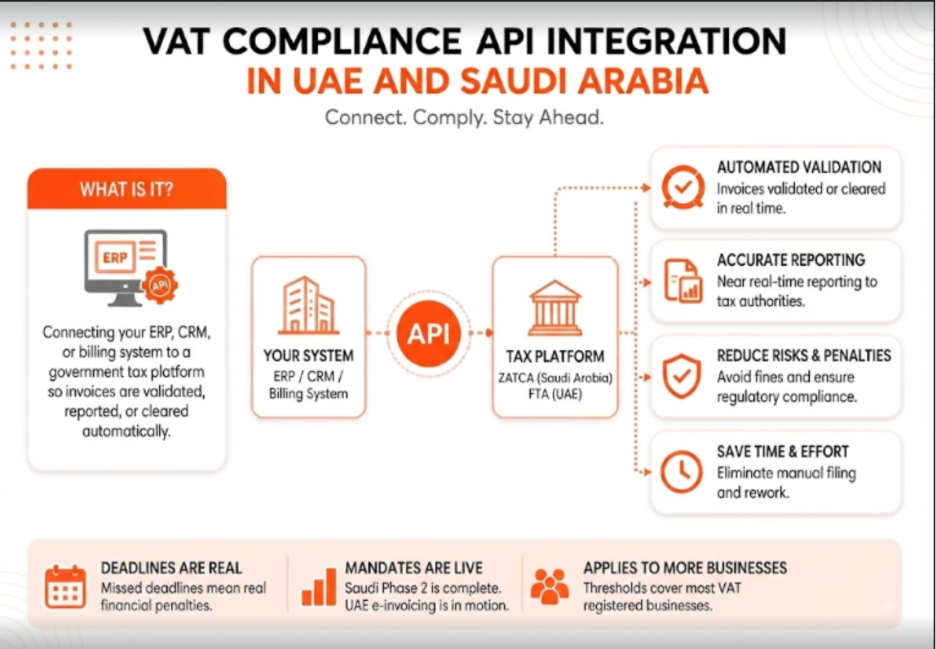
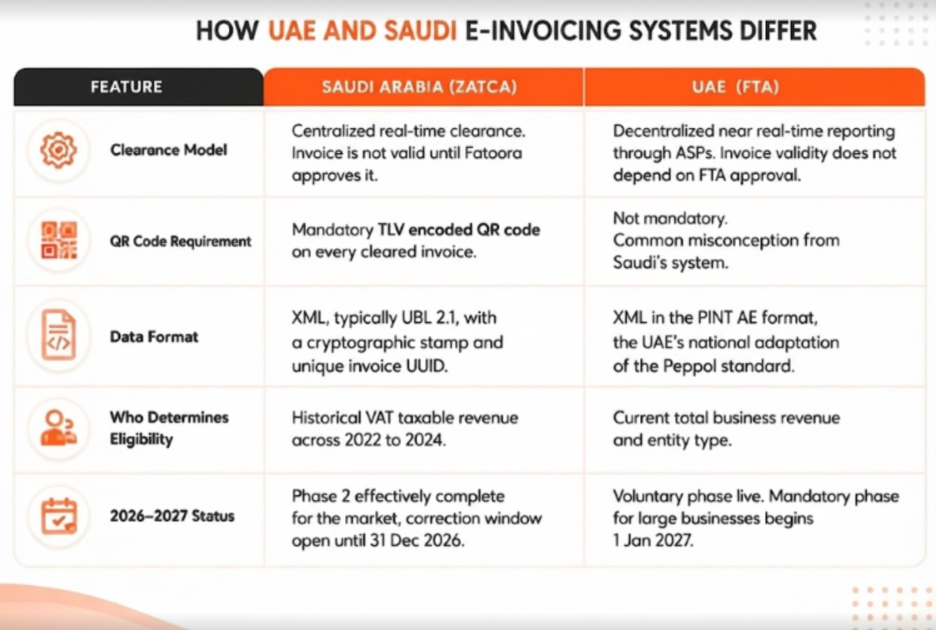
Saudi Arabia and the UAE are often lumped together as one GCC compliance problem, but they run genuinely different systems in 2026. Getting VAT compliance API integration UAE Saudi Arabia projects right starts with accepting that these are two separate regulatory models, not one regional standard. Saudi Arabia operates a two-phase, real-time clearance model, where every invoice above the registration threshold must be transmitted to ZATCA's Fatoora platform and cleared before it is considered valid. The UAE, by contrast, currently runs on a post audit model with a strict 14-day issuance rule but no mandatory real time clearance yet, and its new e-invoicing system, now rolling out in phases through 2027, uses a decentralized reporting architecture rather than Saudi's centralized clearance approach. For a finance or IT lead managing compliance in both countries, treating this as one integration project instead of two is the single most common and most expensive mistake.
Saudi Arabia: A Two-Phase, Real-Time Clearance Model
Phase 1 and Phase 2
Saudi Arabia's e-invoicing mandate began with Phase 1, the Generation phase, in December 2021, requiring businesses to issue structured electronic invoices instead of paper ones. Phase 2, the Integration phase, started in January 2023 and has rolled out in successive waves based on annual VAT taxable revenue, each wave narrowing the threshold and pulling in a larger share of the market. Any ZATCA e-invoicing integration project needs to account for this wave structure rather than treating it as a single, one-time mandate. ZATCA notifies each wave's targeted taxpayers roughly six months ahead of their integration deadline, giving businesses a defined runway rather than a surprise mandate.
Wave 24 and the June 2026 Threshold
Wave 24, announced by ZATCA on 26 September 2025, is the most expansive wave to date, covering every taxpayer whose VAT taxable revenue exceeded SAR 375,000 in 2022, 2023, or 2024. Because that figure matches Saudi Arabia's mandatory VAT registration threshold, Wave 24 effectively brought ZATCA Phase 2 integration to nearly every VAT registered business in the Kingdom by its 30 June 2026 deadline. As of today, that deadline has passed, and ZATCA has not announced a further wave, meaning Phase 2 integration is now the default expectation for any VAT registered Saudi business rather than a future milestone. Businesses that missed their deadline still have a window to correct course, since ZATCA's penalty cancellation initiative, which forgoes certain fines for businesses that come into compliance voluntarily, has been extended through 31 December 2026.
The Technical Requirements
Integration with Fatoora is a real time dependency, not a batch reporting task. Affected businesses must generate invoices as structured XML, typically UBL 2.1, apply a cryptographic stamp and a unique invoice UUID, embed a TLV encoded QR code on every invoice, and transmit it to ZATCA's platform via secure API for real time clearance before it reaches the buyer. This means the integration has to sit inside the transaction flow itself, since an invoice that has not cleared Fatoora is not yet considered valid.
UAE: A Post Audit Model Moving Toward Decentralized Reporting
The 14 Day Issuance Rule
Under current UAE VAT law, a tax invoice or credit note must be issued within 14 days of the date of the business transaction, defined as the earlier of the transaction date or the date payment was received. This rule already exists independently of the new e-invoicing mandate and applies to every VAT registered business today, making it one of the stricter invoice timing rules in the region regardless of which invoicing system a business eventually adopts.
No Mandatory QR Code, a Real Difference From Saudi Arabia
This is worth stating plainly since it is a common point of confusion: QR codes are not a mandatory requirement for UAE e-invoicing, unlike Saudi Arabia's ZATCA mandate, which requires a TLV QR code on every cleared invoice. A supplier may optionally include a QR code on a human readable copy, but it carries no compliance weight under FTA rules. An integration plan that assumes UAE and Saudi share the same technical checklist will build unnecessary QR code logic into the UAE side for no regulatory reason.
The New E-Invoicing Timeline
The UAE's new e-invoicing system, established under Ministerial Decisions No. 243 and 244 of 2025, uses what the Ministry of Finance calls a Decentralized Continuous Transaction Control and Exchange model, a five-corner structure where invoices move between businesses through Accredited Service Providers connected via the Peppol network, while key tax data reaches the FTA in near real time rather than through a single centralized clearance step. Invoices follow the PINT AE data standard, the UAE's national adaptation of the international Peppol format.
The rollout is phased by revenue and entity type: a voluntary participation phase opened 1 July 2026, businesses with AED 50 million or more in total revenue must appoint an Accredited Service Provider by 31 July 2026 and begin mandatory FTA e-invoicing UAE authorities require by 1 January 2027, businesses below that threshold have until 31 March 2027 to appoint a provider and 1 July 2027 to comply, and government entities follow on 1 October 2027. B2C transactions remain outside the mandate for now.
Why This Is a MuleSoft Problem, Not Just a Compliance Problem
Both of these integrations sit inside the transaction flow itself, a Saudi invoice literally isn't valid until it clears Fatoora, and UAE invoice data has to reach an Accredited Service Provider reliably every time. That makes this fundamentally an API-led integration problem, not a reporting or batch-export problem, which is exactly the kind of work MuleSoft's Anypoint Platform is built for rather than a point-to-point script bolted onto an ERP.
In practice, that means:
Reusable API layers instead of one-off connectors
A properly built MuleSoft integration exposes ERP invoice data through a stable system API once, then builds Saudi's clearance logic and the UAE's ASP transmission logic as separate process APIs on top of it, so a change to one country's requirements doesn't mean rebuilding the other.
Built-in retry and error handling for real-time dependencies
Since a Saudi invoice can't reach a buyer until Fatoora clears it, the integration needs proper handling for clearance rejections, timeouts, and resubmissions, not a fire-and-forget API call.
Governance and observability for a compliance-critical data flow
Every invoice transmission is auditable, which matters when a regulator asks for evidence of when and how each invoice was cleared or reported
What This Means for API Integration Architecture
A GCC group operating in both countries needs to plan for two structurally different integrations, not one shared build with a country flag toggled on or off.
- Build for clearance dependency in Saudi Arabia specifically, since an invoice cannot legally reach a buyer until Fatoora has cleared it.
- Do not port QR code generation logic into the UAE build by default, since it adds unnecessary complexity to a requirement that does not exist there.
- Select an Accredited Service Provider for the UAE side early, since ASP appointment deadlines are separate from the mandatory e-invoicing dates and easy to miss - often the point where regional MuleSoft partners earn their keep, given how much local regulatory nuance shapes the build.
- Map both integrations to the same ERP source data where possible, since the underlying invoice data is often identical even though the transmission format and validation rules differ completely.
Forbes notes that organizations achieve stronger transformation outcomes when they build scalable processes around shared business data, governance, and operational efficiency rather than isolated technology initiatives.
Conclusion
VAT compliance API integration UAE Saudi Arabia projects fail most often not because the technical work is unusually hard, but because teams assume one region means one build. Saudi Arabia's Fatoora integration is a real time clearance dependency baked into the transaction itself. The UAE's e-invoicing rollout, still in its voluntary phase as of today with mandatory dates arriving through 2027, is a decentralized reporting model with no QR code requirement and a completely different validation architecture. Any VAT API compliance GCC integration strategy has to start from that split, not from a shared checklist. According to ZATCA's own Wave 24 announcement and the UAE Ministry of Finance's published e-invoicing framework, these are two distinct systems on two distinct timelines and treating them that way from the start is what keeps an integration project on schedule.
Build VAT Compliance Integrations for UAE and Saudi Arabia
Get expert guidance to design and optimize API integrations that align with ZATCA and UAE FTA requirements while keeping your compliance workflows reliable and scalable.
Frequently Asked Questions
The deadline was 30 June 2026, covering all businesses whose VAT taxable revenue exceeded SAR 375,000 in 2022, 2023, or 2024, and it has now passed.
No, QR codes are not mandatory under UAE FTA e-invoicing rules, unlike Saudi Arabia, where a TLV encoded QR code is required on every cleared invoice.
Mandatory e-invoicing begins 1 January 2027 for businesses with AED 50 million or more in revenue, and 1 July 2027 for smaller businesses, following a voluntary phase that opened 1 July 2026.
ZATCA uses centralized real time clearance through its Fatoora platform, while the FTA uses a decentralized model where invoices route through Accredited Service Providers on the Peppol network.
Not necessarily separate systems, but the integration logic, data format, and validation rules must be built separately for each country, since the two regulatory models are structurally different.



Ready to build smarter? Let's talk.
Our experts are ready to help you turn ideas into production-ready AI, cloud and digital solutions.
Get In Touch →Let's Discuss Your Growth Strategy
Let's discuss how we can help you accelerate growth, improve efficiency, and drive real business outcomes.