 AI-First Culture
AI Can Spot the Risk. Can Australia’s $242B Infrastructure Company Act in Time?
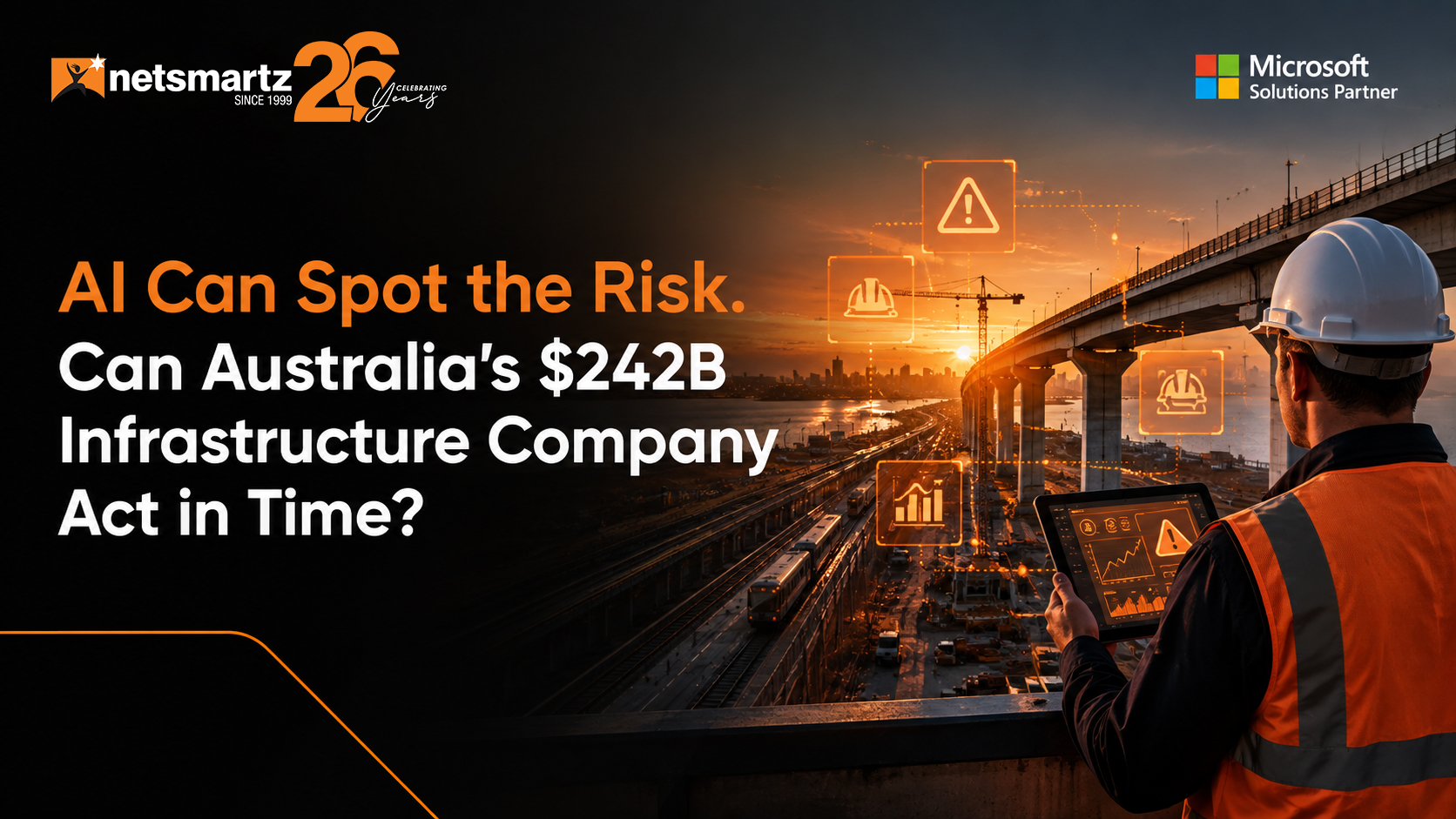
The usual explanation for why Australian construction lags on AI is that the technology isn't ready, or that site teams won't use it. Both are out of date, and holding onto either risks costing money.
The productivity record tells a different story. The Queensland Productivity Commission's 2025 final report found construction labour productivity is only 5 per cent higher than it was in 1994-95, compared with 65 per cent growth across the market economy. It also found construction productivity appears to have declined by around 9 per cent since 2018.
That decline comes despite years of investment in construction technology. Tablets on site. Cloud document control. Live dashboards in the project office. Technology has advanced. The productivity gains have not kept pace.
AI in construction project management can now identify patterns that signal a project may slip. Where Australian contractors lose money is in everything that happens after the warning appears.
What Can AI Actually Do in Construction Project Management Today?
Most vendor pages cover the same use cases: predictive scheduling, safety monitoring, automated takeoff, clash detection, and progress reporting.
These capabilities are increasingly available across major construction platforms. The differentiator is no longer what AI can identify, but how the business responds.
Ask a project executive: if AI flags a three-week slip on a critical activity, what happens in the next 72 hours? Who reads the alert? Who can approve a response? How quickly can they act?
Detection is something you purchase. Response is something you build.
Why Does the Alert Arrive and Nothing Happen?
Three failure modes recur on Australian projects. None is fundamentally a software problem.
- The alert reaches the wrong person. A project manager may see the warning but lack authority to vary a subcontract, approve acceleration costs or trigger a formal notice. Visibility and decision authority do not always sit with the same person.
- The data stops at the subcontract boundary. Critical signals may sit outside the contractor's systems, in supplier updates, site conversations or informal messages. AI can only work with the information it can access.
- False positives erode trust. After several alerts that lead nowhere, teams stop paying attention. The system keeps running. The licences keep getting paid.
Infrastructure Australia's 2025 Infrastructure Market Capacity Report puts the five-year Major Public Infrastructure Pipeline at $242 billion. It also projects peak workforce demand of 521,000, while identifying a 141,000-worker shortage on public infrastructure as of October 2025.
When you cannot simply add people to a problem, response speed becomes one of the few meaningful levers left.
What is the Contractual Risk Nobody Discusses?
AI can flag a delay risk three weeks before a project team would normally spot it. That sounds like a clear win. But earlier visibility also creates a record of when the risk was identified and what happened afterwards.
Under Australian construction contracts, notification windows, record-keeping requirements and extension-of-time provisions can make timely action commercially significant. If an alert sits unresolved, the issue may become more than a project risk. Earlier detection only creates value when governance moves at the same speed.
For CFOs, the question is simple: does better visibility strengthen your claims position, or expose weaknesses in how you respond?
Are You Solving the Right AI Problem?
Not every AI investment in construction does the same job. Some help teams work with information. Others analyse project data to identify what may happen next.
AI that helps teams work with information:
- Search project records, drawings and specifications
- Summarise meetings and correspondence
- Draft RFIs, variation notices and project communications
- Turn project information into reports without hours of rekeying
AI that supports project control:
- Identify emerging schedule and cost risks
- Analyse patterns across project data
- Forecast potential cost or schedule issues
- Help teams assess project health and decide where to intervene
Microsoft's 2025 Work Trend Index found that 82 per cent of leaders see this as a pivotal year to rethink strategy and operations. That pressure to move quickly is real. In construction, it can also create a sequencing problem: investing in visible AI capabilities before fixing the project data underneath them.
The problem is sequencing. Many contractors start with sophisticated project AI while the underlying project record is still fragmented. Job costs sit in one system, subcontractor commitments in another, and project teams still spend hours reconciling information before they trust the numbers.
Feed that into a forecasting model, and the forecast inherits those gaps.
This is where a connected construction ERP becomes relevant. ProjectPro, an AI powered construction management solution, built on Microsoft Dynamics 365 Business Central, brings construction financial and operational data into a connected environment. It does not make the AI smarter. It gives AI a more complete project record to work with.
AI cannot reliably compensate for disconnected information.
What Should You Ask Before Investing?
Assess AI against delivery risk and margin, not feature lists. A feature comparison tells you what the software can do. It does not tell you whether your business can act on it.
- When the tool flags a risk, who can authorise a response, and how quickly can they act?
- What proportion of the data the model needs comes from your own systems, and what sits with your subcontractors?
- Does your notification and claims process move at the same speed as your detection?
- Who owns the false positives, and what happens when the team stops reading the alerts?
A contractor with clear answers can get real value from modest tools. Without them, AI becomes an expensive early warning system your business still cannot act on.
Sophistication does not compensate for weak commercial governance.
So Where Does This Leave Australian Contractors?
The industry keeps treating AI as a technology decision and getting technology-shaped outcomes. But the productivity trend and workforce constraints point to a different priority.
The contractors that gain ground over the next few years will not be distinguished by having the most sophisticated models.
They will be the ones that shorten the distance between knowing and acting.
Ready to Assess Your AI Readiness?
Before investing in another AI tool, look at the systems, data and decision processes underneath it.
Talk to our construction technology team about where AI could create measurable value across your projects.
Frequently Asked Questions
AI is increasingly used for schedule risk prediction, cost forecasting, progress reporting, document analysis and site monitoring. But the bigger question is not what AI can do. It is whether the contractor has the project data and decision processes needed to act on what it identifies.
Yes. It is particularly useful for the information and productivity layer, including document search, meeting summaries, drafting and project reporting. It can support project-management tasks, but it should not be treated as a replacement for specialised schedules or risk analysis.
Traditional software records and reports what happened. AI can analyse patterns and generate predictions about what may happen next. The practical difference is that traditional tools give teams information to interpret, while AI can give them probabilities they still need to evaluate and act on.
Data quality matters, but coverage matters just as much. A clean dataset that only captures part of the project can still produce misleading results. Before investing in predictive AI, understand what information you actually hold across your own systems, subcontractors and suppliers.
It can be, particularly where there is a clear operational problem to solve and enough reliable data to support it. Administrative AI can usually be evaluated through measurable time savings, while predictive project AI requires stronger data, governance and a defined process for acting on alerts.
Ready to build smarter? Let's talk.
Our experts are ready to help you turn ideas into production-ready AI, cloud and digital solutions.
Get in touch →Let's Discuss Your Growth Strategy
Let's discuss how we can help you accelerate growth, improve efficiency, and drive real business outcomes.