 AI-First Culture
Einstein GPT: Transforming CRM Landscape with Generative AI
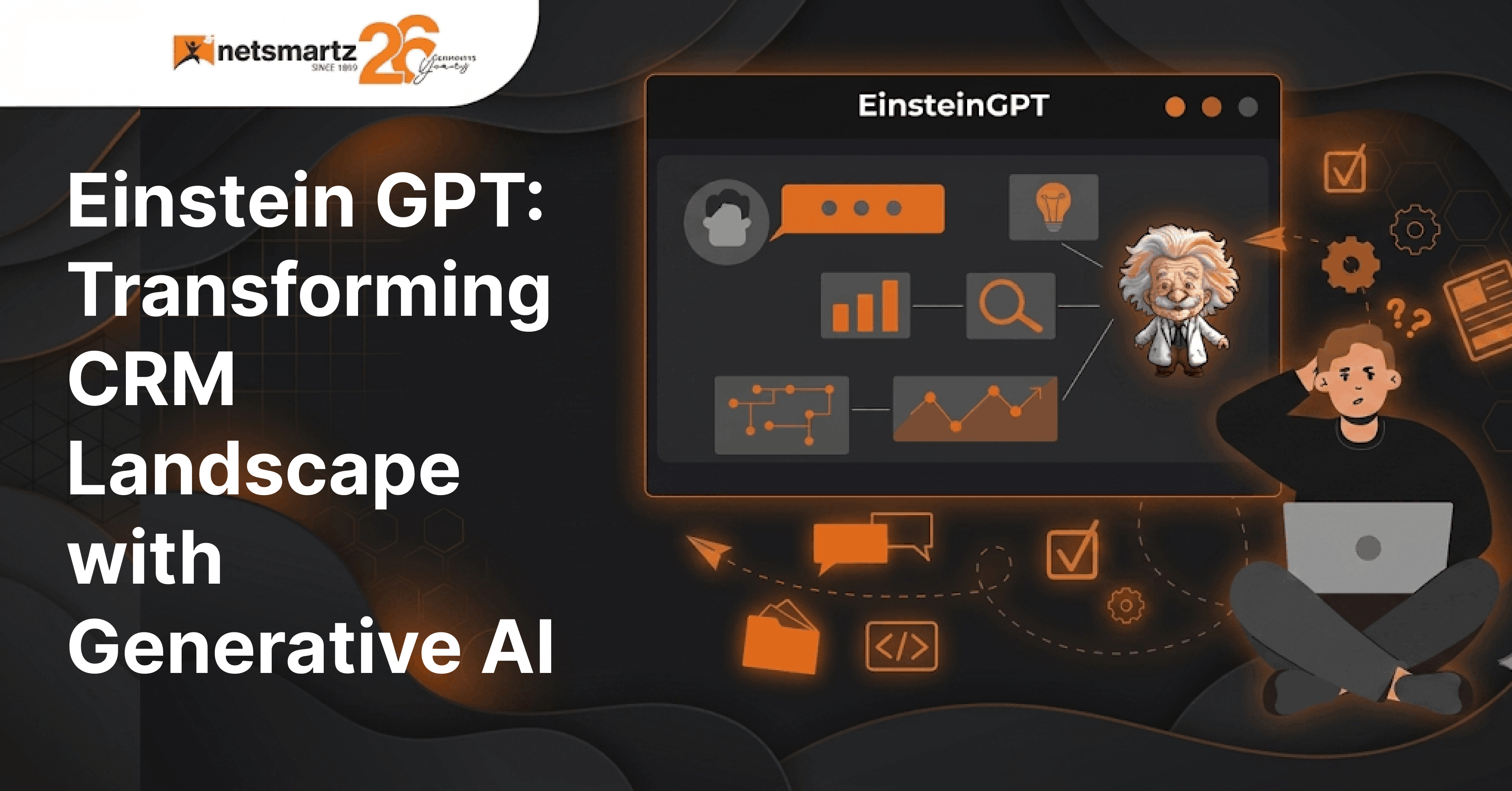
Generative AI has stopped being a novelty in CRM. Your sales team wants their platform to draft follow-up emails instead of writing them from scratch. Your service team wants automatic case summaries so they can focus on actual problem-solving. Marketing wants a campaign copy generated from a single brief instead of written manually.
Einstein GPT is Salesforce's answer to this shift. It’s not a separate tool you need to learn. It’s built into Sales Cloud, Service Cloud, Marketing Cloud, and Slack, platforms your team already uses. What’s changed since its launch is simple. It has moved from experimental to operational. Teams are actually using it now and seeing real time savings.
The key difference from generic ChatGPT is that Einstein GPT pulls from your actual customer data, including purchase history, past conversations, and account context, instead of general web knowledge. A sales rep drafting an email gets suggestions based on what that specific customer actually bought. A support agent gets case summaries grounded in real interaction history. That’s what makes it useful. Not just AI, but AI tailored to your business.
What Einstein GPT Actually Does
GPT stands for Generative Pre-trained Transformer, the model architecture behind ChatGPT. Salesforce partnered with OpenAI to bring that same technology into your CRM, but with one key difference. It generates responses based on your company’s own customer data.
This matters in practice. A predictive model selects from predefined answers. A generative model creates something new each time, shaped by context. Two customers asking similar questions get responses that actually feel personalized, not templated.
Einstein GPT also works within your existing Salesforce data. It pulls from customer records, case history, and past interactions, so what it generates is grounded in real account context, not generic boilerplate.
According to Salesforce, Einstein GPT combines generative AI with trusted CRM data to create personalized content, automate tasks, and generate customer-facing communications directly within Salesforce workflows.
How Does Einstein GPT Fit into Salesforce?
Einstein GPT isn't a separate application. It's built directly into Sales Cloud, Service Cloud, Marketing Cloud, and Slack. Your team encounters generative features inside tools they already use every day - no new login required, no new workflow to learn. That integration matters because adoption happens when the tool meets people where they already work, not where you want them to go.
Data governance automatically carries over too. Because Einstein GPT runs on your CRM records, your existing access controls apply. The tool doesn't show a user more than they could already see themselves. Your compliance rules and data permissions don't change just because AI is writing drafts.
Where Einstein GPT Actually Shows Up in Your Workflow
Sales
Sales reps spend too much time on repetitive emails. "Following up on our call," "Checking in on your timeline," "Here are the next steps"—the same patterns over and over. By mid-2026, Einstein GPT drafts personalized outreach emails based on what you know about that specific customer. A rep still reviews and sends, but the first draft is there. That cuts writing time significantly. More time selling, less time typing. That matters.
Service
Service teams handle countless repetitive inquiries every day. By 2026, Einstein GPT helps agents generate contextual draft responses using customer and case data, reducing manual effort while keeping humans in control. Salesforce research shows AI adoption in customer service grew from 39% in 2025 to 66% in 2026, with 70% of organizations seeing measurable value within 60 days.
Marketing
Marketing teams can ask Einstein GPT to draft campaign copy across web, mobile, email, and social channels from a single brief. By mid-2026, this is actually working. Instead of copywriters manually writing five different versions of the same campaign message, Einstein GPT generates options they can edit and refine. It's faster. It's more consistent.
Development
Developers can ask Einstein GPT for help writing and debugging Apex code, similar to how other AI coding assistants work. By 2026, this is standard for Salesforce developers. It speeds up development cycles.
Slack
Inside Slack, Einstein GPT can summarize open sales opportunities, pull background research on an account, or provide quick context without leaving your chat. By mid-2026, this matters because salespeople are in Slack constantly. Having AI context available there saves switching between tools.
How Are Teams Using Einstein GPT in Practice?
Salesforce designed Einstein GPT around four main outcomes. By mid-2026, real deployments show mixed results.
More personalized interactions: Responses pull from customer history instead of generic templates. This works. A rep sending an email with actual context about a customer's past purchases reads better than generic outreach. Customers notice.
Less time on repetitive work: Automating routine replies frees up service teams for cases needing real problem-solving. This is delivering measurable time savings. Organizations adopting Einstein GPT in late 2025 reported 20-30% time savings on routine case responses by mid-2026.
Easier volume scaling: Handling more customer questions doesn't require hiring proportionally. One team can manage more volume when routine work is automated. This is working for organizations that actually implemented it.
More natural communication tone: Natural-language responses read closer to real conversations than older automated templates. By mid-2026, this is noticeably true. Customers receive emails and case responses that don't feel robotic.
These outcomes are real, but they're not automatic. They require proper implementation, workflow changes, and training. Teams that treated Einstein GPT as plug-and-play got disappointed. Teams that actually changed their workflows around it got results.
“Einstein GPT delivers the most value when it reduces repetitive work, but every output still needs human review to ensure accuracy and trust.”
When Does Einstein GPT Require Human Oversight?
Generative AI writes fluently. Fluent doesn't mean accurate. By mid-2026, this is still the biggest issue.
Any draft from Einstein GPT about pricing, policy, or a customer's account needs a person to check it before sending. Especially in service and sales. Mistakes are costly. A service agent sending out wrong pricing information because they didn't review the AI draft? That's a compliance issue. A sales rep sending incorrect account details? That damages trust.
Cost and integration are open questions. By mid-2026, implementation costs have come down from 2025, but there's still a ramp-up period. Your team adjusts workflows. Training happens. It's not an instant win.
Compliance teams need real answers on specific questions: How is customer data used to generate responses? How long is it retained? Who can see drafts before they're sent? These answers vary by industry and region. Get confirmations in writing rather than assuming defaults.
By mid-2026, organizations have learned lessons on Einstein GPT deployment. The ones that succeeded were clear about these limitations upfront.
Getting Started with Einstein GPT
Implementation typically starts with identifying high-volume, repetitive tasks. Service teams handle routine questions. Sales teams send lots of similar outreach. Marketing teams create multiple versions of the same campaign. These are your first use cases.
From there, you work with your Salesforce team or implementation partner to configure Einstein GPT within your existing setup. You don't need separate infrastructure. It runs on your current Sales, Service, or Marketing Cloud licenses. Teams get trained on when to use it, how to review drafts, and how to escalate when needed.
Timeline? Organizations that deployed in late 2025 saw initial results within 4-8 weeks. Full adoption and optimization across multiple teams? 3-6 months. The variability depends on how many workflows you're changing and how much customization you need.
Final Thoughts
Einstein GPT brings generative AI directly into the CRM tools your team already uses. It helps draft emails, generate responses, and create content faster.
The real value does not come from the feature itself. It comes from how your team uses it. The organizations seeing results are the ones that treated it as a workflow change, not a shortcut.
Start small. Pick one use case. Measure the results. Then expand.
That is how smart adoption happens.
Unlock the Power of AI-Powered CRM
See how Einstein GPT can help your sales, service, and marketing teams automate repetitive tasks and deliver more personalized customer experiences.
Frequently Asked Questions
No. It's built into Sales Cloud, Service Cloud, Marketing Cloud, and Slack. If you already have these licenses, you've got access to Einstein GPT features. Pricing depends on your specific cloud editions and usage, but it's not an additional product line.
No. It drafts emails, case responses, and campaign copy for people to review, edit, and send. Salesforce positions it as a way to cut down repetitive writing, not as a replacement for the people doing the job. By mid-2026, that positioning has held up in practice.
ChatGPT is trained on public web text. Einstein GPT uses the same technology but applies it to your actual CRM data. That means responses are shaped by what that specific customer has done, not general knowledge. That's the difference between generic and personalized.
Salesforce hasn't published a single flat rate. Pricing depends on which clouds and editions you have. Talk to your Salesforce account team for a quote specific to your setup.
Einstein GPT operates within your existing Salesforce data permissions. It doesn't expose data beyond what the person using it already can access. That said, confirm data retention and usage specifics with your compliance team before rolling it out. Don't assume anything.
Sales and service teams with high volume of repetitive written communication see immediate time savings. Marketing and development teams get results too, but often after the core workflows are stable.
By mid-2026, Einstein GPT moved from a proof-of-concept to production deployments. Early adopters in late 2025 worked out implementation issues. By mid-2026, new customers deploying it have better guidance and faster timelines.
Ready to build smarter? Let's talk.
Our experts are ready to help you turn ideas into production-ready AI, cloud and digital solutions.
Get in touch →Let's Discuss Your Growth Strategy
Let's discuss how we can help you accelerate growth, improve efficiency, and drive real business outcomes.