 AI-First Culture
5 Signs Your Business Needs an AI Agent (Before It’s Too Late)
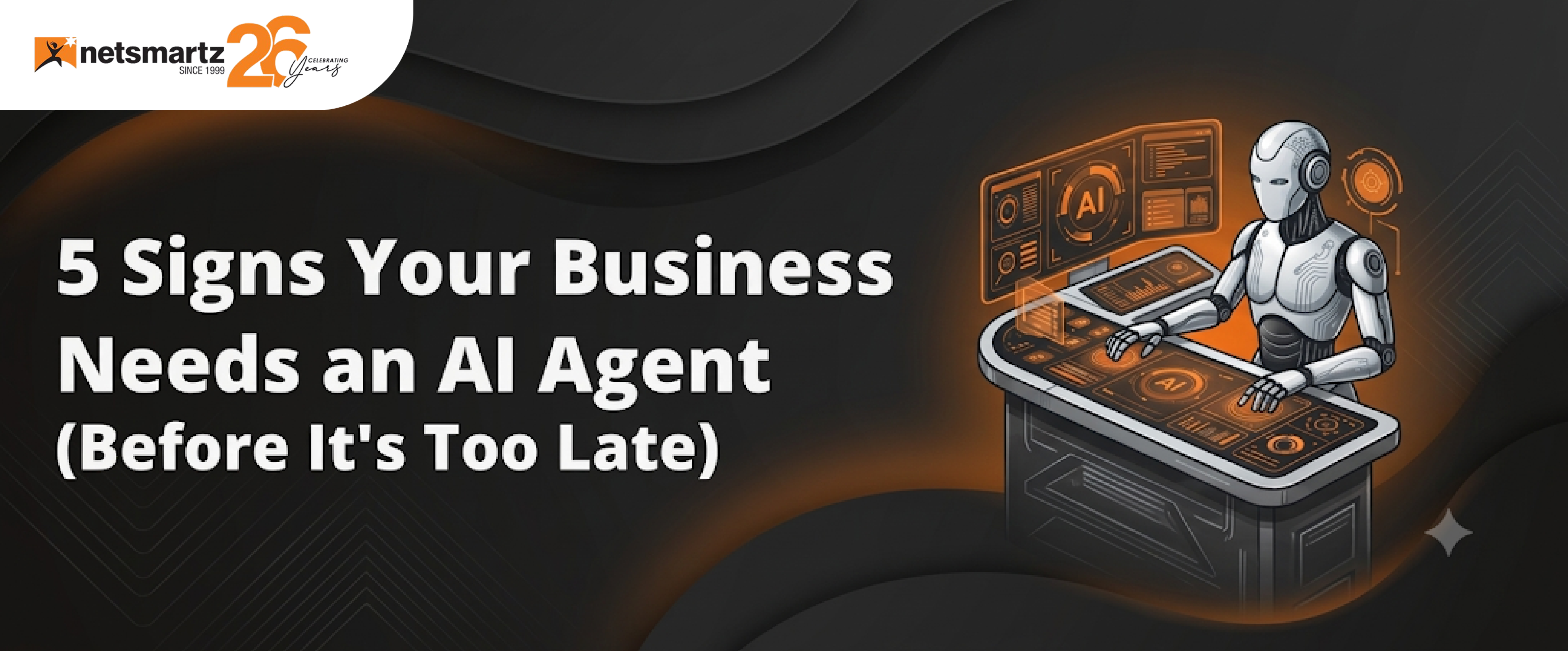
Most businesses don't notice these gaps until growth starts slowing down. Delayed responses, repetitive tasks, and disconnected workflows quietly create friction across teams; one missed follow-up or duplicated task at a time. Meanwhile, competitors using AI agents are automating the operational stuff and pulling ahead on execution speed. The businesses still running everything manually usually don't clock the gap until it's already wide.
The signs tend to show up early. Most companies just don't recognize them as signs until the competitive disadvantage is harder to reverse.
What Are AI Agents for Business and How Do They Work?
AI agents are systems built to automate workflows, manage operational tasks, handle communication, and support faster decisions, mostly without someone standing over them. The difference from older automation tools is adaptability. A basic automation tool follows a fixed script; an AI agent can process new information and adjust a multi-step workflow on the fly instead of breaking the moment something doesn't match the template.
In practice, businesses are putting these agents to work on lead qualification, customer support, scheduling, internal operations, and reporting. None of that is really about automation for its own sake. It's about building operations that scale without everything getting slower and more expensive as the business grows.
For businesses already using Salesforce, working with experienced Salesforce partners can help identify the right AI agent use cases, connect automation with existing CRM workflows, and ensure AI adoption aligns with broader business goals. The right implementation approach helps teams move from experimenting with AI to creating measurable operational improvements.
Where Can Businesses Use AI Agents Effectively?
A few benefits show up again and again once a business starts using AI agents. Execution gets faster, since less time gets lost to manual coordination and repetitive back-and-forth. Customer communication gets more consistent, because responses stop depending on whoever happens to be free that day. Teams spend less time on routine maintenance and more on the work that actually needs a person's judgment. Volume becomes easier to handle without headcount climbing in lockstep. And because agents improve visibility into what's happening across teams, decisions tend to move faster too.
The momentum behind AI adoption is accelerating. Salesforce's State of Marketing research found that marketers are increasingly investing in AI and data-driven engagement to improve efficiency, personalization, and decision-making at scale.
That's the general picture. Here's where it actually shows up.
Sign 1: Your team spends more time managing work than growing the business
Most businesses never measure this leak: employees spending the bulk of their day on tasks that are not really moving anything forward, such as spreadsheets, follow-up emails, manually routed requests, the same customer information being re-entered into three systems, and reports rebuilt from scratch even though nothing about them changes.
None of it looks like a problem on any given Tuesday. That's the issue. It builds quietly until real bottlenecks are slowing the whole business down, not because anyone's slacking, but because half the day goes into keeping the wheels turning instead of pushing anything forward.
Hand the repetitive stuff to an AI agent, and it just handles it, freeing the team for the work that actually needs a person's judgment. The businesses pulling ahead right now aren't grinding harder. They've just gotten better at clearing friction before it turns into something worse.
Sign 2: Leads are sitting unanswered for too long
Every delayed response is a small risk. When a prospect submits an inquiry and waits hours for a reply, their odds of converting start dropping almost immediately, and in plenty of cases, a competitor gets to that same lead before your team has even opened the request. Some industry research suggests responding within the first few minutes can meaningfully outperform a ten-minute delay when it comes to conversion, though the exact multiplier tends to vary by source, so it's worth verifying against your own data before quoting a specific number.
This isn't really a sales problem so much as a process problem. A lot of businesses are still running manual lead qualification; someone monitoring an inbox, delayed routing, and scheduling that depends on a human being available at the right moment. That setup quietly costs revenue every single day it stays in place.
AI agents change the pace here. They can respond to inquiries instantly, qualify leads without a human doing it first, schedule meetings in real time, route prospects to the right person, and keep following up without anything falling through the cracks. Instead of sitting in a queue waiting for someone to get to it, a lead moves through the process right away. Buyers expect that kind of responsiveness now, and a business that's slow to respond is already behind before the actual sales conversation starts.
But slow responses are only half of the problem. Even when your team does answer, inconsistency can undo the trust you've built.
Sign 3: Customer experience feels inconsistent across channels
Customers don't think in terms of "process inefficiency." They just notice whether dealing with you felt easy, and they remember it. That's hard to guarantee when everything runs through manual communication: one person waits ten minutes, the next waits half a day; one issue gets solved in a message, another bounces between departments.
Picture someone filing a support request Monday and not hearing back until Wednesday, while their friend gets an instant reply from a competitor the same afternoon. That's the comparison people make, fair or not, and its exactly what shapes how someone talks about a brand.
This is where AI-driven response tools earn their keep: routine questions get answered right away, quality stays consistent no matter who's answering, and the messier issues still go to a person. The goal was never to remove people, just the friction that makes things feel unreliable.
Sign 4: Growth always means hiring more staff
This is a trap a lot of businesses fall into without meaning to. Every jump in growth seems to demand more support staff, more coordinators, more administrative work, more operational management, more overhead. Eventually that becomes hard to sustain, because revenue grows, but so do operational costs, at roughly the same rate.
Businesses relying entirely on human labor to manage volume tend to feel that tension first in their margins. Using AI agents changes that math. Instead of adding headcount every time volume increases, a business can let intelligent systems absorb the repetitive load: coordinating workflows automatically, routing requests, managing intake, tracking task completion, and keeping communication moving without needing another person added to do it.
That creates room to grow without adding proportional strain. Scalable infrastructure is turning out to matter more than simply expanding the team, and the businesses building that infrastructure now are setting themselves up to grow faster while spending less to do it.
And while all of that plays out internally, the real pressure might already be coming from outside, from competitors who are simply moving faster.
Sign 5: Your competitors are moving faster than you
This is probably the hardest sign to ignore, because you can see it happening. A competitor gets a campaign out faster, reacts to a market shift sooner, solves a complaint in one message instead of five.
It's tempting to chalk up to a bigger team. More often, there's an AI agent doing a lot of that work quietly, and nobody outside the company ever sees it.
Speed like that isn't nice-to-have anymore. Businesses running AI-driven workflows just move differently: fewer bottlenecks, better visibility, less back-and-forth, and the gap keeps widening the longer it goes on. Nobody wakes up one day suddenly behind, either. It's a slightly slower workflow here, a decision that takes a day too long there, until the gap is hard to close.
The shift is already underway. Salesforce's State of Service: AI Agents Edition found that AI agent adoption in customer service organizations increased from 39% in 2025 to 66% in 2026, while 70% of adopters reported measurable value within 60 days. These results suggest that AI agents are rapidly moving from experimentation to everyday business operations.
"The businesses scaling efficiently today aren't necessarily working harder. They're removing friction before it becomes a bigger problem."
Bottom Line
The shift toward AI agents is moving faster than a lot of businesses expected, and the ones adopting them are seeing real gains in efficiency, response time, and how well their workflows scale. The businesses still leaning entirely on manual operations are the ones feeling the pressure build.
None of this is about replacing people. It's about removing the friction that keeps a business from operating at the pace it's actually capable of.
Ready to See What AI Agents Can Do for Your Business?
Get a personalized look at how AI agents can help you automate workflows, improve response times, and eliminate operational inefficiencies.
Frequently Asked Questions
AI agents for business are systems that automate tasks and workflows with minimal human involvement, adapting to new information rather than just following a fixed script.
Yes. Plenty of small businesses have seen real efficiency gains and easier scaling after automating parts of their operations with AI agents.
Many businesses start seeing measurable improvement within a few weeks of rolling AI agents out across their key workflows.
Not typical. AI agents tend to take on the repetitive work, which frees employees up for higher-value tasks that still need a person's judgment.
High-volume, repetitive, time-sensitive workflows, like lead routing or scheduling, are usually the strongest candidates.
Mostly to move faster, keep quality consistent, and cut down on wasted effort, all of which matter more as markets keep shifting.
Ready to build smarter? Let's talk.
Our experts are ready to help you turn ideas into production-ready AI, cloud and digital solutions.
Get in touch →Let's Discuss Your Growth Strategy
Let's discuss how we can help you accelerate growth, improve efficiency, and drive real business outcomes.