 AI-First Culture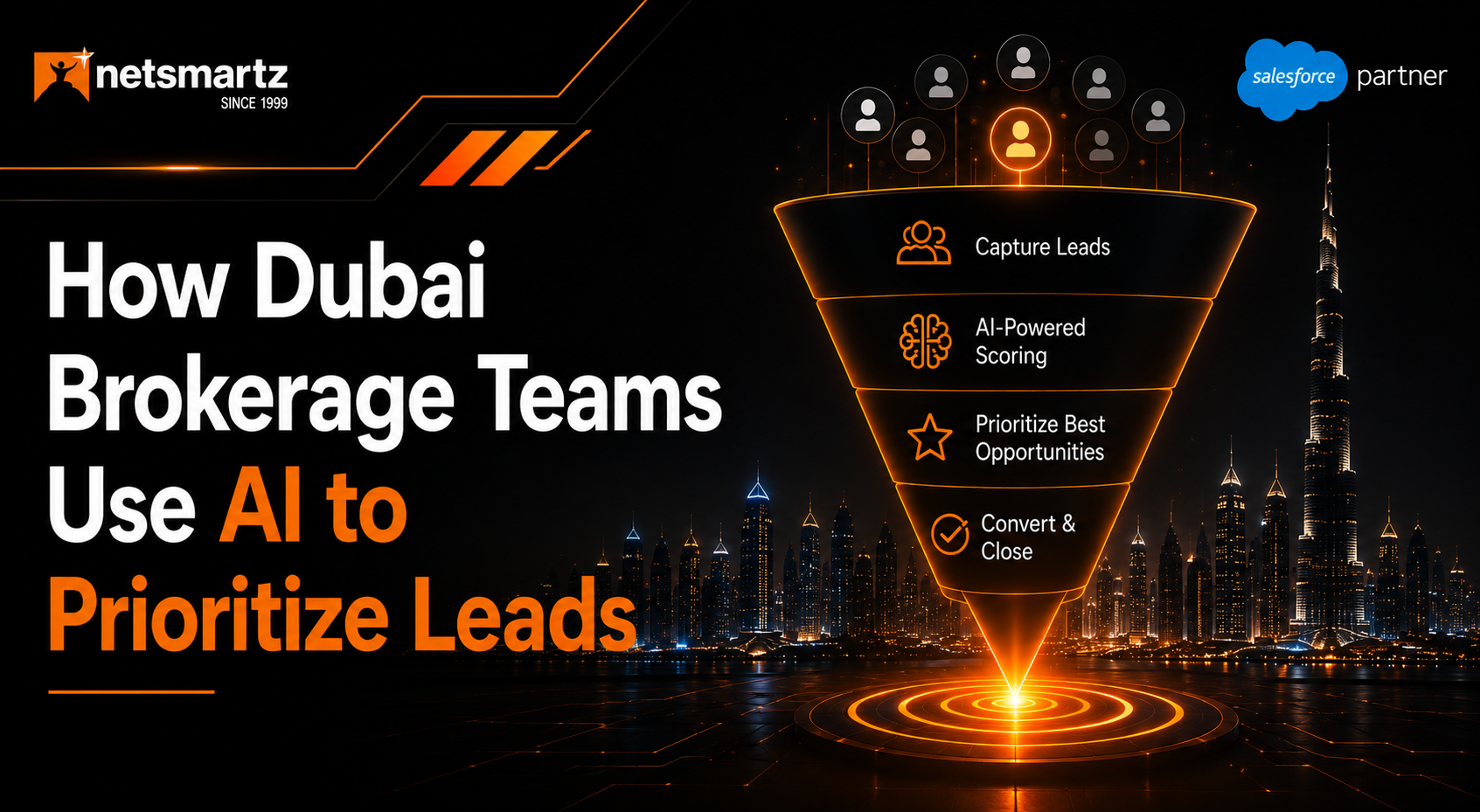
A mid-sized Dubai brokerage running active campaigns across Property Finder, Bayut, and a WhatsApp business line can easily generate two hundred inquiries in a single week. The problem was never getting leads. It is that a team of six or eight agents cannot manually read, judge, and respond to two hundred inquiries with the same urgency, and by the time someone gets to inquiry number one hundred and forty, the buyer who was ready to view three units on Thursday has already booked a viewing with someone else. This lead-volume squeeze is just one piece of a wider set of real estate broker challenges, and AI lead prioritization Dubai brokers are increasingly relying on solves exactly this piece of it, not by generating fewer leads, but by telling agents which ones deserve a callback in the next ten minutes versus which ones can wait until tomorrow.
This is not a theoretical benefit. Response speed is the single biggest lever in real estate conversion, full stop. Leads contacted within five minutes convert dramatically more often than leads contacted thirty minutes later, and in a market where the same buyer is often messaging three or four brokerages on Property Finder and Bayut simultaneously, the agent who replies first usually wins the conversation regardless of who has the better unit. AI lead scoring Dubai teams use does not change how many leads arrive. It changes how fast the right ones get a human response.
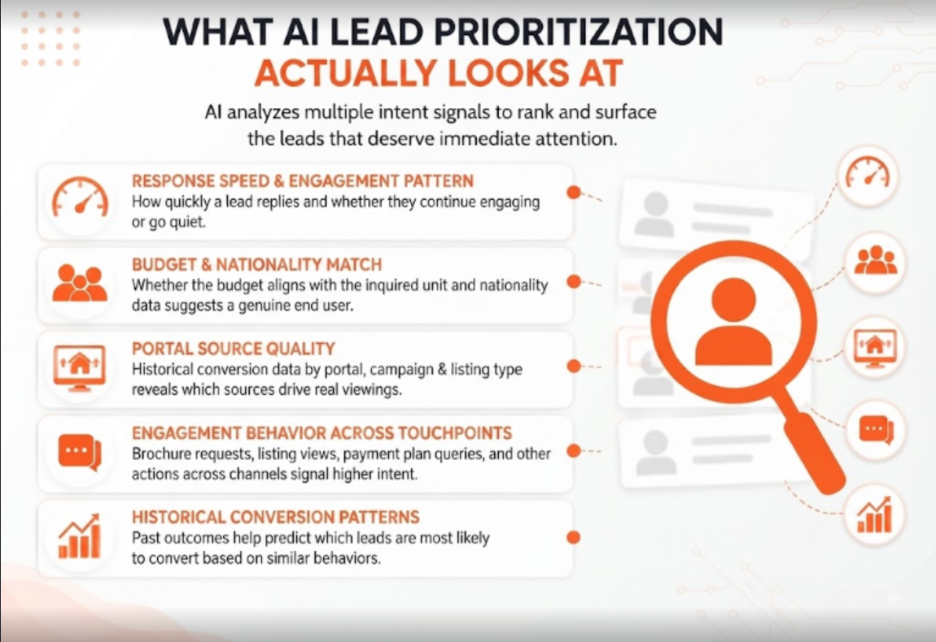
What AI Lead Prioritization Actually Looks At
Vague language like AI ranks your leads is not useful to a brokerage manager trying to evaluate a tool. What actually happens under the hood involves a specific set of signals, most of which a manager could describe out loud if asked.
- Response speed and engagement pattern: how quickly a lead replies to the first message, and whether they continue engaging or go quiet, since a lead who responds within minutes and asks a follow up question behaves very differently from one who never opens a second message.
- Budget and nationality match: whether the stated or inferred budget aligns with the actual unit inquired about, and whether nationality or buyer origin data suggests a genuine end user versus a browsing investor testing multiple markets at once.
- Portal source quality: not every inquiry from Property Finder or Bayut carries equal weight, since historical conversion data by portal, campaign, and even listing type reveals which sources reliably produce viewings versus which mostly produce tire kickers.
- Engagement behavior across touchpoints: whether a lead who first messaged on WhatsApp also viewed the listing page multiple times, requested a brochure, or asked about payment plans, since stacked signals across channels are a stronger indicator than any single action alone.
None of this replaces an agent's judgment. It replaces the need for an agent to manually re-read two hundred inquiries every morning just to guess at which four deserve a same-day call. Similarly, McKinsey highlights that AI-powered sales organizations are increasingly using predictive analytics and intelligent prioritization to help teams focus on the opportunities most likely to convert.
Before and After: A Typical Monday Morning
The clearest way to see the difference is to compare how the same lead volume gets handled with and without AI prioritization in place.
| Scenario | Without AI | With AI |
|---|---|---|
| 60 new inquiries arrive overnight across Property Finder, Bayut, and WhatsApp | Agents scroll chronologically, working oldest first regardless of intent signal, or triage by gut feeling based on message tone | Leads arrive pre-ranked by response urgency, with the top ten flagged for immediate callback based on budget match and engagement speed |
| A high intent WhatsApp inquiry arrives at 11pm | Sits unread until morning standup, by which point the buyer has likely messaged two other brokerages | Flagged as high priority overnight, with an automated acknowledgment sent immediately and a callback task assigned for first thing morning |
| A Property Finder lead with a mismatched budget for the listed unit | Agent spends fifteen minutes on a call before realizing the mismatch | Deprioritized automatically before any agent time is spent, freeing that slot for a better matched lead |
| End of week reporting on lead source performance | Manager manually cross-references spreadsheets from three portals plus WhatsApp exports | Portal source quality is already tracked and visible, showing which channel is actually producing viewings versus inquiries |
The pattern across every row is the same. AI prioritization does not remove the agent from the process; it removes the guesswork about where to spend the next ten minutes.
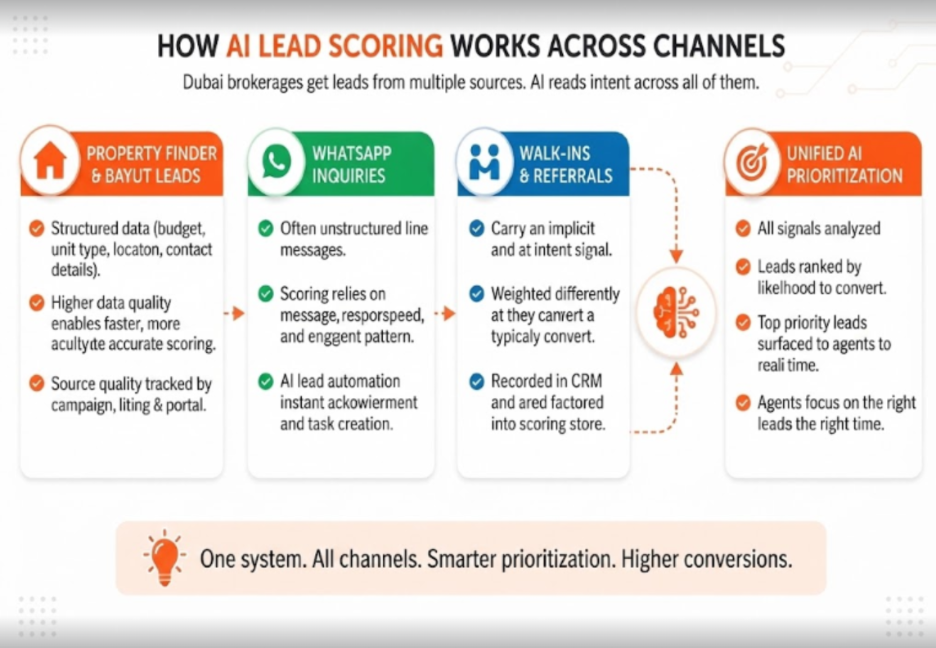
How This Plays Out Across Channels
Dubai's lead mix does not look like a single funnel, and prioritization has to account for that. Property Finder and Bayut inquiries typically arrive with more structured data, budget range, unit interest, sometimes verified contact details, which gives a scoring model more to work with immediately. WhatsApp lead automation real estate teams increasingly depend on is trickier, since a WhatsApp inquiry might be a single line of text with no structured data at all, and scoring has to lean more heavily on response pattern and message content than on form fields. Walk-ins and referrals sit differently again, arriving with an implicit trust signal that a cold portal lead does not carry, which a well-built system should weight accordingly rather than treating every channel identically.
PropSmartz's AI Lead Scoring Agent, for example, is built specifically to read intent signals across this exact mix of channels rather than assuming every lead arrives through a single structured form, which is closer to how real estate lead management UAE brokerages actually operate day to day.
Where AI Lead Scoring Falls Short
Being honest about limitations matters more than another feature list. AI scoring is only as good as the data feeding it, and a brokerage with inconsistent CRM logging or agents who skip updating call outcomes will get unreliable scores regardless of how sophisticated the underlying model is. It also cannot read tone, urgency, or relationship context the way an experienced agent instinctively can on a phone call, so scores should inform prioritization, not replace an agent's final judgment on a borderline lead. This aligns with Forbes' 2026 view that the most effective AI strategies enhance human decision-making and customer engagement rather than replacing people outright.
And any scoring model trained mostly on past conversion data will underweight genuinely new buyer segments it has not seen much of yet, which matters in a market as nationality diverse as Dubai's.
Conclusion
The lead volume problem in Dubai real estate was never going away - portal-driven demand generation guarantees it. What changes with AI lead prioritization is not how many inquiries a brokerage receives, but whether the right ones get a human response while the buyer is still paying attention. Dubai brokerages adopting this aren't chasing a trend, they're closing the gap between lead volume and agent bandwidth that manual triage was never built to handle.
Want to see how AI lead prioritization would actually work against your brokerage's real lead mix?
Talk to a PropSmartz specialist for a walkthrough built around your Property Finder, Bayut, and WhatsApp volume.
Frequently Asked Questions
It analyzes signals like response speed, budget match, portal source quality, and engagement behavior across channels to rank leads by likelihood to convert, then surfaces the highest priority ones to agents first.
No, it prioritizes which leads deserve immediate attention, but final judgment on ambiguous or borderline leads still benefits from an experienced agent's read on tone and context.
Yes, though WhatsApp leads typically carry less structured data than portal inquiries, so scoring relies more heavily on message content and response pattern for that channel.
Scoring accuracy depends directly on data quality, so inconsistent logging or skipped call outcomes will produce less reliable scores regardless of the underlying model's sophistication.
No, referrals and walk-ins typically carry an implicit trust signal that portal leads do not, and a well built scoring system should weight that difference rather than treating every channel identically.



Ready to build smarter? Let's talk.
Our experts are ready to help you turn ideas into production-ready AI, cloud and digital solutions.
Get in touch →Let's Discuss Your Growth Strategy
Let's discuss how we can help you accelerate growth, improve efficiency, and drive real business outcomes.