 AI-First Culture
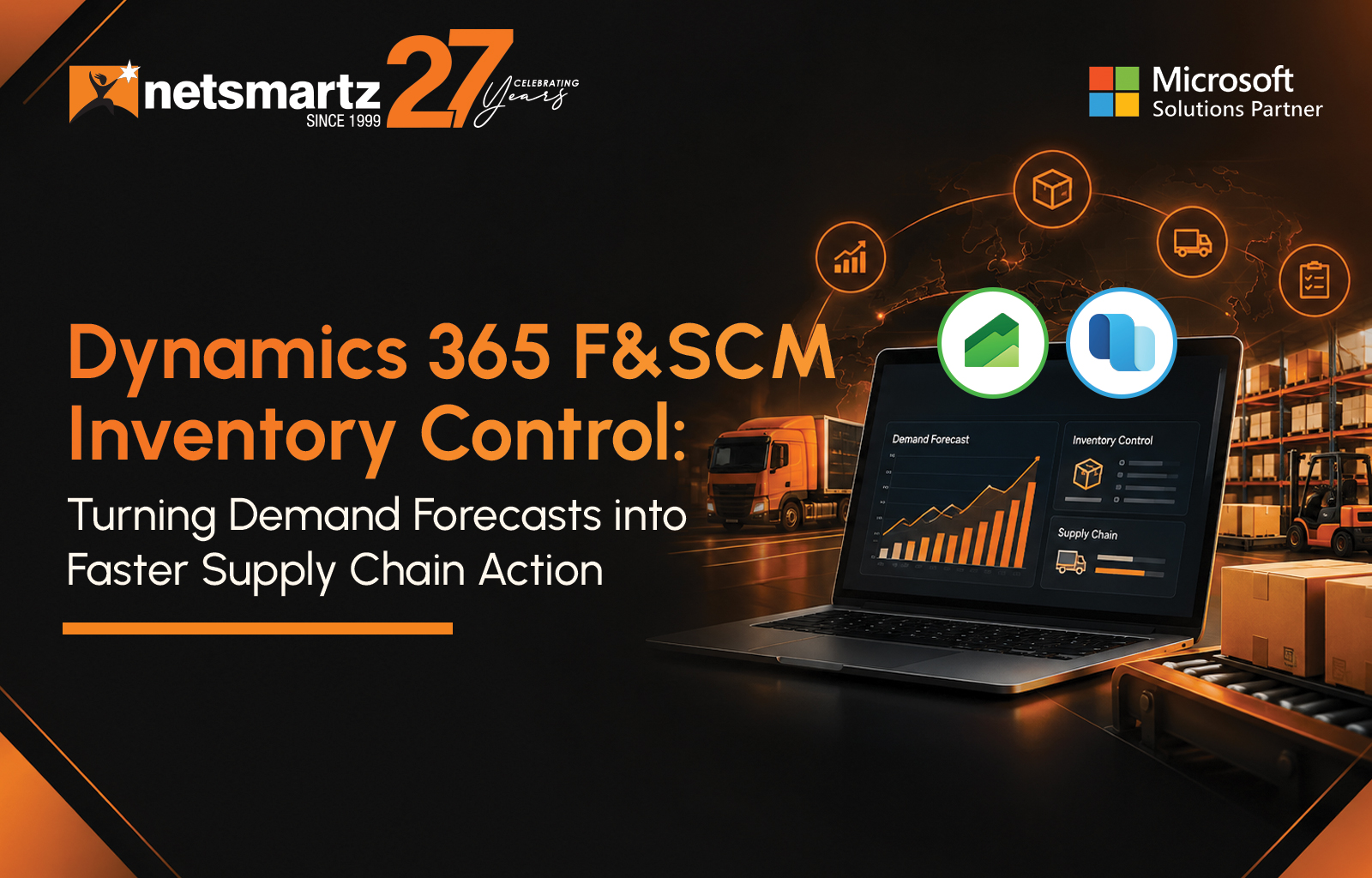
Dynamics 365 F&SCM Inventory Control: Turning Demand Forecasts into Faster Supply Chain Action
A demand spike hits one of your fastest-moving products. Dynamics 365 Supply Chain Management flagged it days ago, and your supply planning team saw the alert.
But the purchase order is still waiting for approval. Another warehouse is sitting on excess stock, and nobody has checked whether it can be transferred. The safety stock setting hasn't been reviewed in years. By the time the team acts, the stockout has arrived.
The model was right. The organization was slow.
Better forecasting improves the signal, but it doesn't change what happens next. The real value of AI-powered inventory management comes from redesigning the decisions that follow: replenishment, inventory transfers, and customer promise dates.
For teams using Dynamics 365 Supply Chain Management, that starts with a harder question: Which decisions should AI automate, which should it support, and where should people stay in control?
What is AI-Powered Inventory Management in Dynamics 365 Finance & Supply Chain Management?
AI-powered inventory management uses demand, supply, pricing, and inventory signals to help teams make faster decisions about replenishment, stock transfers, and customer commitments.
In Dynamics 365 Finance & Supply Chain Management, the opportunity is connecting forecasting signals to the decisions that determine what gets ordered, moved, reserved, or escalated.
Why has the Inventory Problem Moved from Prediction to Action?
Inventory teams have more visibility into their operations than ever. The challenge is turning those signals into timely decisions.
Modern supply chain systems can surface demand changes, inventory positions, supply constraints, and planning exceptions. The harder question is what happens after the signal appears.
A planner may know that demand has changed but still need to:
Review the recommendation
Check inventory at other locations
Validate supplier lead times
Get approval for a purchase order
Decide whether to transfer, buy, or wait
Protect an existing customer commitment
Every handoff adds time.
At Netsmartz, we call that gap decision latency: the time between a system identifying what needs to happen and the business actually acting on it. That matters because a more accurate forecast has limited value if the organization takes too long to respond.
Gartner's 2026 research highlights the same challenge from another angle. While 67% of supply chain digital investments are now allocated to AI, 55% of chief supply chain officers say they are unclear about the returns from those investments.
The implication is important: AI inventory projects need to improve a measurable business decision, not simply add another intelligent signal to the planning process.
What Can AI Actually Do in Dynamics 365 Finance & Supply Chain Management?
Dynamics 365 F&SCM adds capabilities that can improve how planning teams interpret and respond to inventory signals.
For example, Microsoft's 2026 capabilities include enhanced demand forecasting using additional inputs such as pricing, inflation, and weather data, along with machine learning models that can assess their relationship to historical sales.
Other capabilities address what happens after the forecast:
Inventory challengeWhere Dynamics 365 F&SCM can helpDemand changesAI-enhanced demand forecasting and additional data inputsSupply constraintsPlanning Optimization and supply planningInventory visibilityInventory Visibility across locationsCustomer commitmentsConfirmed CTP date protectionSupplier follow-upSupplier communication and engagement capabilitiesInventory imbalanceAI-driven inventory rebalancing
The important distinction is between identifying a problem and resolving it.
A forecast can identify that demand is changing. A planning process still needs to determine whether to increase supply, transfer inventory, change a parameter, or escalate the exception.
That is where the design of the decision process matters.
Which Inventory Decisions Should You Redesign First?
Not every inventory decision needs AI. The strongest starting points are decisions that happen frequently, have clear inputs, and have measurable outcomes.
Three are particularly worth examining.
1. Replenishment: Can You Automate the Predictable?
Replenishment is an obvious candidate for AI because many decisions follow recurring patterns. The mistake is trying to automate everything at once.
Start by segmenting inventory according to factors such as demand stability, value, lead time, service requirements, and business risk. Stable, high-volume items may be suitable for more automated decisions within defined tolerance and spending limits.
Items with irregular demand, long lead times, high value, or strategic customer commitments may need planner review.
This is where better demand planning becomes useful. The goal is not simply to produce a better forecast. It is to connect the forecast to a replenishment decision with clear rules for when AI can act and when a person needs to intervene.
Start with predictable decisions where the cost of a wrong recommendation is limited. Expand automation only after the business can measure the result.
2. Rebalancing: Should You Buy More or Move What You Already Have?
A stockout at one warehouse does not automatically mean the business needs to place another purchase order. There may already be enough inventory somewhere else.
Consider a food and beverage distributor with three regional warehouses. One location is running short on a fast-moving product while another has more inventory than its current demand requires.
A planning signal that only triggers replenishment can lead to another purchase. A better decision process asks a different question first:
Can existing inventory be rebalanced before we buy more?
Dynamics 365 F&SCM includes capabilities for inventory visibility and AI-driven inventory rebalancing that can support this type of decision.
The business rules still matter. Shelf life, transportation cost, customer priority, transfer lead time, and minimum stock requirements can all affect whether a transfer makes sense. AI can identify the opportunity. The organization still needs to define the conditions under which that recommendation becomes an action.
3. Customer Promise Dates: Can You Protect What You've Already Committed?
Inventory decisions are not only about keeping shelves or production lines supplied. They also affect what sales teams promise customers.
Imagine a manufacturer producing make-to-order equipment. A customer has received a confirmed delivery date based on available material and production capacity.
If that capacity or material is later reallocated to a newer order, the business may improve one transaction while putting an existing commitment at risk.
Dynamics 365 F&SCM has CTP date protection capability designed to prevent material and capacity allocated to confirmed delivery dates from being reallocated to newer orders. This illustrates an important principle for AI inventory management:
The best inventory decision is not always the one that optimizes the latest demand signal. It is the one that optimizes the business commitment.
When Should Humans Override AI Inventory Decisions?
AI should not have the same level of autonomy across every inventory decision. A practical approach is to establish three levels of decision authority.
Decision typeRecommended approachExamplesLow risk, repeatableAutomateRoutine replenishment, supplier follow-ups, low-risk transfersModerate risk or uncertaintyAssistSafety stock changes, unusual demand, new supplier ordersHigh impact or strategicHuman controlCustomer allocation during shortages, contract decisions, strategic supplier negotiations
This is also where organizations need to be careful with the term agentic AI.
Not every AI assistant is an autonomous decision-maker. Gartner has warned against "agent washing" in supply chain planning and recommends starting with high-volume, well-defined use cases where the cost of an error is manageable.
For inventory teams, that is a useful rule. Automate where the decision is predictable. Assist where judgment matters. Keep people accountable for decisions that carry significant commercial or customer risk.
How Should You Start an AI Inventory Pilot?
At Netsmartz, we recommend starting with the decision rather than the technology. The goal is not to automate inventory management in 90 days. It is to prove where AI can reduce decision latency without creating new operational risk.
Weeks 1–3: Establish the baseline
Measure where inventory decisions slow down today. Look at approval queues, planner intervention, stock transfers, replenishment decisions, and the time between a planning signal and action.
You may find that the bottleneck is not the forecast. It could be an approval workflow, disconnected data, unclear ownership, or a planning rule that has not been revisited.
Weeks 4–8: Redesign two decisions
Choose two high-volume, measurable use cases, such as replenishment or inventory rebalancing.
Define:
Required data inputs
Business rules
Approval points
Automation thresholds
Escalation conditions
Exception ownership
The objective is to make the decision process explicit before introducing more automation.
Weeks 9–12: Measure before scaling
Compare the pilot with the baseline using the metrics below. If the decision is faster without increasing exceptions or service risk, expand the use case. If it is not, fix the process before adding more AI.
The principle is simple: prove the decision model before scaling the automation.
How Do You Know If AI Is Actually Improving Inventory?
Forecast accuracy alone is not enough. A stronger measurement framework looks at whether AI is changing operational outcomes and reducing the time between signal and action.
Track:
Signal-to-action time: How long does it take to act after a planning signal appears?
Fill rate and OTIF: Are customer service levels improving?
Inventory turns or days of supply: Is working capital being used more effectively?
Planner effort: How much manual review is required?
Forecast value added: Are AI-driven forecasts actually improving the decisions that follow?
The right metrics depend on the use case. A replenishment pilot may focus on planner effort and service levels. A rebalancing pilot may focus more heavily on inventory turns, transfers, and stockout reduction. The point is to measure the business decision, not just the AI model.
Is Decision Latency Slowing Down Your Inventory?
Better inventory forecasting is only the starting point. The bigger opportunity is to connect better signals to faster, better-controlled decisions about what to buy, move, reserve, and escalate.
Book a Decision Latency Assessment with Netsmartz to identify where inventory decisions are slowing down and which Dynamics 365 capabilities could help reduce that gap.
Frequently Asked Questions
Yes, depending on your version, configuration, data, and the specific AI capability you want to introduce. The first step is to map your current planning processes, data sources, and inventory decisions against the capabilities available in your environment.
Netsmartz can help identify where an existing Dynamics 365 environment is ready for an AI pilot and where configuration or process changes may be needed.
Not necessarily, and perfect data is not a prerequisite. The important question is whether the data required for your chosen use case is reliable enough. That may include demand history, inventory positions, supplier lead times, planning parameters, and item or location information.
Rather than starting with a broad data cleanup exercise, Netsmartz can help scope the requirements around a defined group of SKUs and a specific inventory decision.
Start with high-volume, repeatable decisions where the inputs are reasonably predictable and the cost of an error is manageable.
Routine replenishment, supplier follow-ups, and certain inventory transfers can be good candidates. Customer allocation during shortages, strategic supplier negotiations, and other high-impact decisions generally need stronger human oversight.
Netsmartz can help define the guardrails and approval thresholds around your specific catalog and operating model.
A focused pilot typically starts with one or two measurable inventory decisions rather than the entire supply chain.
The work includes identifying the business problem, validating the required data, defining decision rules and human approval points, configuring the relevant Dynamics 365 capabilities, and establishing baseline metrics.
The aim is to prove measurable value before expanding the use case.
Yes. AI readiness should be considered as part of the broader Dynamics 365 F&SCM roadmap rather than treated as a separate project after migration. During a migration, teams can review data quality, planning processes, integrations, workflows, and decision ownership alongside the core ERP requirements.
Netsmartz can help identify where AI-enabled inventory processes fit into the migration roadmap and which use cases are worth piloting first.
Keep reading
Move Stock, Don’t Buy Stock: Re-engineering Retail Inventory with Dynamics 365 F&SCM

How to Stop Legacy IT Infrastructure from Holding Back Your Retail Business
Getting Real Value from Dynamics 365 F&SCM: Smart ROI Strategies for UAE Retail Businesses
Ready to build smarter? Let's talk.
Our experts are ready to help you turn ideas into production-ready AI, cloud and digital solutions.
Get in touch →Let's Discuss Your Growth Strategy
Let's discuss how we can help you accelerate growth, improve efficiency, and drive real business outcomes.