 AI-First Culture
Move Stock, Don’t Buy Stock: Re-engineering Retail Inventory with Dynamics 365 F&SCM
Most retail finance directors face the same quiet frustration. They know inventory is costing them money, not just through the cost of goods, but through storage, handling, obsolescence, and working capital tied up when it could be deployed elsewhere.
Yet when they ask for a clear view of inventory turns, margin impact, or forecast accuracy, the answer is often the same: the data is spread across different systems.
Imagine a retailer holding $10 million in inventory. Even modest carrying costs across storage, handling, insurance, financing, and obsolescence can make that inventory expensive to maintain.
The instinct is to buy less. But that can create stockouts and lose sales.
The real opportunity is to know what to buy, when to replenish it, where to position it, and when to move existing stock instead of buying more. That's where Dynamics 365 Finance & Supply Chain Management (F&SCM) can help.
Why Retail Inventory Costs Stay Higher Than They Should
Four hidden inventory problems quietly increase costs, tie up cash, and affect margins.
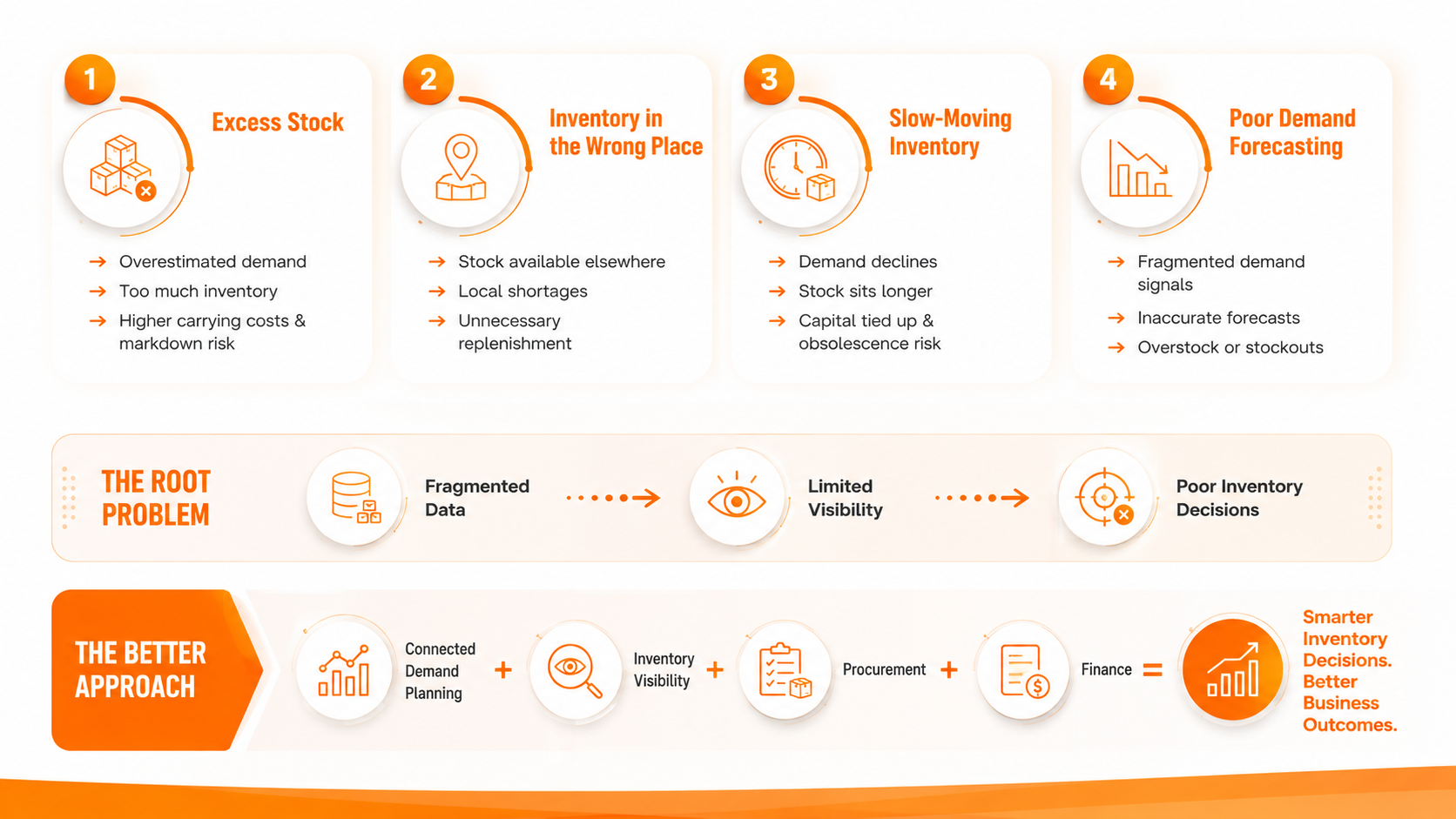
4 Ways Dynamics 365 F&SCM Can Help Reduce Inventory Costs
1. Improve Demand Planning Before Inventory Becomes a Cost
Many inventory problems start long before products reach the shelf.
Dynamics 365 F&SCM includes demand planning capabilities that help retailers forecast demand using historical sales, trends, seasonality, promotions, and other external factors. Its event and promotion planning capabilities can also help teams account for planned demand spikes before they make purchasing decisions.
For UAE retailers, this is particularly useful during:
Ramadan and Eid demand peaks
Seasonal tourism cycles
Promotional campaigns
Multi-store replenishment planning
Better forecasts help retailers order more accurately, reducing excess stock and unnecessary carrying costs.
2. Gain Real-Time Visibility Across Stores, Warehouses, and Online Channels
Inventory visibility is only useful when the underlying stock data can be trusted. Dynamics 365 F&SCM provides a near-real-time view of inventory across stores, warehouses, and e-commerce channels. This helps retailers answer critical questions:
Do we already have this SKU elsewhere?
Which locations are overstocked?
Which stores are likely to run short?
Can existing stocks fulfill demand before we purchase more?
For UAE retailers operating across multiple locations and channels, this visibility can help reduce unnecessary replenishment while improving product availability.
3. Move Existing Inventory Before Buying More
Sometimes the lowest-cost inventory is the inventory already sitting in another location.
Dynamics 365 F&SCM supports inventory allocation, transfers, and replenishment planning across channels, stores, and warehouses. Retailers can move inventory based on demand rather than automatically raising new purchase orders.
This helps reduce excess stock, lower safety inventory levels, improve inventory turns, and release working capital.
For retailers managing operations across Dubai, Abu Dhabi, Sharjah, and other locations, better stock allocation can reduce both inventory costs and markdown risk.
4. Connect Inventory Decisions with Finance
Every inventory decision has a financial impact. Dynamics 365 F&SCM connects demand planning, procurement, inventory management, warehousing, costing, and finance.
This gives finance teams visibility into:
Inventory value by location
Slow-moving products
Carrying cost exposure
Obsolete inventory risks
Microsoft describes Dynamics 365 Supply Chain Management as an end-to-end platform connecting planning, inventory, procurement, logistics, and costing processes.
The result is a shift from "How much inventory do we have?" to "How much cash is tied up, and what should we do about it?"
Why This Matters for UAE Retailers
UAE retail is expanding, but growth also means more inventory decisions to manage. Deloitte projects total retail expenditure in Dubai to grow at a 10% CAGR from 2024 to 2028, with retail sales projected to grow by 6% between 2025 and 2027.
For retailers, that growth can mean:
More SKUs and locations to manage
Greater demand across stores and digital channels
Longer planning cycles for imported products
Sharp seasonal and promotional demand shifts
As inventory networks become more complex, disconnected planning and stock data can make growth more expensive. For UAE retailers, the right ERP solution can connect demand planning, inventory, procurement, and finance, making it easier to control inventory as the business scales.
Extending F&SCM with Value-Added Retail Solutions
To move beyond baseline ERP capabilities, MENA retailers can extend Dynamics 365 F&SCM with specialized value-added solutions. Purpose-built add-ons, such as advanced Replenishment Management and Van Sales Management, streamline stock reallocation across stores, warehouses, and mobile delivery fleets. Paired with integrated Treasury, Coupon Management, and regional compliance modules like ZATCA and Planet VAT Integration, these extensions protect retail margins, optimize working capital, and eliminate operational bottlenecks across every sales channel.
The Bottom Line
Reducing inventory costs is not about keeping less stock at all costs. It is about keeping the right inventory, in the right location, at the right time. Dynamics 365 F&SCM gives retailers the connected demand planning, inventory visibility, procurement, and financial insight needed to make those decisions with greater confidence.
For UAE retailers managing growing product ranges, multiple locations, and digital channels, better inventory decisions can mean less cash tied up in stock and fewer costly surprises.
Want to see where your inventory costs are coming from? Speak to our retail ERP specialists to explore how Dynamics 365 F&SCM can help improve inventory visibility, planning, and control.
Frequently Asked Questions
A connected retail ERP gives finance and supply chain teams a shared view of demand, stock levels, purchasing, and inventory movement. Dynamics 365 F&SCM can help retailers identify excess stock, improve replenishment decisions, and use existing inventory before placing new orders.
Yes. Dynamics 365 Supply Chain Management retail UAE deployments can support retailers managing multiple stores, warehouses, and online channels. It connects demand planning, inventory, procurement, and finance, helping teams manage stock across the retail network from a connected system.
Look beyond basic inventory tracking. A suitable Cloud ERP for retail UAE should connect demand forecasting, purchasing, inventory, warehouse operations, costing, and finance. It should also support multi-location operations and give teams timely information for replenishment and working-capital decisions.
Yes. Dynamics 365 F&SCM provides inventory visibility across stores, warehouses, and channels, helping retailers identify where stock is available, where shortages are developing, and whether existing inventory can be allocated before new stock is purchased.
Consider an ERP assessment when inventory data is spread across multiple systems, replenishment relies heavily on spreadsheets, finance lacks timely inventory visibility, or teams regularly purchase stock while excess inventory sits elsewhere. These are often signs that the current system is limiting inventory control.
Keep reading
Dynamics 365 F&SCM Inventory Control: Turning Demand Forecasts into Faster Supply Chain Action
How to Stop Legacy IT Infrastructure from Holding Back Your Retail Business
Getting Real Value from Dynamics 365 F&SCM: Smart ROI Strategies for UAE Retail Businesses
Ready to build smarter? Let's talk.
Our experts are ready to help you turn ideas into production-ready AI, cloud and digital solutions.
Get in touch →Let's Discuss Your Growth Strategy
Let's discuss how we can help you accelerate growth, improve efficiency, and drive real business outcomes.