 AI-First Culture
2,975 Aussie Builders Couldn't See It Coming: Why Accounting Software Isn't Enough for Project Visibility
A project can look profitable right up until the numbers say otherwise. By month-end, the concrete is poured, the variation is still unpriced, and the margin the team expected has started to disappear.
The estimating may have been right. The trades may have been delivered. Yet finance can still be working from a picture that is already out of date. The system running the business was built to keep a ledger, not to run a project.
Construction remains Australia's largest industry category for corporate external administrations. According to ASIC, construction accounted for 24.4% of external administration appointments between July 2025 and May 2026, ahead of accommodation and food services at 14.9%.
For growing Australian builders, the question is whether their accounting system gives them enough visibility into what is happening across their projects while there is still time to act. That is where ERP for builders in Australia starts to make a business case.
Where accounting software hits the construction ceiling
MYOB, QuickBooks and Xero can work well for a growing business. The pressure starts when a builder needs more than the ledger can tell them. Finance needs to know what a job is costing now, what is already committed, and where the final margin is heading.
Spreadsheets often fill the gaps. Cost reports sit in Excel, purchase commitments in email, and retentions in separate files. It works until several projects are running at once, and too much knowledge depends on the people holding it together.
Where the gaps become costly
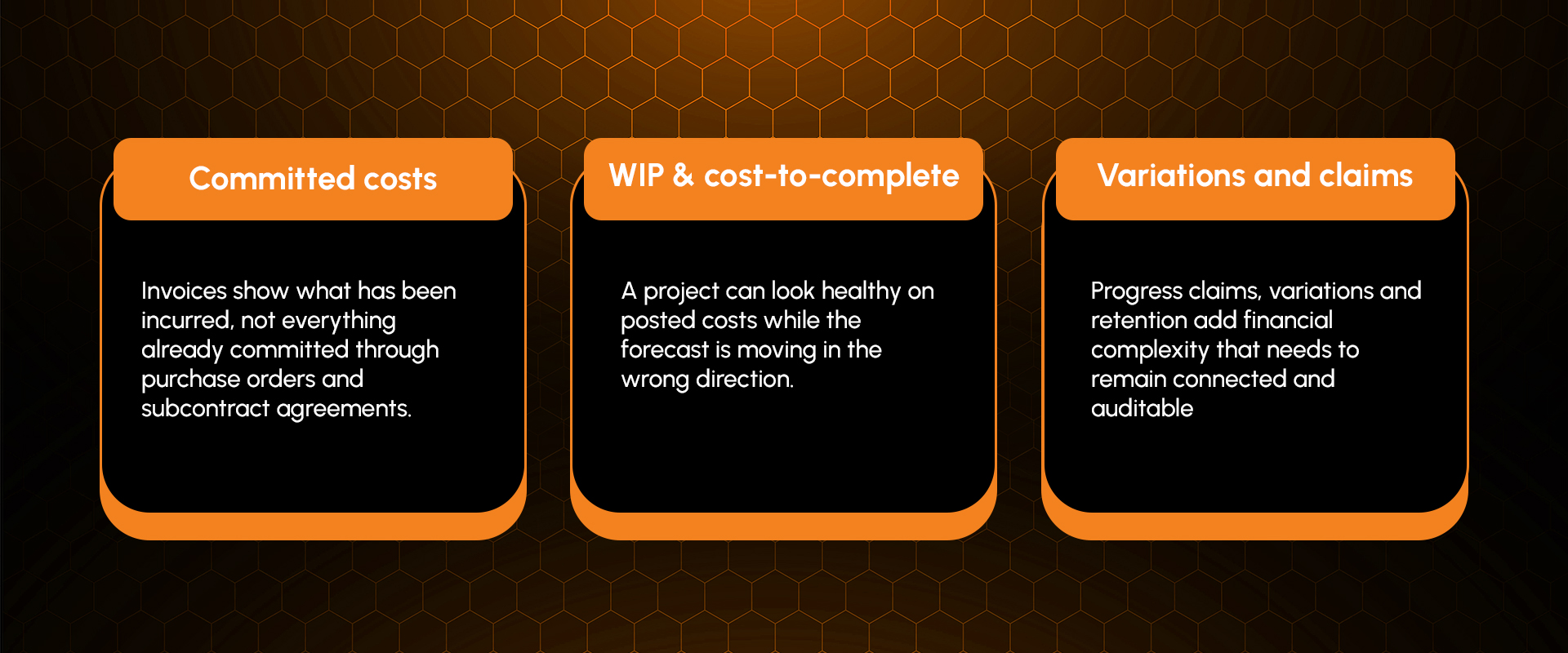
Australian construction adds another layer
Progress claims, retention, payment schedules and Security of Payment requirements create deadlines between work completed and cash received. A $500,000 progress claim may involve certification, variations, retention and payment timing before the full amount becomes available.
For a builder running several projects, these details quickly connect. A delayed claim affects cash flow. A variation changes the forecast. A missed commitment can distort project margins.
The accounting system needs to record the transaction. The business needs to see the commercial position behind it.
What Modern Construction ERP Changes for Australian Builders
From recorded costs to live project visibility
Accounting software tells you what a job cost after costs are posted. Modern ERP brings the view forward, showing actual, committed, and forecast costs together. Project teams can spot margin pressure while there is still time to respond, rather than explaining it at month end.
From disconnected processes to one commercial picture
Most builders do not have a data problem so much as a reconciliation problem. Estimates, purchase commitments, variations, progress claims and cash often sit across different systems and spreadsheets.
A connected ERP brings them together so teams can see:
Committed costs before invoices arrive
Variations and WIP as they affect project margin
Claims and retention held against practical completion, alongside payment timing and cash flow
What this can look like in practice
This is where an AI-powered construction-specific ERP like ProjectPro comes in. Built for construction businesses on Microsoft Dynamics 365 Business Central, ProjectPro connects project operations and financial management in one system, helping teams bring together job costs, commitments, variations, WIP, progress billing, retention, and financial data.
Instead of relying on separate spreadsheets and systems to understand project performance, finance and project teams can work from a more connected view of what has happened, what is already committed, and where costs may be heading.
Where AI Starts to Matter
Modern construction ERP is also bringing AI into everyday financial and project workflows. With project and financial data connected, AI can help flag unusual spending, emerging budget pressure and changes in cost-to-complete, giving finance and project teams earlier visibility into issues that need attention.
AI capabilities vary between platforms, so builders should test them against their own project data rather than rely on a demo.
The Trade-Off
ERP takes time, investment, and process discipline. The right construction ERP software in Australia should fit the builder's size and operating model, not simply offer the longest feature list.
A practical test: If WIP lives in spreadsheets, committed costs are hard to see, finance and project teams work from different numbers, and month-end depends on manual reconciliation, the business may already be outgrowing its accounting system.
When Should a Builder Move Beyond Accounting Software?
You do not need a consultant to tell you. The signals are consistent. If month-end takes days, WIP lives in spreadsheets, committed costs are difficult to see, or finance and project teams work from different numbers, your accounting system may already be limiting project visibility.
Modern ERP gives builders a connected view of costs, commitments, claims, and cash while there is still time to act.
Considering ERP for your construction business? Get in touch with us to see how modern ERP helps Australian builders manage the financial and operational complexities of every project.
Frequently Asked Questions
When should Australian builders consider ERP for their construction business?
When WIP, committed costs, variations and project reporting depend on spreadsheets, ERP for builders in Australia can bring project and financial information into one connected system. The trigger is usually not revenue, but the point where manual processes start affecting visibility and decision-making.
Are builders outgrowing QuickBooks or MYOB ready for construction ERP software?
Often, yes. Builders outgrowing QuickBooks or MYOB may find that their accounting system handles transactions well but struggles with project costing, WIP, commitments, variations and cost-to-complete. That gap can signal a need for construction ERP software in Australia.
What should Australian builders look for in construction ERP software?
Look beyond accounting features. The right construction ERP solution in Australia should connect job costing, purchasing, commitments, WIP, variations, progress claims, retention and financial reporting so project and finance teams work from the same information.
Can ERP help Australian builders improve project margin visibility?
Yes. An ERP solution for Australian builders can bring actual and committed costs together with budgets, WIP and cost-to-complete information. This gives project and finance teams a clearer view of where margins are heading before problems surface at month-end.
How much does ERP for builders in Australia cost?
There is no useful one-size-fits-all figure. Implementation depends on users, projects, integrations, data quality, and existing processes. The better question is what the construction ERP software needs to solve, and whether the expected improvement in project control justifies the investment. A construction technology specialist can help assess the requirements before you commit to a platform.
Keep reading

Is Your Legacy Construction ERP Ready for What Comes Next? 5 Signs It Isn't
Profitable on Paper, Broke in Practice: The Truth About Construction Project Profitability
Siloed Sites, Broken Data: Why Construction Tech Stack Integration Is Broken
Ready to build smarter? Let's talk.
Our experts are ready to help you turn ideas into production-ready AI, cloud and digital solutions.
Get In Touch →Let's Discuss Your Growth Strategy
Let's discuss how we can help you accelerate growth, improve efficiency, and drive real business outcomes.