 AI-First Culture
Salesforce Data Cloud and Agentforce: Building AI Agents With Connected Customer Data
Picture a customer asking your AI agent about an order. The agent answers politely, confidently and completely wrong, because the shipping update lives in one system, and the complaint history sit in another. Nothing is wrong with the agent. The trouble is what it was given to work with. For companies across the Middle East and North Africa racing to deploy AI, that gap between a clever agent and a well-informed one is where most of the value gets won or lost.
Why AI is only as good as the data behind it
Most businesses don’t have one customer view. They have several. Sales keeps contacts in the CRM, service tracks cases in another system, marketing runs campaigns from a third, and the finance team holds billing details somewhere else. Each team sees a slice of the customer, and none of them sees the whole person.
That’s why so many AI projects stall. The model isn’t weak. It’s working from incomplete, duplicated or outdated records, so its answers feel off. Think about who gets hurt by that. A customer repeats their issue for the third time. A salesperson follows up on a deal that has already closed. A marketing team emailed someone who complained yesterday. Each is small. Together they erode trust in both the data and the AI built on it. Gartner predicts that through 2026, organizations will abandon 60% of AI projects that aren’t supported by AI-ready data. Put simply, good intentions and good models don’t make up for messy foundations.
Understanding the connection between Data Cloud and Agentforce
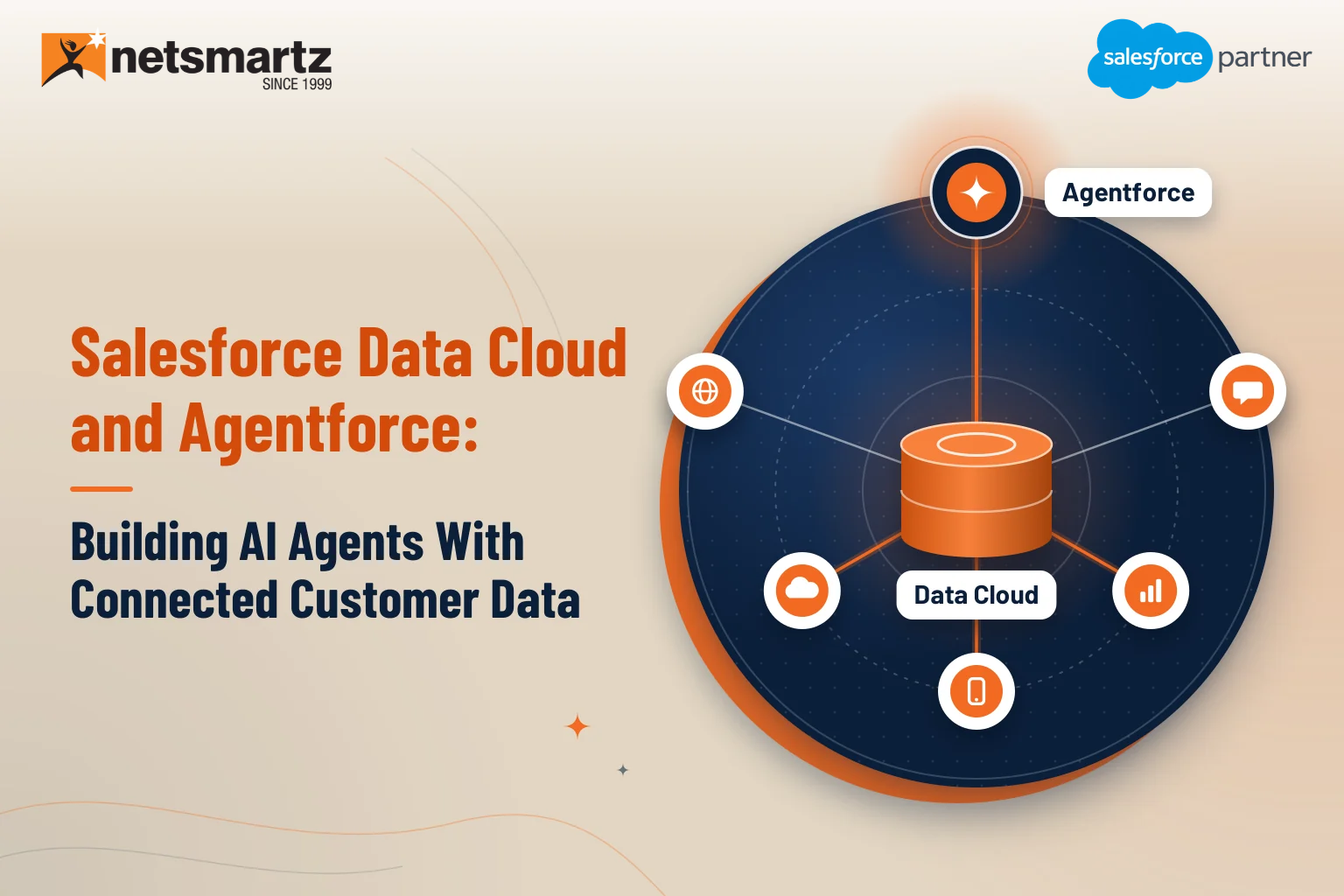
Think of the Salesforce Data Cloud Agentforce integration by giving an agent both a memory and a pair of eyes. Data Cloud, which Salesforce now brands as Data 360 under its Agentforce 360 platform, pulls together information from across your business. Agentforce then uses that information to answer questions and take action. Agentforce, Salesforce’s platform for building AI agents, can answer questions, update records and hand them over to a person when needed. Here’s what the connection delivers:
- Unified customer profiles: Records from sales, service, marketing and other sources are resolved into one profile per customer, so an agent isn’t guessing which “Ahmed Al Mansoori” it’s talking to.
- Real-time data access: Fresh events like a purchase, a support request or a site visit reach the profile quickly, so responses reflect what’s happening now, not last week.
- An AI-ready foundation: Governed, consistent data gives agents context they can trust and gives your team a single place to manage it. Salesforce describes Data 360 as the data foundation that gives Agentforce agents their customer context.
For the people running the project, the takeaway is simple: integration comes first, agents second. Teams that connect and clean the data first usually find that agent design gets easier, because there’s less guesswork involved.
An agent is only as sharp as the context you hand it in.
Business problems solved by connected customer data
Connected data isn’t a technical nicety. It solves problems your customers and your teams feel every day. Strong Salesforce AI data foundations tend to show up in four places:
- Personalized customer experiences: Offers and messages reflect what a person actually bought, browsed or asked about, not a broad guess.
- Better service interactions: Agents and people alike see the full history, so customers don’t have to repeat themselves.
- Improved sales recommendations: Sales teams get suggestions based on real engagement patterns instead of gut feel.
- Increased customer intelligence: Leaders can spot churn risks, upsell chances and service trends sooner, because the data finally lines up.
Each of these is measurable, which matters. Faster resolution times, higher conversion rates and better retention give leaders something concrete to track, instead of a vague promise that AI will help. Pick one or two to watch from the start.
Real-world use cases across key industries
Who benefits most, and where? A few examples show how connected data changes the picture.
Real estate
Lead engagement and buyer journeys: Enquiries arrive from portals, calls, messaging apps and events. When those touchpoints feed one profile, an agent can follow up with the right property at the right moment. Buyers also move between channels, so a connected profile stops them being treated as a brand-new lead every time. This is the thinking behind PropSmartz, our AI-first real estate CRM on Salesforce.
Retail and e-commerce
Personalization and customer retention: Purchase history, browsing behavior and service issues come together, so recommendations and win-back messages feel relevant instead of random. A retail agent might notice that a loyal customer has an open delivery complaint and holds back a promotional message until it’s resolved.
Manufacturing and logistics
Customer support and account management: Order status, shipment updates and past issues sit in one view, so support teams and account managers can answer quickly and spot problems before they escalate. A logistics account manager who can see delayed shipments, open cases and renewal dates side by side has a much better conversation with the customer.
Common data readiness challenges businesses face
Before connecting anything, it helps to know what usually gets in the way. When should you check? Before you build an agent, not after it disappoints someone.
| Challenge | What it looks like | What helps |
|---|---|---|
| Data silos | Teams hold separate records that never meet | A shared data model and unified profiles |
| Poor data quality | Duplicates, missing fields, outdated contacts | Clear standards, validation and regular cleanup |
| Legacy systems | Older platforms that don’t talk to modern ones | Planned connectors and phased modernization |
| Integration gaps | Some sources feed in, others don’t | An integration map that covers every key source |
None of these problems are unusual. They’re just easier to fix before an AI agent is relying on the result.
Legacy systems deserve special mention. Replacing them isn’t always realistic, and it isn’t always necessary. Often the practical route is to connect them carefully, move the most valuable data first, and modernize in phases. Integration gaps are quieter but just as costly: one missing source can leave an agent blind to a whole part of the customer journey.
Building an AI-ready data foundation
A solid foundation comes down to four habits:
- Data governance: Decide who owns each data set, who can change it, and how definitions are agreed.
- Integration planning: Map your sources, set priorities and agree on what needs real-time updates and what can wait for.
- Security considerations: Control access carefully, apply consent rules, and keep customer data protected. Regional data protection laws, such as those in the UAE, make this a design issue from day one.
- Data quality management: Treat quality as ongoing work, with owners, checks and simple metrics.
Who owns all this? Ideally a mix of IT, data and business leaders, not IT alone. When business teams help define what good data means, agents end up answering the questions people actually ask. Start small, with the data an agent needs one use case, rather than trying to fix everything at once. Where does security fit? At every step. Decide early which customer fields an agent can see, which actions it can take on its own and when it must hand over to a person.
Get these four rights and agents to behave more predictably; audits get easier, and teams trust the numbers.
How Netsmartz helps organizations connect data and AI
Plenty of teams know where they want to go but not how to get there. Working with a Salesforce certified partner can shorten that journey, because the platform, the integrations and the AI all have to fit together. Our team supports four areas:
- Data Cloud implementation: Setting up unified profiles, data streams and governance, so the foundation holds up.
- Salesforce integrations: Connecting CRM, ERP and other systems so data flows both ways.
- AI readiness planning: Assessing data, processes and ownership before any agent goes live.
- Agentforce deployment: Designing, testing and launching agents that act on trusted data, with PropSmartz as one example for real estate teams.
A short readiness assessment usually shows whether your data is ready, which sources matter most and what a realistic first phase looks like. Many MENA organizations start with one team and one-use case, then expand once results are clear.
Conclusion
AI success rests on data. Not every business needs every capability on day one. What every business needs are information it can rely on. Connect it, clean it, govern it and protect it, and the agents built on top become far more useful. A well-planned Salesforce Data Cloud Agentforce integration is where that work comes together. If you’re weighing Agentforce, start by auditing your data, choose one high-value use case and plan the connections before you build.
Ready to connect your data and put Agentforce to work?
Schedule a free consultation with Netsmartz and talk through your highest-impact use cases.
Schedule a CallFrequently Asked Questions
Data Cloud unifies customer data from multiple sources into a single view. Agentforce agents use that data as context, so their answers and actions reflect your actual business.
Not for every scenario, but Data Cloud significantly improves results by giving agents a complete, current view of customer data across systems.
Data can come from Salesforce and other business systems such as ERP, finance and marketing platforms. The right sources depend on your use case and should be planned with your integration needs in mind.
Common causes are data silos, duplicate or incomplete records, legacy systems and poor integrations. When agents work from unreliable data, their output is unreliable too.
Set clear governance: define who can access what data, set escalation rules and apply security controls, aligned to the UAE PDPL and any sector or free zone requirements. An AI readiness assessment can help identify what applies to you.
Start with one high-value use case, such as lead engagement or case resolution, and connect the data it needs first. Assess your data readiness before you build, then expand step by step.
Ready to build smarter? Let's talk.
Our experts are ready to help you turn ideas into production-ready AI, cloud and digital solutions.
Get In Touch →Let's Discuss Your Growth Strategy
Let's discuss how we can help you accelerate growth, improve efficiency, and drive real business outcomes.