 AI-First Culture
How to Stop Legacy IT Infrastructure from Holding Back Your Retail Business
70% of UAE retailers are integrating digital tools into their physical stores, while 57% now operate both physical and digital storefronts. As omnichannel retail becomes the norm, IT teams are under increasing pressure to connect POS, ecommerce, ERP, inventory, CRM, and supply chain systems into a seamless technology ecosystem.
Yet adding new channels is only part of the challenge. According to Kyndryl's 2025 Retail Readiness Report, nearly one in four retailers identify technical debt as a major constraint, making it harder to modernize and support business growth.
For retail IT leaders across the UAE, the challenge isn't deploying more technology. It's managing years of interconnected systems, custom integrations, and legacy retail platforms that have grown alongside the business. As complexity increases, so does the effort required to maintain reliable data, support new initiatives, and keep omnichannel operations running smoothly.
As retail operations continue to evolve, your IT infrastructure should make growth easier, not more complex.
Why Retail IT Infrastructure Becomes More Complex as You Grow
Your retail IT infrastructure wasn't designed to fail. It was designed to support growth.
Every new store, ecommerce platform, marketplace integration, loyalty programme, or payment gateway was introduced to solve an immediate business need. Individually, each investment delivered value. Over time, however, those decisions created a technology environment that became increasingly difficult to connect, manage, and scale.
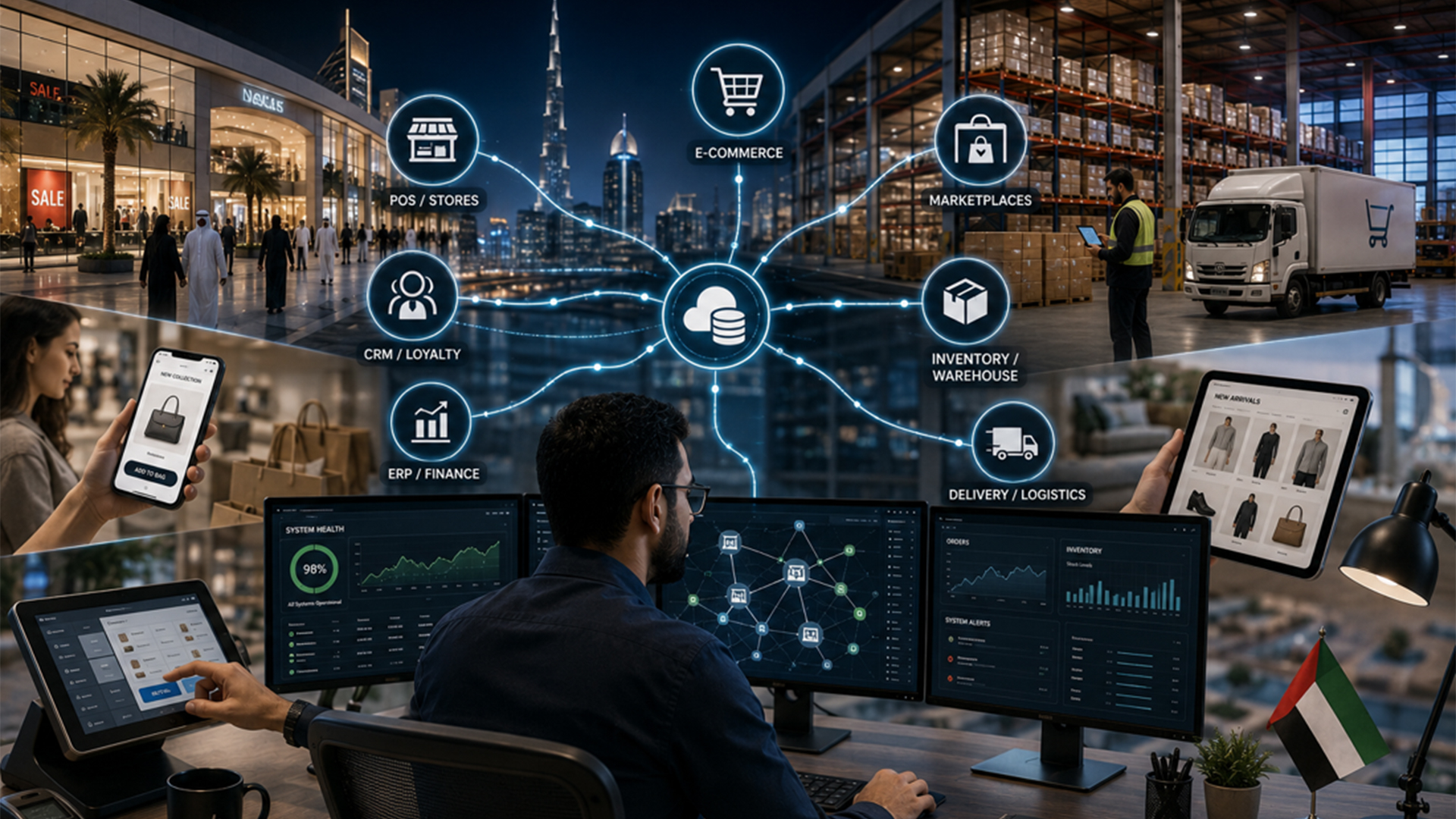
As retailers across the UAE expand their omnichannel operations, IT teams are expected to support an increasingly interconnected ecosystem, including:
Physical stores with POS, inventory, and finance systems.
Ecommerce platforms and online marketplaces requiring seamless order and inventory synchronization.
Loyalty programmes, digital payments, and customer engagement platforms that must share consistent customer and transaction data.
Warehouse, fulfilment, and delivery systems that need real-time visibility across every sales channel.
Rather than replacing existing systems, many organizations continue extending them through APIs, middleware, custom integrations, and workarounds. As a result, IT teams often find themselves dealing with:
More time managing integrations than enabling innovation.
Limited visibility across channels due to fragmented data.
Growing technical debt as legacy and modern applications operate together.
Constant troubleshooting instead of focusing on strategic initiatives.
Without a connected IT architecture, every new business initiative risks adding another layer of complexity instead of creating long-term value.
The Point Where Retail IT Complexity Becomes a Business Problem
The impact of IT complexity isn't measured by the number of systems you manage. It's measured by how quickly the business can respond to change.
For retail IT leaders, the consequences extend far beyond infrastructure. They affect the speed, agility, and customer experience that modern retailers depend on to compete.
As IT complexity increases, the business begins to feel it in tangible ways:
Inventory loses its accuracy across channels, increasing the risk of stock discrepancies, delayed fulfilment, and inconsistent customer experiences.
New stores, marketplaces, and digital initiatives take longer to launch, as every project depends on additional integrations and testing before it can go live.
Customer data remains fragmented, limiting personalization, demand forecasting, and AI-driven insights that rely on trusted, connected information.
IT budgets shift from modernization to maintenance, leaving fewer resources to improve automation, security, analytics, and innovation.
None of these challenges may seem critical in isolation. Together, they slow decision-making, delay growth initiatives, and reduce the organization's ability to adapt in an increasingly competitive retail market.
At that point, the technology environment is no longer supporting business growth. It's defining the pace at which the business can grow.
What Leading Retailers Are Doing Differently
Leading retailers aren't responding to growing complexity by adding more applications. They're building connected retail ecosystems that enable applications, data, and teams to work together at scale.
Rather than replacing every legacy system, they're creating an architecture where information flows seamlessly across stores, ecommerce, marketplaces, inventory, finance, warehouses, and customer engagement platforms. The result is fewer integration issues, less manual reconciliation, and faster decision-making across the business.
For retail IT teams, that shift changes how technology supports the business:
From managing integrations to orchestrating a connected ecosystem, where information moves automatically across retail operations.
From reactive troubleshooting to proactive innovation, with less time spent resolving synchronization issues and more time supporting AI, automation, and digital initiatives.
From fragmented reporting to real-time operational visibility, giving business leaders a consistent view of inventory, orders, customers, and financial performance across every channel.
From slow technology rollouts to faster business agility, making it easier to introduce new stores, marketplaces, payment solutions, or customer experiences without rebuilding integrations each time.
A connected retail ecosystem doesn't eliminate every legacy system overnight. It reduces the operational complexity around them, allowing IT teams to spend less time maintaining technology and more time helping the business adapt, innovate, and grow.
Is Your Retail IT Infrastructure Ready for What's Next?
As retailers expand across stores, ecommerce, and marketplaces, IT teams discover that keeping existing systems connected becomes harder than supporting the next phase of growth.
A Retail IT Infrastructure Assessment helps identify integration gaps, data silos, and architectural bottlenecks that may be limiting visibility, agility, and innovation. The result is a clearer understanding of where your technology environment can evolve to better support a connected retail ecosystem.
FAQs
If launching new stores, marketplaces, or digital initiatives consistently requires complex integrations, manual workarounds, or extended IT effort, your retail IT infrastructure may be slowing business agility.
Not necessarily. Many retailers continue using legacy retail systems while modernizing the surrounding architecture. The priority is creating seamless data flow and reducing operational complexity across the technology environment.
A connected omnichannel retail infrastructure enables real-time inventory visibility, consistent customer experiences, faster channel expansion, and more reliable decision-making across stores, ecommerce, and marketplaces.
A connected ecosystem allows applications, data, and business functions to work together, reducing integration overhead so retail IT teams can focus more on innovation than ongoing maintenance.
Start by assessing your existing retail IT infrastructure to identify integration bottlenecks, data silos, and dependencies. Understanding where complexity exists helps prioritize modernization efforts with the greatest business impact.
A connected retail ecosystem enables applications and data to move seamlessly across stores, warehouses, and digital channels, helping retail IT teams support expansion into markets like Saudi Arabia, Kuwait, Qatar, and Bahrain with greater efficiency.
Keep reading
Dynamics 365 F&SCM Inventory Control: Turning Demand Forecasts into Faster Supply Chain Action
Move Stock, Don’t Buy Stock: Re-engineering Retail Inventory with Dynamics 365 F&SCM
Getting Real Value from Dynamics 365 F&SCM: Smart ROI Strategies for UAE Retail Businesses
Ready to build smarter? Let's talk.
Our experts are ready to help you turn ideas into production-ready AI, cloud and digital solutions.
Get in touch →Let's Discuss Your Growth Strategy
Let's discuss how we can help you accelerate growth, improve efficiency, and drive real business outcomes.