 AI-First Culture
The Hidden Power of MuleSoft Integration Solutions That Most Enterprises Miss
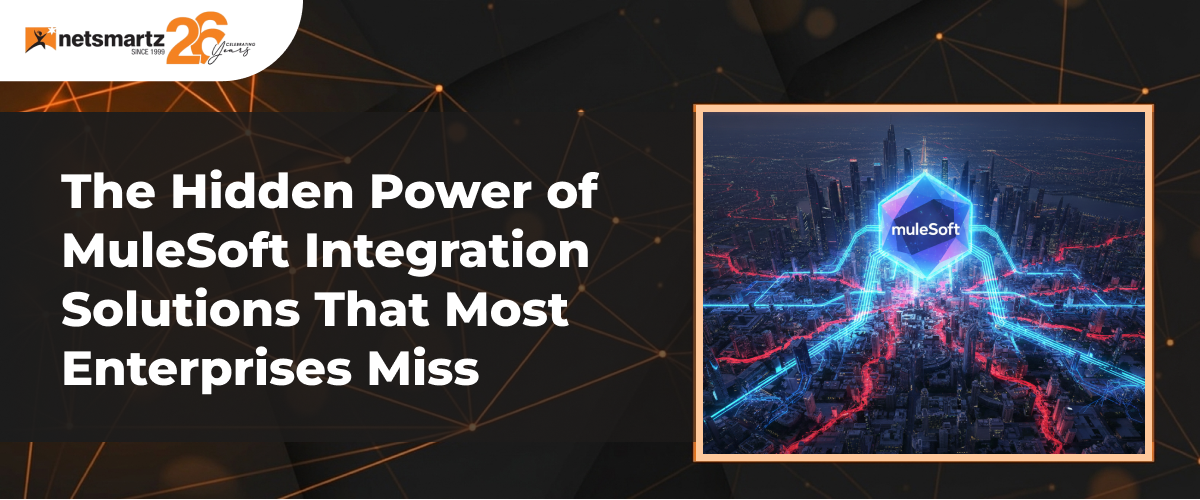
Most enterprises don't have a technology problem. They have a connection problem.Over the years, businesses keep adding applications, databases, cloud services, and departmental platforms. Each investment solves a specific need. Sales gets a CRM. Finance adopts a new reporting platform. Operations introduces another application. Before long, information is scattered across dozens of places.
At first, nobody notices. Then reports start taking longer to prepare. Teams begin requesting the same data from different departments. Customer information looks different depending on where you check it. What seemed like small inconveniences slowly become everyday obstacles.
This is often the point where organizations begin exploring the MuleSoft integration platform. Yet many enterprises use only a fraction of its capabilities. They connect a handful of applications, solve an immediate challenge, and move on. The interesting part is that the biggest benefits often appear later. Not from connecting systems. But from changing how information moves across the entire organization. Before discussing those benefits, it helps to understand why so many integration projects struggle to deliver the value leaders expect.
When integrations solve one problem and create another
A lot of integration projects begin with good intentions. A department needs data from another application. A quick connection is built. Then another request arrives. Another connection follows. A few months later, dozens of integrations exist. A few years later, nobody wants to touch them.
This situation is surprisingly common. Many organizations fall into the trap of building direct connections between applications without thinking about long-term maintenance. The result is a growing collection of dependencies that become harder to manage with every new business requirement. Gartner estimates that by 2028, infrastructure and operations leaders using structured methods to manage technical debt will report 50 percent fewer obsolete systems than those who do not, underscoring how unmanaged integration complexity compounds into a long-term operational liability.
These point-to-point integration issues usually show up in familiar ways:
- When teams break down integrations repeatedly, it results in longer development cycles
- Each time an additional connection is established to the environment, maintenance costs will continue to rise..
- Business data will be stored inconsistently between multiple applications and departments
- When policies are not centrally managed, security issues will continue to grow.
- Integration logic will be replicated across several projects and teams.
What looked like a practical short-term solution eventually becomes a barrier to growth.
This is one reason many enterprises are rethinking their approach to enterprise integration solutions and looking for strategies that can scale over time.
The value most organizations overlook
Ask someone why they use MuleSoft and you'll probably hear the same answer.
"It helps us connect applications."
That's true, but it isn't the whole story.
The real value starts appearing when organizations embrace API-led integration rather than treating integrations as isolated projects. Think about a customer record. Without reusable APIs, multiple teams might create separate integrations to access the same information. Every connection requires maintenance, security reviews, updates, and testing. Now imagine one API serving that information across the organization.
Instead of rebuilding the same connection repeatedly, teams can use an existing asset.
Though simple, the impact is significant, enabling faster project delivery, reducing duplicate development efforts, simplifying governance, strengthening security consistency, and creating efficiencies that compound over time. Many organizations discover that the biggest return doesn't come from the first integration. It comes from the tenth, twentieth, and fiftieth integration that reuses what has already been built.
That's where platforms such as MuleSoft Anypoint Platform begin showing their full potential.
Why legacy systems don't have to slow transformation efforts
One misconception appears in almost every modernization discussion. People assume older systems must be replaced before innovation can happen. In reality, things are rarely that straightforward. Large enterprises often depend on applications that have supported operations for years. Replacing them overnight would introduce unnecessary risk, cost, and disruption. A more practical approach is often integration.
A common MuleSoft Integration example involves connecting legacy applications with modern cloud services through APIs. Instead of rebuilding everything from scratch, organizations expose specific data and business functions while keeping critical platforms in place.
This approach creates flexibility. Customer-facing experiences can evolve. Internal processes can improve. Teams gain access to information without manually moving data between applications.
Perhaps more importantly, it helps reduce data silos in organizations, which continue to be one of the most persistent challenges in enterprise environments. The goal isn't necessarily to replace everything. Sometimes the smarter move is simply helping everything work together better.
Governance becomes more important as integration grows
Connectivity gets attention, governance rarely does. Yet governance often determines whether an integration strategy succeeds over the long term. As organizations expand their integration landscape, visibility becomes increasingly important.
Who is accessing data?
Which APIs are being used?
Are security policies being followed consistently?
Without answers to these questions, complexity starts growing quickly. Gartner's 2024 strategic roadmap for data and analytics governance warns that siloed, asset-specific governance approaches frequently result in increased business risk, rising costs, and resistance to governance programs outcomes that become significantly harder to reverse as integration environments scale. Strong integration governance and security practices help organizations maintain control while continuing to scale.
This includes areas such as:
- API lifecycle management keeps integrations current as business needs change.
- Security enforcement ensures consistent policies across all connections and data flows.
- Performance monitoring identifies bottlenecks that could slow operations or affect reliability.
- Access management controls who can use APIs and what data they access.
- Compliance tracking documents activities for audits and regulatory requirements.
Many enterprises also strengthen their api management mulesoft strategy to ensure integrations remain reliable as usage increases. Good governance doesn't slow innovation. If anything, it creates the confidence needed to move faster.
Real-time information changes how teams work
While many organizations still rely on delayed information and manual updates, enterprise data integration enables real-time data flow that supports faster decisions, improves customer experiences, reduces operational inefficiencies, and scales efficiently with business growth. For organizations pursuing scalable enterprise integration, these advantages become increasingly valuable as operations grow.
Looking beyond today's integration needs
Technology environments never stay still. New applications arrive, business priorities shift and customer expectations change. An integration strategy built only for today's requirements can become tomorrow's limitation. This is why many enterprise architects pay close attention to MuleSoft integration platform features that support reuse, governance, flexibility, and growth.
The strongest integration programs often share similar characteristics. They prioritize reusable APIs. They follow integration architecture best practices. They plan for future expansion rather than immediate requirements alone. And they recognize that integration is no longer just an IT responsibility. It has become a critical part of enterprise digital transformation.
Experienced MuleSoft developer teams understand this well. Their focus isn't simply connecting applications. Their focus is creating foundations that continue delivering value years after the first implementation.
Conclusion
Many enterprises invest in integration to solve immediate challenges. The organizations that gain the most value take a broader view. The MuleSoft integration platform offers far more than application connectivity. When supported by governance, reusable APIs, and a thoughtful architecture strategy, it can help reduce complexity, improve agility, and support long-term business growth. The hidden power isn't in making systems talk. It's in helping the business move faster without creating more complexity along the way.
"The organizations seeing the greatest value from integration are rarely the ones building the most connections. They're the ones building connections they can reuse, govern, and scale."
Ready to unlock more value from your integrations?
Discover how MuleSoft can help your enterprise simplify connectivity, improve governance, and build for long-term growth.
Talk to an expertFrequently Asked Questions
It is a platform that connects applications, data sources, and services through APIs.
It helps organizations create reusable connections that reduce complexity and speed up delivery.
Yes, MuleSoft supports integration across both legacy and modern environments.
They are APIs designed to serve multiple business needs without rebuilding integrations repeatedly.
It improves security, visibility, compliance, and operational control.
Yes, it is widely used to support complex and scalable enterprise integration requirements.
Ready to build smarter? Let's talk.
Our experts are ready to help you turn ideas into production-ready AI, cloud and digital solutions.
Get In Touch →Let's Discuss Your Growth Strategy
Let's discuss how we can help you accelerate growth, improve efficiency, and drive real business outcomes.