 AI-First Culture
Ransomware Up 41%: Why Construction Firms Must Upgrade to Cloud ERP & Copilot to Protect Financial Data
Construction finance teams manage subcontractor invoices, multi-project budgets, payroll records, and compliance documents every day. Many still rely on spreadsheets, email threads, and disconnected legacy systems to keep everything moving. However, when financial data spreads across multiple tools, controlling access, tracking changes, and preventing security risks becomes more challenging. And the risks are growing fast.
Cyberattacks targeting construction companies increased sharply between 2023 and 2024. Phishing incidents rose by 83%, while ransomware attacks increased by 41%. Financial data has become a prime target for attackers.
Yet many firms still use on-premises ERPs and Excel-heavy processes that were never designed for today’s threat landscape. Disconnected platforms and manual data sharing make it harder to maintain audit trails and respond to threats quickly.
Cloud ERP for construction finance, combined with Microsoft Copilot, helps close those gaps. Firms gain a centralized system with built-in security, role-based access, auditability, and governance. Finance teams can better protect sensitive data while improving efficiency and visibility across projects.
Why Construction Finance Data is Especially Vulnerable
Construction finance is more complex than finance in most industries. A single project may involve general contractors, subcontractors, project owners, lenders, and compliance teams. Each group needs access to different types of financial data.
That information moves constantly between teams. They often share WIP reports, lien waivers, pay applications, and AIA billing documents through email attachments, spreadsheets, and other disconnected systems.
This creates several security challenges:
Financial data is spread across multiple systems.
Teams often rely on manual file sharing.
Legacy ERPs may use broad user permissions.
Audit trails are incomplete or difficult to track.
Security updates and monitoring are often delayed.
The result is limited visibility into who accessed data, what changed, and when it happened. As projects grow, these risks become even harder to manage across teams and locations.
How Cloud ERP for Construction Upgrades Financial Data Protection
When financial data lives across disconnected tools, security is only as strong as the weakest link. Cloud ERP for Construction replaces fragmented platforms with a single, governed environment designed to protect financial data at every level.
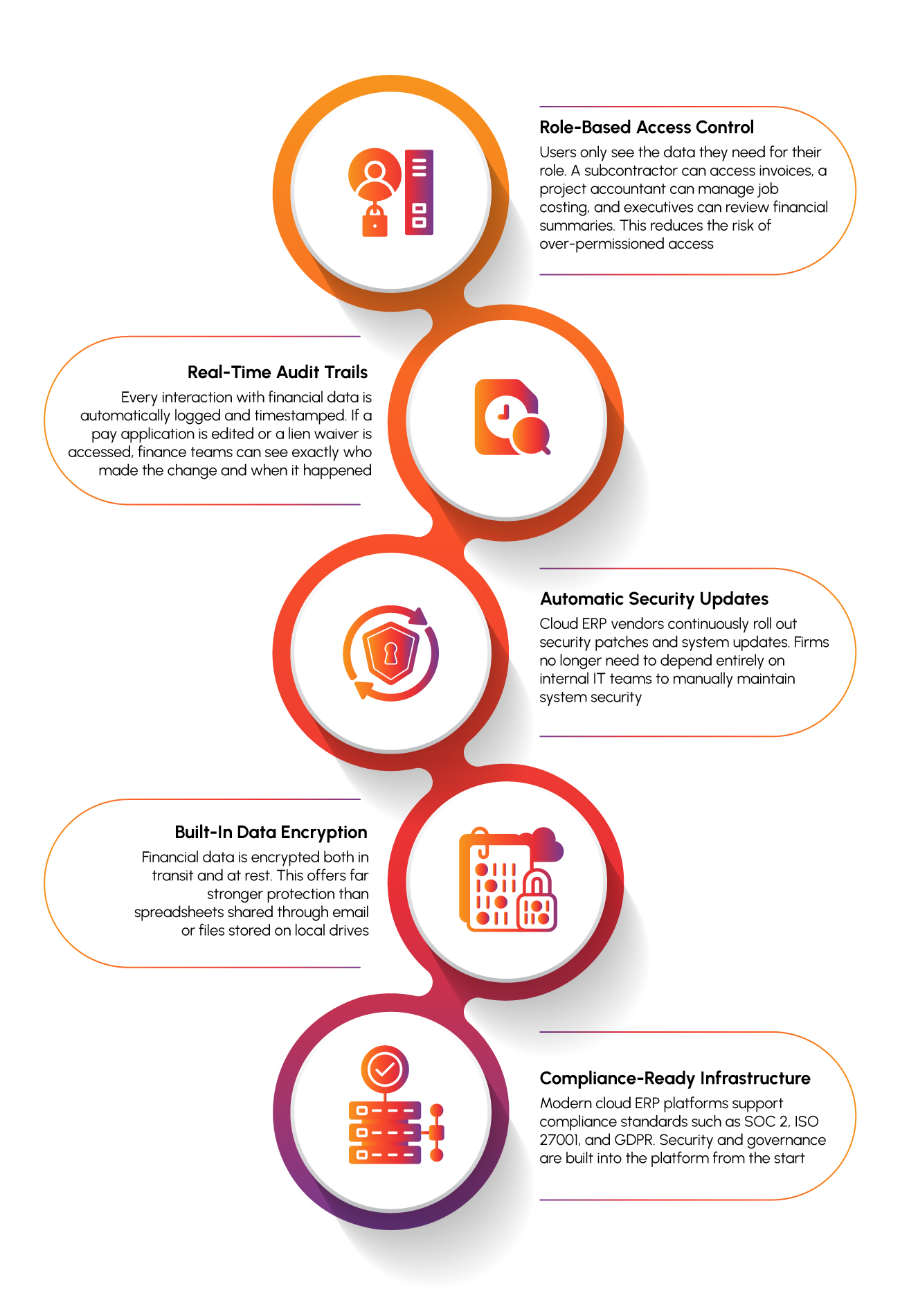
For construction firms, these protections become even more effective when financials, project management, and job costing operate within the same connected system. Solutions like ProjectPro, an AI-powered construction management solution built on Microsoft D365 Business Central, reduce insecure data handoffs between disconnected tools, eliminating one of the most common sources of security risk.
Microsoft 365 Copilot for Construction Finance: AI That Respects Security Boundaries
AI in finance sounds powerful until someone asks the obvious question: What happens to the data?
With Microsoft Copilot, the answer is straightforward. It is built on the same security foundation as Microsoft 365. That means your existing permissions, compliance policies, and governance rules continue to apply.
It Works Within Existing Permissions
Copilot AI only accesses the data a user is already authorized to see. If someone cannot view a subcontractor’s payment history inside the ERP, Copilot cannot surface it either.
Every interaction follows existing role-based access controls, audit trails, and compliance policies already configured within the system.
Humans Stay in Control
Microsoft 365 Copilot accelerates financial workflows while keeping finance teams firmly in control of approvals and decision-making.
It can:
Draft collections communications
Flag budget variances
Highlight contract discrepancies
Surface missing financial details
Instead of replacing oversight, Copilot enhances it. Finance teams thoroughly review recommendations, validate outputs, and approve actions before finalizing them. This approach helps reduce errors while maintaining the accuracy and accountability that construction finance operations require.
Your Data Stays Inside Your Environment
Copilot AI responses are grounded in your ERP and Dataverse data, which helps reduce inaccurate or unsupported outputs.
More importantly, your organizational data remains within your Microsoft 365 environment. It is not used to train external AI models.
What This Looks Like in Practice
With Microsoft 365 Copilot for construction finance, teams can reconcile subcontractor invoices against contract values, monitor project budget variances, and draft payment communications using live financial data from Microsoft Dynamics 365 Business Central.
The result is faster financial workflows without sacrificing security, governance, or control.
How to Close Construction Finance Security Gaps with Cloud ERP and Microsoft 365 Copilot
Knowing the risks is one thing. Knowing where to start is another. The good news is that improving construction finance security does not require a complete technology overhaul overnight.
It starts with a few focused steps.
Review Who Has Access to Financial Data
Start by auditing user permissions across your finance systems. You may find employees accessing payroll records, billing data, or project financials that are outside of their responsibilities.
Identifying over-permissioned access is the first step toward reducing security risk.Evaluate Your Platform Integrations
Every connection between project management, accounting, payroll, and field systems creates another point where data moves.
Map those integrations carefully. Understand what financial data is being shared and whether those transfers are secure, encrypted, and monitored.Create a Roadmap Away from Legacy ERP Systems
Many on-premises ERP systems depend on manual updates and outdated infrastructure, which do not meet today's security standards.
Moving to a cloud-based ERP is no longer just a modernization initiative. It is part of a long-term risk management strategy.Configure Security and Governance Early
When deploying a cloud ERP for construction, role-based access controls and audit logging should be configured from the start.
Building governance into the system early creates stronger security, cleaner audit trails, and better operational control over time.Introduce AI Within Your Existing Microsoft Environment
Microsoft 365 Copilot works within the Microsoft 365 environment that your teams already use. That allows firms to introduce AI-powered workflows without creating separate data silos or exposing financial information across disconnected platforms.
Finance teams can automate reconciliation tasks, surface anomalies faster, and improve reporting efficiency while maintaining existing security and compliance controls.
The Future of Construction Finance Security Is Already Here
Cyber threats increasingly target high-value, heavily regulated construction finance data. Cloud ERP for Construction improves security by filling the gaps that older systems can't, offering features like role-based access, encryption, audit trails, and compliance readiness all in one managed platform.
Microsoft 365 Copilot adds an AI layer that works within your existing security boundaries, helping finance teams improve efficiency without compromising control or governance.
Want to see what the solution looks like in practice? Speak to an expert.
Frequently Asked Questions
1. Why are construction firms moving to Cloud ERP for Construction Finance?
2. How does Cloud ERP for Construction improve collaboration between finance and project teams?
3. Is Microsoft 365 Copilot for Construction Finance secure to use with sensitive financial data?
4. What should construction companies look for in construction ERP security solutions?
5. Can construction firms adopt Microsoft 365 Copilot without replacing their entire ERP platform immediately?
Keep reading

Is Your Legacy Construction ERP Ready for What Comes Next? 5 Signs It Isn't

2,975 Aussie Builders Couldn't See It Coming: Why Accounting Software Isn't Enough for Project Visibility

Profitable on Paper, Broke in Practice: The Truth About Construction Project Profitability
Ready to build smarter? Let's talk.
Our experts are ready to help you turn ideas into production-ready AI, cloud and digital solutions.
Get In Touch →Let's Discuss Your Growth Strategy
Let's discuss how we can help you accelerate growth, improve efficiency, and drive real business outcomes.