 AI-First Culture
What are autonomous AI agents and why real estate teams cannot ignore them in 2026
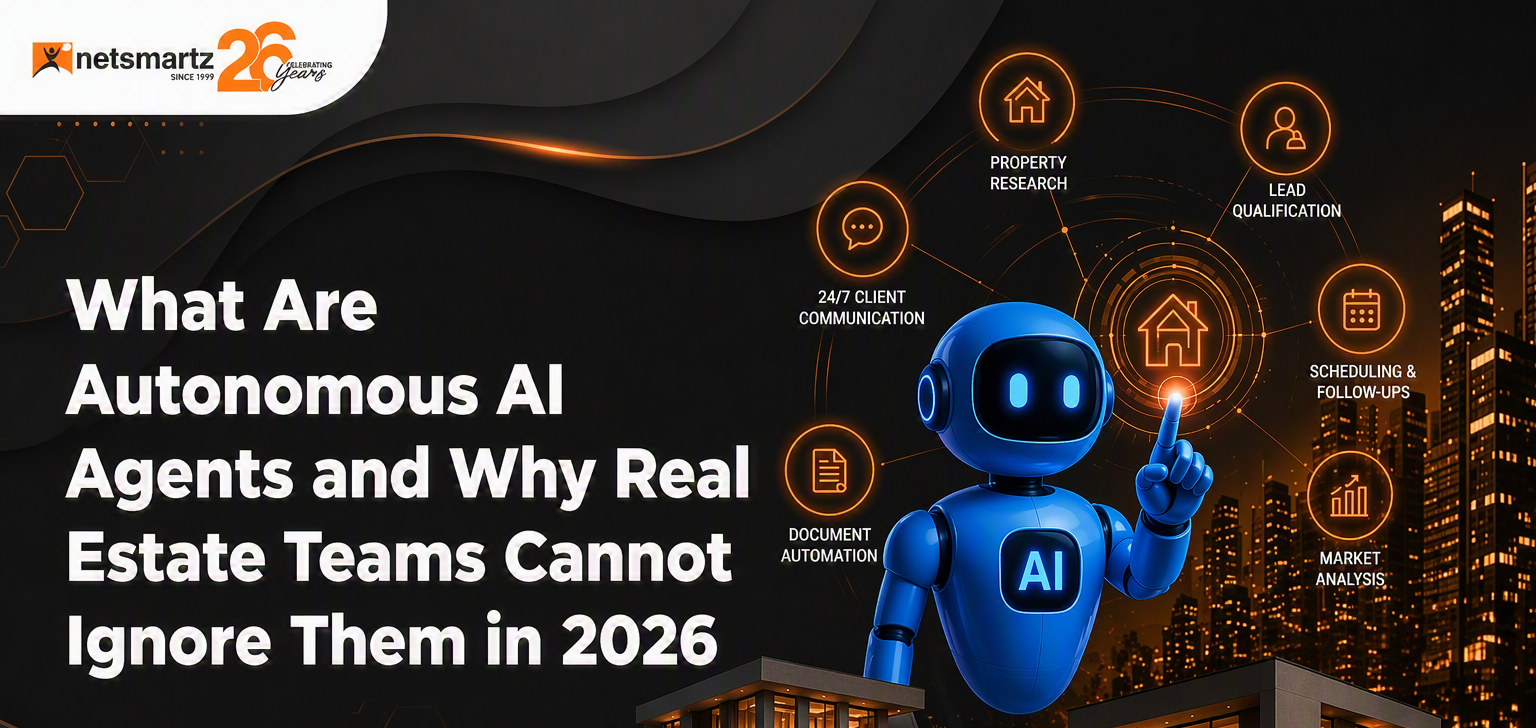
Real estate teams are handling more buyer inquiries than ever before. Leads arrive from websites, property portals, broker networks, WhatsApp, social platforms, and referral channels at the same time. Buyers expect quick replies, easy scheduling, and updates without delays.
A study from InsideSales found that responding within five minutes can significantly improve conversion outcomes compared to delayed follow-up.
That expectation is changing how real estate teams operate.
This is one reason conversations around AI agents in real estate have accelerated in 2026. Unlike traditional automation that waits for instructions, autonomous AI agents continuously monitor activity, detect patterns, recommend actions, and automate repetitive work across the buyer's journey.
For developers, brokers, leasing teams, and channel partners, the discussion is becoming less about experimentation and more about operational readiness.
Why real estate workflows started becoming harder to manage
Real estate operations have expanded quickly. Sales teams manage more inquiries. Leasing teams support customers outside business hours. Post-sales teams coordinate documentation, payments, and handovers simultaneously.
Most teams are not struggling because the work became harder. They are struggling because the volume has increased.
Many organizations still rely on spreadsheets, reminders, manual assignments, and disconnected communication. Meanwhile, buyer expectations continue moving faster. Customers now expect responses in minutes instead of days. That gap creates operational pressure.
Businesses started realizing the challenge was not hiring more people. The challenge was reducing the amount of time employees spend coordinating information manually.
As a result, many organizations began rethinking how lead capture and nurturing should operate inside real estate workflows.
Real estate chatbots vs autonomous AI agents
Many teams still treat chatbots and AI agents as the same thing. They are not.
| Traditional chatbot | Autonomous AI agent |
|---|---|
| Responds only after a message arrives | Continuously monitors signals and activity |
| Follows predefined workflows | Learns from patterns and interactions |
| Requires manual intervention | Initiates actions automatically |
| Works reactively | Helps identify issues earlier |
| Handles isolated conversations | Supports connected workflows |
A practical example makes the difference easier to understand. A chatbot may answer pricing questions. An autonomous AI agent can detect repeated visits to premium inventory pages, identify strong engagement with payment information, notify the sales team, and suggest scheduling a site visit automatically.
That shift explains why AI automation conversations continue gaining attention across real estate.
Where AI agents are already supporting real estate teams
The biggest impact is appearing inside operational work that traditionally consumes time and slows execution.
1. Lead qualification and routing
Sales teams often spend valuable hours sorting inquiries manually. Modern AI-supported environments evaluate buyer intent, engagement signals, budget alignment, inquiry timing, and property interest.
That helps teams focus on buyers with stronger purchase signals instead of treating every inquiry equally. When combined with structured CRM workflows, prioritization becomes more consistent. Research from Salesforce also suggests teams using AI-supported CRM environments report on measurable productivity improvements.
2. Broker and channel partner coordination
Large developers often manage multiple brokers and partner networks. AI-supported workflows help match inventory, monitor engagement quality, identify delays, and improve partner visibility. That creates smoother inventory movement and better coordination.
3. Follow-up and site visit coordination
Response delays reduce momentum. AI-supported workflows can automate reminders, callback scheduling, communication updates, proposal preparation, and site visit coordination. Buyers experience less waiting. Teams spend less time managing repetitive tasks.
4. Payment tracking and post-sales coordination
Post-sales activities often involve multiple handoffs. Payment reminders, document collection, support requests, and handover scheduling create operational load. AI-supported monitoring helps identify delays earlier and surface issues before they escalate.
5. Leasing and renewal management
Leasing teams are also using predictive models. Historical interactions, support records, payment activity, and communication patterns help estimate renewal likelihood. That creates more time to retain tenants before decisions are finalized.
Why adoption is accelerating in 2026
Buyer behaviour continues to change. People compare projects digitally before speaking with advisors. They explore inventory across channels simultaneously. They expect communication to feel immediate.
Research from HubSpot shows that fast responses increasingly influence customer expectations.
Real estate teams already manage:
- Inventory allocation
- Broker coordination
- Payment tracking
- Lead nurturing
- Post-sales execution
- Leasing renewals
- CRM updates
Manual coordination becomes difficult to sustain at a scale. At the same time, adoption barriers are falling. AI capabilities are becoming more accessible beyond enterprise organizations. Mid-sized developers and brokerages can now adopt connected workflows without rebuilding their technology stack.
Common challenges when implementing AI
Technology alone rarely solves operational issues. Some common implementation obstacles include:
Poor CRM adoption
Incomplete records reduce AI effectiveness.
Approach: Build CRM usage into everyday processes before adding automation.
Data quality issues
Duplicate records and outdated information reduce accuracy.
Approach: Audit and clean data before deployment.
Team resistance
Employees sometimes assume automation removes jobs.
Approach: Show how automation reduces administrative effort rather than replacing expertise.
Too much automation
Over-automation can make communication feel impersonal.
Approach: Automate coordination while keeping important conversations human.
Integration limitations
Disconnected platforms create information gaps.
Approach: Prioritize connected environments that support integrated workflows.
How PropSmartz supports this shift
As teams explore automation, attention is moving toward environments that combine CRM, operational intelligence, and workflow coordination. PropSmartz, developed on Salesforce by Netsmartz, is designed around real estate operations.
Instead of treating AI as an additional layer, the platform applies autonomous AI capabilities across multiple operational functions.
Examples include:
- Lead scoring and prioritization
- Predictive forecasting
- Inquiry qualification
- Sentiment monitoring
- Pricing recommendations
- Voice-based CRM updates
- Content generation
- Connected integrations
Because workflows operate inside one environment, teams gain better visibility across sales, leasing, post-sales, and broker coordination.
The human side of AI adoption
A common concern is whether automation reduces the role of employees. Most teams using AI describe a different outcome.
People still manage relationships. Sales teams still negotiate. Leasing specialists still guide customers. AI reduces repetitive coordination.
That creates more time for work that depends on human judgment. This aligns with a broader trend across sales organizations, where AI is increasingly used to reduce administrative effort while allowing employees to focus on relationship building, advisory conversations, and complex decision-making that benefits from human expertise.
What happens if teams ignore the shift
Operational issues do not appear overnight. They accumulate gradually. Response times are slow. Reporting becomes inconsistent. Customers become frustrated. Employees experience higher pressure. Competitors are becoming faster.
That is why real estate digital transformation discussions are becoming more practical and less theoretical.
Questions to ask before choosing an AI platform
Before selecting a platform, ask:
- Does it connect naturally with your CRM?
- Can workflows adapt across departments?
- Is decision logic visible and understandable?
- How much manual work remains after implementation?
- Will teams realistically use it?
- Can it support future growth?
These questions often determine long-term adoption success.
Conclusion
Real estate has traditionally adopted technology carefully. But operational expectations continue to change. Autonomous AI agents are not replacing people. They are helping teams reduce repetitive work, improve response speed, and create more connected experiences.
For developers, brokers, leasing specialists, and operations teams, the larger risk in 2026 may not be moving too quickly. It may be waiting too long.
Autonomous AI agents are not replacing people. They are helping teams reduce repetitive work, improve response speed, and create more connected experiences.
Want smarter real estate automation?
See how autonomous AI workflows support lead management, follow-ups, site visits, and post-sales coordination inside your CRM.
Frequently asked questions
An autonomous AI agent monitors activity, identifies patterns, and supports actions automatically across sales and operational workflows.
It keeps engagement active, supports faster response times, and helps route opportunities more effectively.
Yes. AI-supported workflows can coordinate scheduling, reminders, confirmations, and updates.
Costs vary based on business size and implementation scope, but adoption is becoming more accessible.
AI can reduce delays, missed follow-ups, and manual coordination gaps.
Review CRM compatibility, workflow flexibility, reporting visibility, integration capability, and adoption requirements.

Ready to build smarter? Let's talk.
Our experts are ready to help you turn ideas into production-ready AI, cloud and digital solutions.
Get in touch →Let's Discuss Your Growth Strategy
Let's discuss how we can help you accelerate growth, improve efficiency, and drive real business outcomes.