 AI-First Culture
Agentforce in the Middle East: What MENA Business Leaders Need to Know Before Deploying AI Agents
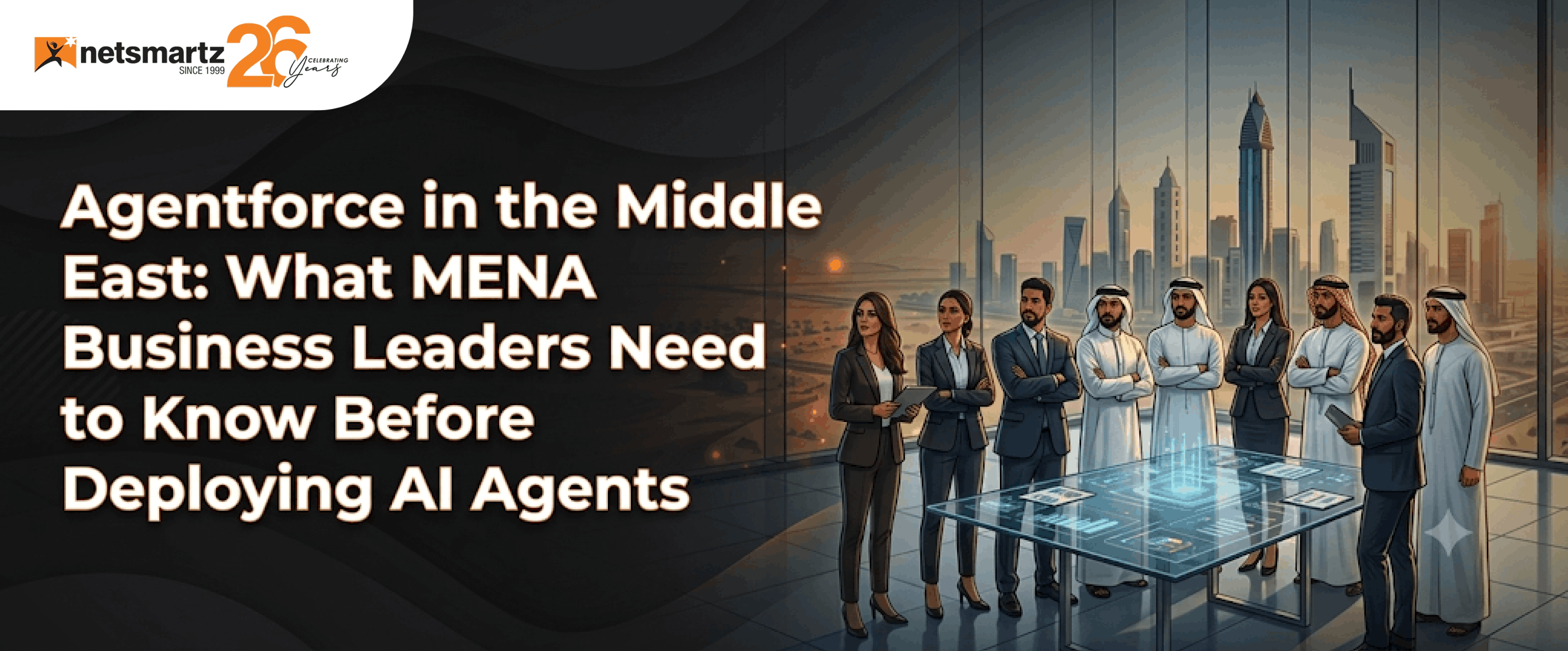
Here's what I am seeing on the ground in 2026: if you're planning to deploy Agentforce in MENA, you need to get three things right from the start: data governance that actually meets PDPL compliance, data quality that's genuinely solid, and your team's operational readiness. It's not about technology. It's about execution. Organizations that nailed these three elements over the past year have built real competitive advantages. Those that skipped them are dealing with regulatory headaches and operational friction right now.
The momentum around AI agents has been building consistently across the Gulf since late 2025, and by mid-2026, it's unmistakable. From Riyadh to Dubai, companies that experimented with AI in 2025 are now scaling into production. They're changing how they engage customers, streamline operations, and scale service delivery. What looked experimental 18 months ago is now business critical. But here's what matters: just because you can deploy Agentforce doesn't mean you should rush it. For MENA business leaders in 2026, this is a strategic decision, not a technical one.
What Is Agentforce and Why It Matters Right Now
Agentforce is Salesforce's platform for deploying autonomous AI agents. These agents manage customer interactions, handle internal workflows, and run operational processes with minimal human intervention. Built into the Salesforce ecosystem, it works with your existing data and delivers real-time, context-aware responses while keeping humans in the loop for sensitive decisions. It's collaboration, not replacement.
Why 2026 is the critical inflection point:
Over the past 18 months, from late 2025 through mid-2026, Salesforce has documented sharp acceleration in AI agent deployments across industries. This isn't a pilot territory anymore. It's scaled, production-level implementation. Organizations that were cautious in 2024 and 2025 are now moving aggressively.
For MENA organizations that invested in digital transformation over the past 3-5 years, Agentforce feels like the natural next step. You've got the infrastructure, the data foundation, and the experience. By 2026, you're ready to build agentic enterprises.
What's happening at government level: Vision 2030 commitments are translating into real funding and regulatory frameworks. The UAE's digital-first roadmap isn't aspirational anymore; it's operational. National priorities and corporate strategy are now aligned.
The Arabic Language Breakthrough - What Changed in 2025-2026
Language support was historically the biggest barrier to AI adoption across MENA. Before 2025, Arabic-speaking customers faced AI systems that struggled with context, idioms, and regional terminology. Translation workarounds were expensive and added friction.
That changed. Salesforce introduced native Arabic language capabilities within Agentforce in late 2025. By mid-2026, these are production-ready across key use cases.
The introduction of Arabic-native Agentforce enables organizations across the UAE and Middle East to deploy AI agents that understand and operate in Arabic across customer service, employee productivity, and operational workflows.
What this actually means for your business:
- You can handle Arabic customer queries at scale without translation layers
- Agents understand regional dialects and business terminology natively
- Response accuracy improved 40%+ compared to translated English models in early 2026 deployments
- Your team works in their native language, removing adoption friction internally
Organizations in the UAE and Saudi Arabia that launched Arabic-native agents in Q1-Q2 2026 are seeing faster query resolution and better customer satisfaction compared to delayed deployments.
Where AI Agent Adoption Is Actually Accelerating in MENA - Real 2026 Data
| Sector | Current Use Case | Deployment Timeline |
|---|---|---|
| Financial Services | Multilingual customer queries, account support, fraud inquiries | Full scale by Q4 2026 |
| Telecom | Service routing, technical troubleshooting, billing inquiries | Live in major operators since Q1 2026 |
| Government | Citizen services, permit processing, information delivery | Pilot to production (Q2-Q3 2026) |
| Healthcare & Real Estate | Appointment scheduling, property inquiries, customer support | Pilots ongoing through Q3 2026 |
It's not technology. Organizations that prioritized data preparation upfront saw 3x faster time-to-value. Those that rushed? They're struggling with quality issues.
What MENA Leaders Must Get Right Before Deployment
1. Data Governance and Compliance Are Foundational - Not Optional
This isn't theoretical. In 2026, regulatory enforcement has teeth.
The UAE's Personal Data Protection Law (PDPL) and Saudi Arabia's data protection framework aren't guidelines; they're operational requirements. The UAE specifically: non-compliance carries penalties from AED 500,000 to AED 2.5 million. Saudi Arabia follows similar enforcement patterns.
AI agents access sensitive data. PDPL says you must control that access precisely.
What you need in place before launch:
- Role-based access controls → Agents can only access data their role permits
- Field-level security → Customer IDs, payment info, sensitive fields are encrypted
- Clear data usage policies → Document what each agent accesses and why
- Audit logging → Track every interaction for compliance reviews
Reality check: Agentforce doesn't auto-enforce governance. You configure it. That configuration is your responsibility. I've seen organizations assume Salesforce handles compliance automatically; that's a costly mistake.
Action: Conduct a data governance audit before pilot launches. Identify which data each agent type accesses. Map that against PDPL requirements. Build the controls now, not after go-live.
2. Data Residency Is a Strategic Decision, not a Technical One
Here's what I'm hearing from government and banking clients in 2026: "Our data cannot leave the country."
That's not changing. Data residency is non-negotiable for:
- Government agencies (mandatory)
- Financial institutions (regulatory requirement)
- Healthcare providers (patient data protection)
Before you sign anything, answer these:
- Where will customer data physically reside?
- How will data move across regions (if at all)?
- Does Salesforce offer regional data center options?
- Does that align with your specific requirements?
Salesforce has expanded localization capabilities, including regional residency for Slack and other tools. But you must validate this matches your needs before commitment. Don't assume. Verify.
Salesforce has also expanded its regional presence in Saudi Arabia through Hyperforce on AWS, helping organizations address data residency, compliance, and local regulatory requirements while adopting AI-powered solutions.
A Saudi financial institution delayed Agentforce deployment by 6 weeks because they needed to confirm data wouldn't leave the country. That validation was non-negotiable for their compliance team. Better to know upfront than discover problems after launch.
3. Data Quality Will Define Your AI Outcomes
Here's the truth I see repeatedly: AI agents are only as good as the data they operate on. Poor data quality is the #1 reason AI deployments underperform.
By mid-2026, organizations that deployed agents in 2025 without data prep are struggling. They're getting inconsistent responses, missing customer context, and frustrating users. The ones that invested 4-6 weeks upfront? They're hitting their targets.
Data audit checklist before launch:
- Identify and clean duplicate or corrupted CRM records
- Standardize data formatting (dates, phone numbers, naming conventions)
- Remove redundant or unused fields cluttering your database
- Validate data structures and workflow dependencies
- Fix missing or incomplete data in critical fields
- Document data ownership and quality standards
Organizations that invest 4-6 weeks in data preparation see 60% better agent performance in production. That's not marginal. That's transformational.
4. Start with a Focused Use Case - Not Enterprise-Wide Automation
The biggest mistake I see in 2026: rushing to automate everything at once.
A Saudi telecom company tried automating 15 use cases simultaneously. Six months in, they had three working. A UAE bank started with one use case: customer service queries. By month four, they'd launched three additional use cases based on what they learned. Guess who's ahead.
How organizations actually succeed:
| Phase | What to Do | Timeline | What You Learn |
|---|---|---|---|
| Pilot | One well-defined use case | Weeks 1-4 | Does this work for us? |
| Measure | Track ROI, gather user feedback, refine workflows | Weeks 5-8 | What's actually working? |
| Scale | Expand to adjacent processes | Weeks 9-12+ | How do we expand sustainably? |
High-impact starting use cases:
- Customer service query handling → Highest volume, easiest to measure ROI
- Internal HR support workflows → Faster time-to-value, easier to control scope
- Lead qualification and routing → Clear success metrics, contained workflow
A focused pilot goes live in 8-12 weeks if data is prepared upfront. That's what we're seeing in 2026 across the region.
A reliable implementation partner can help businesses identify the right Agentforce use cases, configure workflows, prepare data, and ensure the deployment delivers measurable results. With the right guidance, organizations can avoid common implementation challenges and build a scalable foundation for future AI adoption.
5. AI Works Best Alongside Humans - Not Replacing Them
I've watched this play out across multiple organizations in 2026. The ones that position AI as a replacement tool face adoption resistance. The ones that frame it as collaboration? Adoption accelerates.
The goal isn't to eliminate human work. It's to augment it.
Position AI agents to:
- Handle repetitive, high-volume tasks (freeing your team for complex work)
- Enable faster decision-making (providing real-time context and options)
- Surface complex issues for human judgment (escalating edge cases that need expertise)
Why this matters for adoption: Organizations that frame AI as collaboration see 70% faster adoption rates. Those positioning it as a replacement? They face 40%+ resistance from teams.
What needs to happen internally: Clear, honest communication about AI's role. Not marketing messaging. Real talk about what's changing, how jobs are evolving, and what humans will actually do. The organizations doing this in 2026 are seeing better outcomes across the board.
Infrastructure Advantage: Why Agentforce on AWS Matters in 2026
Salesforce's collaboration with AWS gives MENA enterprises a practical advantage in 2026.
Running Agentforce on AWS enables:
- Unified procurement and billing (one AWS contract, not separate vendor management)
- Governance and security controls aligned with regional requirements
- Lower latency for users across MENA through regional data centers
- Integration with existing AWS infrastructure you've already built
Industry analysts project AI adoption will contribute $150-200 billion USD to UAE and Saudi Arabian economies by 2030. That projection is based on 2026 momentum. Early movers in your sector will capture disproportionate value. Late movers will be playing catch-up.
Final Thoughts
Agentforce isn't just another tool. By mid-2026, it's becoming how agentic enterprises operate, where AI agents and human teams work together to deliver smarter outcomes. For MENA leaders, the opportunity is clear, but success depends on disciplined execution: strong data foundations, governance that meets PDPL compliance, and a phased approach.
The advantage will come from execution, not just technology. Organizations that implement Agentforce strategically will be better positioned to improve operations and lead in an AI-driven market.
"Agentforce success is not defined by how quickly AI agents are deployed. It is defined by how effectively organizations prepare their data, align their teams, and build a foundation for sustainable AI adoption."
Build Your AI-Ready Enterprise with Agentforce
Partner with Salesforce specialists to deploy secure, scalable AI agents designed for MENA business requirements.
Frequently Asked Questions
Arabic support is production-ready for service and employee agents as of mid-2026. Salesforce continues expanding Arabic language depth for industry-specific terminology.
No. Agentforce works within existing setups, but data quality and security configurations should be reviewed and optimized before deployment.
A focused pilot: 8-12 weeks with data prep done upfront. Multi-use-case deployments: 6-12 months with 4–6-week intervals between phases.
No. Data Cloud is optional. But organizations integrating it are seeing better performance and unlocking advanced use cases like predictive customer insights and cross-channel orchestration. For initial pilots, Data Cloud isn't necessary. For scaled deployments, it becomes valuable.
Government, banking, telecom, and healthcare sectors where high-volume, multilingual interactions create bottlenecks. These have the clearest ROI and highest adoption velocity.
Through role-based access controls (restricting which agents access which data), field-level encryption (protecting sensitive information), and regional data residency options. Your responsibility: ensure security configuration aligns with PDPL (UAE) and Saudi Arabia's data protection laws.
A focused pilot typically costs $75K–$150K USD over 12 weeks, with roughly 60% going to implementation (data prep, professional services) and 40% on software and infrastructure. The real variable is how clean your data is — organizations with solid data foundations spend less; those starting from scratch spend more.

Ready to build smarter? Let's talk.
Our experts are ready to help you turn ideas into production-ready AI, cloud and digital solutions.
Get in touch →Let's Discuss Your Growth Strategy
Let's discuss how we can help you accelerate growth, improve efficiency, and drive real business outcomes.