 AI-First Culture
Agentforce Implementation: Architecture, Integrations and Enterprise Requirements
Ask a UAE leadership team about AI today and the conversation rarely stops at “should we?” It moves quickly to “how soon?” Interest in Agentforce has grown fast, and many enterprises already have a shortlist of use cases.
The hard part comes next. An AI agent that works in a demo still has to run inside real systems, on real data, under real security rules. Companies that skip the planning usually find out about the gaps after go-live, which is the most expensive time to find them.
This guide covers what a solid Agentforce implementation involves: the architecture, the integrations, the governance and a phased path from first pilot to scale.
1. What Enterprises Need to Know Before Implementing Agentforce
Demand for AI-powered business processes is rising across banking, real estate, retail, logistics and government services in the UAE. Leaders want faster responses, lower handling costs, and less manual work, and AI agents promise all three.
But Agentforce isn’t a switch you flip. It’s a platform that connects to your CRM, your data, and your other systems, so the quality of the outcome depends on how well those pieces fit together.
That’s why implementation planning matters so much. A clear architecture, a defined scope and agreed ownership save months of rework later. Teams that plan first tend to go live with fewer surprises and a much clearer way to measure success.
2. Core Components of an Agentforce Architecture
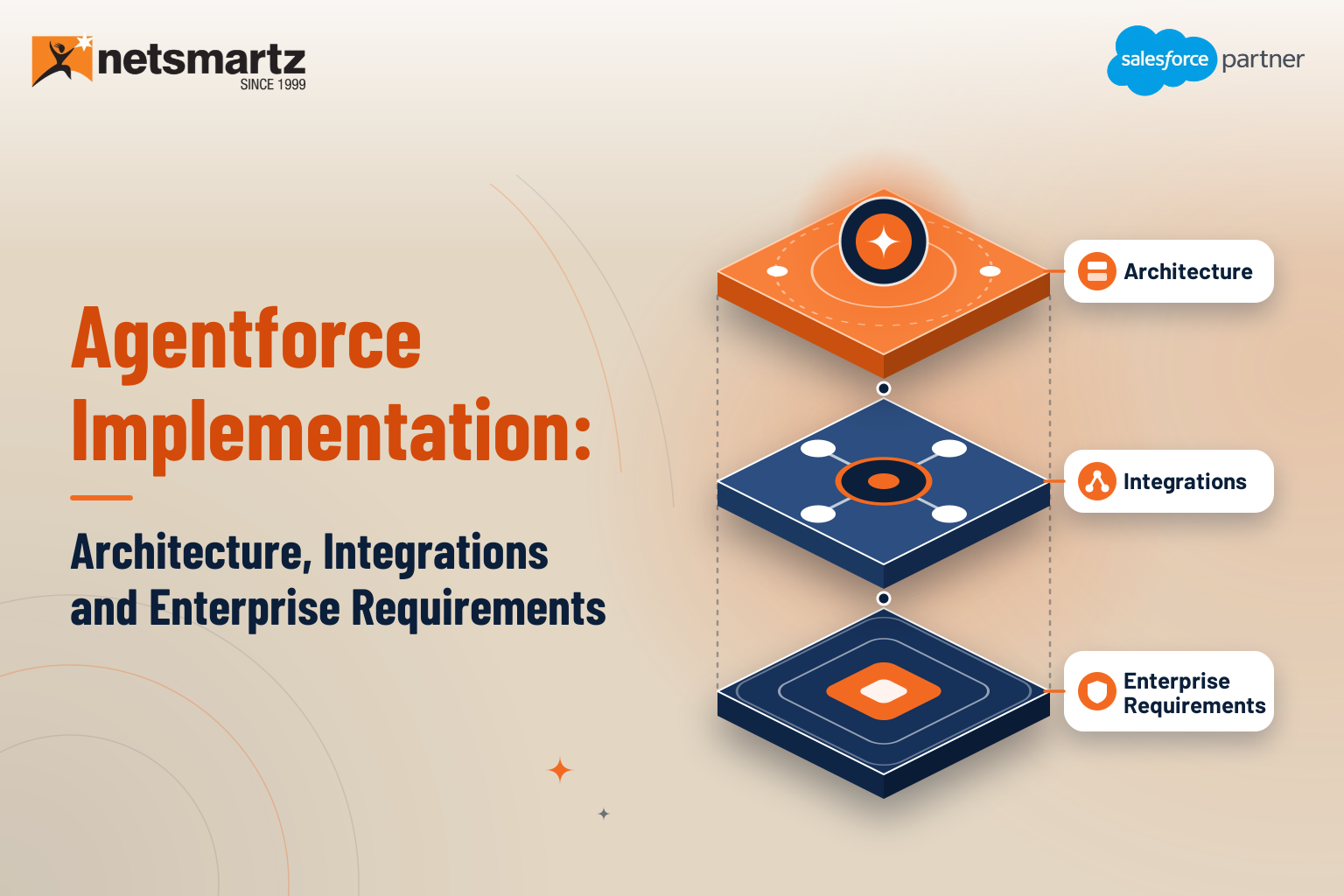
Think of Agentforce as the top layer of a stack. Five components sit underneath and around it.
- Salesforce platform. This is where agents are built and run. You define each agent’s role, its instructions and the actions it’s allowed to take, using tools such as Flows, Apex and APIs.
- Data Cloud. Salesforce Data Cloud unifies data from multiple sources into one customer view, so agents work from complete information rather than one system’s slice of it.
- CRM data. Accounts, contacts, opportunities, cases and interaction history give agents the day-to-day business context they need.
- Integrations. Agents often need to read from or write to systems outside Salesforce, such as ERP, billing and support tools. Reliable connections make that possible.
- Security layers. Permissions, access controls and Salesforce’s trust layer keep agents within the boundaries you set and limit what data they can see and use.
“A good Agentforce implementation is mostly decisions made before the first agent is built: what data it can trust, what systems it must reach and what it must never do.”
3. Integration Requirements for Successful Agentforce Deployments
An agent that can only see Salesforce can only help with what’s in Salesforce. Most real processes cross several systems, so integration is where many projects either come together or fall behind.
- ERP integration. Order status, invoices, pricing, and inventory often live in the ERP. If an agent can’t reach them, it can’t answer the questions customers ask most.
- External systems. Telephony, identity, document management and industry-specific platforms may all hold data an agent needs. List them early, because each one adds scope.
- Marketing platforms. Campaign and engagement data helps agents understand where a lead came from and what they’ve already seen, which makes follow-up more relevant.
- Customer support applications. Ticketing tools, knowledge bases and chat channels such as WhatsApp need to feed agents about the full conversation history, so customers aren’t asked to repeat themselves.
Plan each integration around a specific job: what the agent needs to read, what it needs to update, and how fresh the data must be.
4. Enterprise Data and Governance Requirements
Enterprises can’t treat governance as a later phase. It decides what agents are allowed to do, so it belongs in the first design discussion.
- Data quality. Duplicates, gaps, and outdated records produce weak agent output. Set clear ownership and cleanup rules before launch and keep them running afterward.
- Privacy and compliance. In the UAE, customer data handling may fall under the Personal Data Protection Law, along with sector or free zone rules such as those in DIFC or ADGM. Involve your legal and compliance teams early.
- Access controls. Give agents and users only the data they need for their role. Least-privilege access limits both risk and the blast radius of any mistake.
- AI governance. Define what an agent can decide on its own, when it must escalate to a person and how its actions are logged and reviewed. Without these rules, it’s hard to trust an agent with anything important.
5. Common Agentforce Implementation Challenges
Most struggling projects share a short list of causes.
- Poor data foundations. The agent is only as good as the records behind it. Weak data leads to weak answers, and users quickly lose confidence.
- Siloed systems. When customer information is split across tools that don’t connect, agents see a partial picture and act on it.
- Undefined use cases. “Let’s use AI somewhere” isn’t a plan. Without a specific problem, owner and success measure, projects drift.
- Adoption barriers. Even a good agent fails if the people around it doesn’t trust it, don’t understand it or weren’t consulted. Training and change management matter as much as configuration.
6. A Phased Approach to Agentforce Implementation
A phased plan keeps risk low and lets you prove value before committing a larger budget.
- Discovery. Identify the business problems worth solving and rank them by impact and feasibility. Choose one or two use cases to begin with.
- Readiness assessment. Run an Agentforce readiness assessment to review your data quality, integrations, security setup and processes. The goal is a clear list of gaps to close before you build.
- Pilot deployment. Launch a focused agent for one use case, with defined metrics such as response time, resolution rate or lead follow-up speed. Keep the scope tight so you can learn quickly.
- Scale and optimization. Once the pilot proves its value, expand to new use cases and teams. This is the stage where you scale Agentforce with confidence, because the data, integrations, and governance are already tested. Keep tuning agent performance as the business changes.
7. How Netsmartz Helps Enterprises Implement Agentforce Successfully
Planning is one thing. Delivering across real systems and busy teams is another. As a certified Salesforce partner, Netsmartz works with UAE organizations on Agentforce implementation services from first assessment to ongoing support.
- Architecture review: We review your Salesforce environment and give actionable recommendations on performance, scalability, security and long-term return on investment.
- Data Cloud integration: we unify your customer data across systems, so your agents work with real-time, unified customer intelligence.
- Enterprise implementation services: we design and deploy AI agents across sales, service and operations, and connect Salesforce with your ERP, finance and other business systems.
- Ongoing support and optimization: managed services and continuous enhancements keep your environment and agents performing as your needs evolve.
Our Salesforce experts measure every engagement against your business KPIs, such as revenue growth, cost reduction and customer satisfaction.
Conclusion
Agentforce can deliver real results, but the technology is only part of the story. Strong implementations rest on three things: sound architecture, reliable integrations and clear governance.
If you’re evaluating Agentforce, start with your foundations. Map your data and systems, agree on the rules, choose one use case that matters and test it with a pilot. Once that works, scaling is a much easier decision.
Ready to Implement Agentforce the Right Way?
Talk to our Salesforce experts about your architecture, integrations and first use case. Your first consultation is free.
Schedule a Free ConsultationFrequently Asked Questions
It covers agent design, Salesforce platform configuration, Data Cloud and CRM data setup, integrations with other systems, security and governance. Most enterprises roll it out in phases, starting with one use case.
It depends on scope, data quality and the number of integrations. A focused pilot is usually much faster than a broad, multi-department rollout, which is why starting small is recommended.
Not for every scenario, but Data Cloud gives agents a unified, current view of customer data across systems, which usually improves accuracy and relevance.
It should review data quality, automation, security settings, integrations and licence usage, and result in a clear list of gaps and quick wins to address before you build.
Set clear governance from the start: define who can access which data, when agents must escalate to a person and how actions are logged. Align this with the UAE PDPL and any sector or free zone rules, and involve your compliance team early.
Prove the pilot against agreed metrics, fix any data or integration gaps it exposed, then add new use cases and teams one step at a time while continuing to tune performance.
Keep reading
Ready to build smarter? Let's talk.
Our experts are ready to help you turn ideas into production-ready AI, cloud and digital solutions.
Get In Touch →Let's Discuss Your Growth Strategy
Let's discuss how we can help you accelerate growth, improve efficiency, and drive real business outcomes.