 AI-First Culture
Modern businesses depend on a wide range of cloud-native software to stay competitive. In 2025, leading saas service providers continue to expand their portfolios to meet evolving enterprise challenges, from automation to analytics, vertical specialization, and hybrid experiences.
This guide explores eight essential types of saas applications transforming industries today, offers insight on sourcing top SaaS consulting services, and provides tips on working with a trusted SaaS solutions company or firm that delivers world-class SaaS development services.
What You’ll Learn in This Guide
Discover eight essential SaaS application categories transforming industries today, learn how to source top-tier SaaS consulting services, and get practical tips for working with a trusted SaaS solutions company that delivers world-class SaaS development services.
- Customer Experience & Support
- Marketing Automation
- Project & Workflow Management
- HR, Payroll & Engagement
- Finance & Billing
- Business Intelligence & Analytics
- Vertical SaaS Applications
- Developer & Low-Code Platforms
Enhance customer interactions with omnichannel platforms and AI-driven support tools.
Streamline campaigns through personalized, data-driven automation across multiple channels.
Optimize team productivity with agile tools for task tracking and collaboration.
Automate people operations like payroll, onboarding, and performance tracking.
Manage subscriptions, invoice management, and revenue recognition with compliance-ready tools.
Embed real-time dashboards and insights directly into business applications.
Leverage industry-specific tools tailored for compliance and niche workflows.
Enable rapid app development with drag-and-drop tools and API integrations.
Let’s dive deeper into each of these SaaS solution types to better understand their impact and use cases.
Customer Experience & Support (CX/SaaS Application)
A standout saas application in this category is omnichannel support platforms combining chat, ticketing, self‑service portals, and feedback tools.
- Use Cases: Real-time customer support, proactive suggestions, AI-driven chatbots.
- Why It Matters: Improves response times, CSI scores, and brand reputation.
- Key Player(s): Firms specializing in CX SaaS solutions partner with saas service providers to customize AI models, multilingual support, and integration with CRM.
For example, an e-commerce giant might collaborate with a saas solutions company to integrate AI-powered chatbots into their CX stack, handling everything from order inquiries to product recommendations.
Marketing Automation & Engagement
Marketing teams rely on campaign orchestration tools for email, social media, A/B software testing, behavioral triggers, and analytics.
- Use Cases: Lead scoring, nurturing, cross-channel messaging.
- Why It Matters: Automates repetitive campaigns and reduces manual workload for minimal resources.
- Top Advantage: Data-driven personalization using integrated analytics and customer profiles.
When hiring saas consulting services, marketing teams often request custom development for special segmentation tools or compliance with international regulations (GDPR, CCPA).
Project & Workflow Management
Modern saas development services include comprehensive workflow platforms handling tasks, sprints, dependencies, time tracking, and cost analytics.
- Use Cases: Agile team coordination, resource planning, client billing.
- Why It Matters: Improves project visibility, accelerates delivery, and supports remote/hybrid operations.
A saas solutions company may build custom integrations, such as linking project boards with ticketing systems or CRM, using APIs or Zapier-like connectors.
HR, Payroll & People Engagement
Core “people stack” saas application tools cover payroll, benefits, onboarding, performance, and culture surveys.
- Use Cases: Automating pay runs, tax filings, PTO management, culture mapping.
- Why It Matters: Improves retention, reduces errors, and speeds HR workflows.
Saas service providers often preconfigure connectors to payroll authorities and benefits platforms—avoiding manual reporting.
Finance, Billing & Revenue Recognition
Subscription SaaS revenue needs tools that support flexible billing models, deferred AR, and complex invoicing.
- Use Cases: Usage-based billing, recurring subscriptions, global payments.
- Why It Matters: Ensures compliance with ASC 606/IFRS 15, supports investor-grade reporting.
Leading saas development services build modules for multi-currency invoicing, tax withholding (e.g., 1099, VAT), and revenue dashboards for CFOs.
Business Intelligence & Embedded Analytics
In 2025, data visualization and embedded dashboards are SaaS staples for real-time decision-making.
- Use Cases: Performance metrics, custom reports, AI-driven insights.
- Why It Matters: Delivers timely information to both business users and developers.
A saas solutions company might embed interactive analytics into HR or customer support tools for role-based insights and drill-down capabilities.
Industry-Specific/Vertical SaaS Applications
Vertical SaaS caters to niche needs—for example, healthcare, fintech, logistics, legal, hospitality, and manufacturing.
- Use Cases: Customized workflows, compliance (HIPAA, PCI), specialized APIs.
- Why It Matters: Accelerates time-to-market and ensures deep domain alignment.
This is where saas consulting services shine—they craft regulatory dashboards, SLA packages, secure file handling, and data categorization within the industry.
Developer Platforms & Low-Code PaaS
Low-code platforms let businesses rapidly build custom apps and integrations without coding from scratch.
- Use Cases: Prototyping workflows, internal tools, APIs.
- Why It Matters: Powers citizen developer culture and innovation velocity.
Saas service providers couple these platforms with consulting offerings—training citizen devs, building custom widgets, packaging enterprise-grade add-ons.
Why These 8 SaaS Types Matter in 2025?
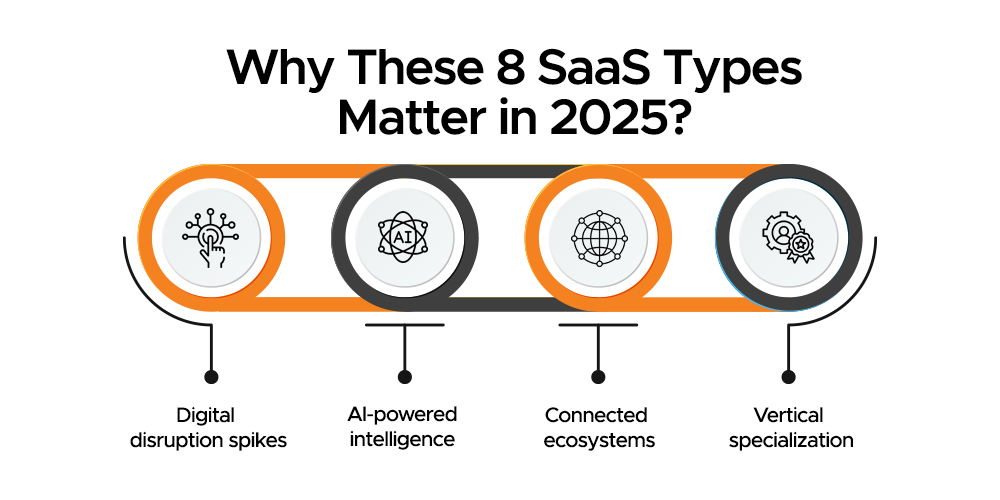
- Digital disruption spikes: Cloud budgets jump as companies pivot to hybrid and remote-first models.
- AI-powered intelligence: Embedded AI powered, predictive analytics, and generative agents are rapidly becoming baseline features.
- Connected ecosystems: APIs, event pipelines, and microservices require apps to work together—making modular SaaS essential.
- Vertical specialization: General tools aren’t enough—businesses demand niche SaaS tailored to regulation, compliance, or detail-level complexity.
Choosing the Right SaaS Service Providers, Development & Consulting Team
- Domain Experience: A top-tier saas development services firm builds your apps with best-practice patterns—especially in security, data modeling, and mobile/responsive UX.
- Consulting Depth: When hiring saas consulting services, ensure they cover strategy, roadmap planning, vendor evaluation, architecture design, and ROI modeling—not just code.
- End-to-End Delivery: The best saas solutions company offers turnkey delivery: spec → UI/UX design → development → testing → launch → maintenance.
- Scalability & Flexibility: They should architect multi-tenant cloud systems, auto-scaling, and cost governance to support changing usage and ecosystems.
- Support & Insights: Post-launch strategic advisory—like adoption analytics, performance tuning, and roadmap updates—is a sign of a partnership mindset.
- Predictive Customer Support App A saas development services team built a self‑service portal with AI ticket deflection and sentiment analysis—improving CSAT by 23% and cutting 30% in agent workload.
- Compliance‑Ready Healthcare SaaS Consultants with vertical expertise created a HIPAA-secure patient engagement platform—complete with audit trails, encryption, and health-data integrations—delivering trusted healthcare for SaaS solutions.
- Embedded Analytics in HR Tools A saas solutions company integrated embedded Power BI dashboards into a recruitment app, enabling data‑rich decision-making across HR teams.
Partner with experts who build secure, scalable solutions — powered by Netsmartz for SaaS
How to Evaluate Providers Quickly?
| Criteria | Why It Matters |
|---|---|
| Previous SaaS clients | Shows real-world, scalable SaaS deployments. |
| Tech stack & frameworks | Ensures performance and maintainability by using the right tools (e.g., React, Terraform, AWS). |
| Domain alignment | Especially vital for vertical SaaS (healthcare, finance, logistics). |
| Roadmap guidance | Do they provide vision beyond launch—updates, usage optimization, analytics? |
| Security & compliance | Essential: encryption at rest/in transit, GDPR, ISO 27001, PCI, HIPAA, etc. |
| Transparent pricing | Are team rates clear? Do they estimate TAM, work packaged deliverables, and SOWs? |
| Support & SLAs | Ensure post-launch care—incident management, patch cycles, new releases. |
Spotlights: Real-World SaaS Solution Examples
Best Practices to Implement Winning SaaS Solutions
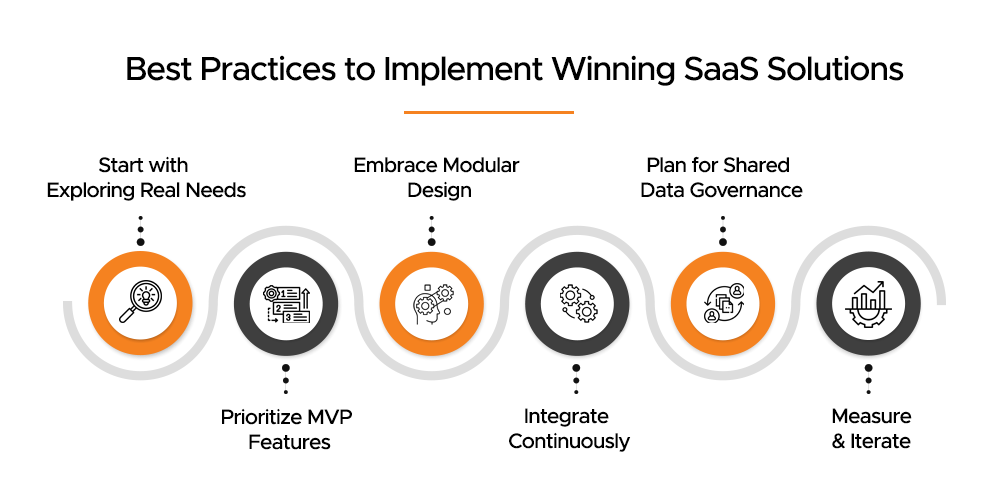
Start with Exploring Real Needs
Begin with workshops (Discovery Phase) to clarify users, pain points, workflows, and tech dependencies.
Prioritize MVP Features
Launch minimum viable product quickly—test with real users first, then expand in sprints.
Embrace Modular Design
Build with reusable components and microservices to support iterative growth across different SaaS use cases.
Integrate Continuously
Use open APIs or middleware to link CRM, ERP, analytics, or AI platforms early—not “later in Phase 2.”
Plan for Shared Data Governance
With GDPR, CCPA, and global privacy laws, ensure encryption, control tiers, audit logs, and deletion/retention policies are baked in.
Measure & Iterate
Track SaaS metrics like MRR, churn, user engagement, NPS, and feature adoption—and feed them back into product evolution.
Final Take
The landscape of enterprise-ready SaaS in 2025 demands more than general-purpose tools. Businesses need specialized saas applications tailored to functions or industries, powered by AI‑infused intelligence, connected platforms, and robust saas development services.
To succeed, organizations should align with expert saas service providers, invest in strategic saas consulting services, and partner with a capable saas solutions company that can deliver end-to-end—from ideation to scaling.
By understanding the eight SaaS solution types and following a disciplined implementation roadmap, you can build secure, compliant, agile, and impactful cloud-native platforms that drive growth—today and tomorrow.
Ready to build the next-gen SaaS application?
Contact our team of experienced saas service providers and saas development services experts. We offer hands-on saas consulting services, MVP product prototyping, vertical SaaS accelerators, and turnkey SaaS delivery.
Ready to scale your SaaS business? Book a free consultation today!
Frequently Asked Questions
A saas application is a software delivered via the cloud, typically subscription-based. It’s accessed over the internet and managed centrally.
Saas development services focus on multi-tenancy, scalability, API-first design, real-time metrics, and continuous deployment.
Aonsulting helps clarify product development roadmaps, vendor choices, licensing models, compliance planning, and ensures your launch is on time and on budget.
They offer full-cycle delivery, domain knowledge, scalable architecture, and ongoing product support—not just code.
It depends on complexity: a basic MVP may start at $50K; feature-rich enterprise vertical SaaS could be $250K+. Request a discovery call.
Keep reading
Managed Detection and Response (MDR): How It Works, Key Components, and When You Need It
Why Are Healthcare Organizations Turning to AI Pods for HIPAA-Compliant AI Solutions?
Traditional AI Hiring vs AI Pods for SaaS Service: Which Model Drives Faster ROI?
Ready to build smarter? Let's talk.
Our experts are ready to help you turn ideas into production-ready AI, cloud and digital solutions.
Get In Touch →Let's Discuss Your Growth Strategy
Let's discuss how we can help you accelerate growth, improve efficiency, and drive real business outcomes.